 By
By  March 9th, 2021
Japan’s Hayabusa2 is pulling up to Ryugu – a C-type asteroid – for detailed study.
Artwork: Akihiro Ikeshita
Japan’s Hayabusa2 asteroid sample-return mission continues to provide data regarding its returned specimens and the overall performance of the spacecraft.
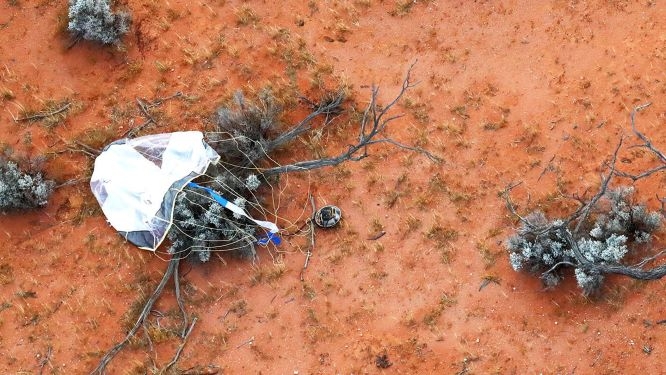
Hayabusa2 sample return capsule recovery in Australia.
Credit: JAXA
Flown by the Japan Aerospace Exploration Agency (JAXA), Hayabusa2 carried out detailed work for a year and a half at near-Earth asteroid 162173 Ryugu.
Samples snagged at the space rock were returned to Earth in early December of 2020. The spacecraft’s sample capsule landed and was recovered at the Woomera Test Range in Australia.
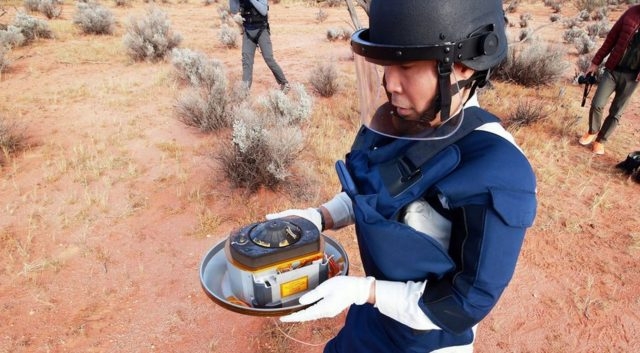
A post-flight analysis of the re-entry capsule collected in Australia is being intensely studied for use in designing future missions.
Credit: JAXA
Curation work underway
The amount of Hayabusa2 samples collected from the returned sample catcher exceeded expectations. Researchers from Japan’s Astromaterials Science Research Group (ASRG) are diligently cataloging the bits and pieces brought back to Earth.
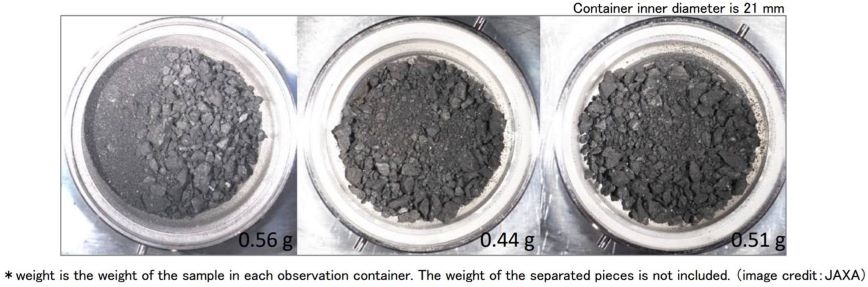
The sample in chamber C was placed in observation containers with weight measurement and optical microscope observations started.
Credit: JAXA

Researchers from Japan’s Astromaterials Science Research Group (ASRG) are diligently cataloging the bits and pieces brought back to Earth from asteroid Ryugu.
Credit: ASRG
In a JAXA-held briefing last week, it was explained that curation work is proceeding with the weight measurement and acquisition of high-definition optical microscope images of the particles and bulk powder sample from asteroid Ryugu, focusing on the particles in chamber C recovered from Hayabusa2s second touchdown point on the space rock.
Re-entry capsule condition
Project experts noted that the condition of each capsule part is generally good, and the on-board equipment is functioning normally after return to the JAXA Sagamihara campus. A detailed analysis of the condition of the return capsule’s heat shield is currently underway.
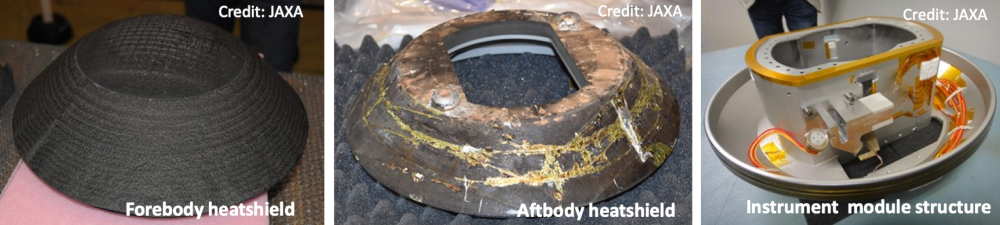
Return capsule parts. Credit: JAXA
In addition, data has been retrieved from the Re-entry Environment Measurement Module (REMM) that was mounted on the re-entry capsule. REMM measured the airframe motion and temperature of each part of the capsule during the high-speed re-entry into the atmosphere.
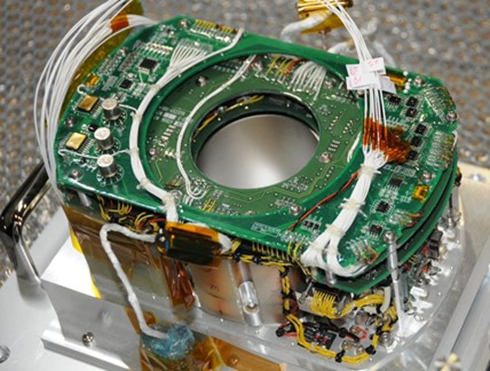
Credit: JAXA
Analysis of the data acquired by REMM confirmed that the inside of the re-entry capsule — including the sample stored in the sampler — maintained a temperature environment that did not greatly exceed room temperature from re-entry to landing. Study of the REMM acquisition data will continue in detail, put to use in the research and development of future re-entry vehicles.
Credit: JAXA
Round-trip names and messages
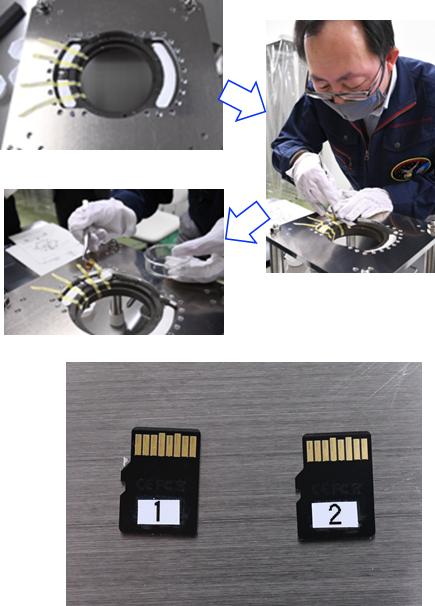
The re-entry capsule was also equipped with memory chips containing electronic files of names and messages that were submitted before launch from people all over the world.
“We removed the two memory chips and were able to read both normally: the virtual round-trip to asteroid Ryugu was completed successfully! We are currently designing a system that will allow everyone to search for written names and messages,” Hayabusa2 researchers said at the March 5 press briefing. A system is being designed to allow participants to search for their written names and messages.
Depending on Covid-19 restrictions, public viewing of the Hayabusa2 re-entry capsule is slated to start this week at the Sagamihara City Museum, followed by a capsule showing at the country’s National Science Museum.
 Posted in Space News

