 By
By  January 6th, 2021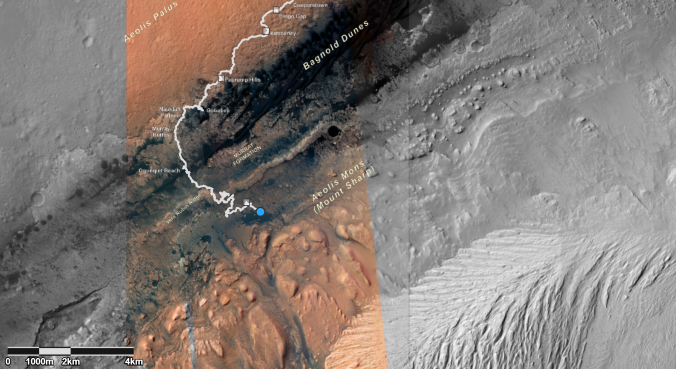
Curiosity’s location on Sol 2991. Distance Driven 14.81 miles (23.84 kilometers).
Credit: NASA/JPL-Caltech/Univ. of Arizona
NASA’s Curiosity Mars rover is now performing Sol 2993 tasks.
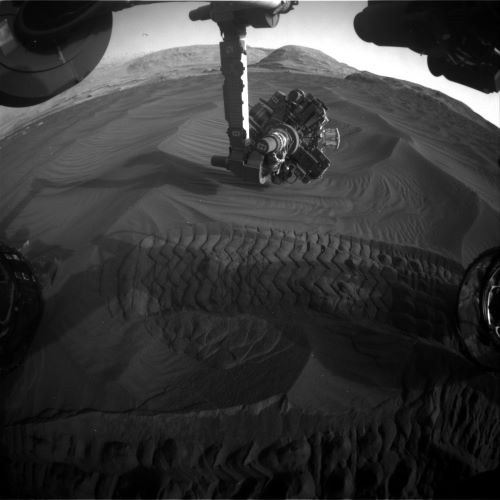
Front Hazard Avoidance Camera Right B image taken on Sol 2992, January 5, 2021.
Credit: NASA/JPL-Caltech
“Here on Earth, people often use the start of a new year as an opportunity to adopt new resolutions for themselves. In planetary exploration, we often talk about a different kind of resolution, namely the spatial resolution of the cameras carried by a spacecraft,” reports Mariah Baker, a planetary geologist at the Center for Earth & Planetary Studies, Smithsonian’s National Air & Space Museum.
Baker explains that Curiosity has a large suite of cameras with a range of spatial resolutions, one of which is the Mars Hand Lens Imager (MAHLI) camera.
“Located at the end of the rover’s robotic arm,” Baker points out, “MAHLI can be placed in close proximity to the surface to acquire incredibly high-resolution images of the grains within loose soil and rocks. And in the rover’s first plan of 2021, MAHLI’s imaging capabilities took center stage.”
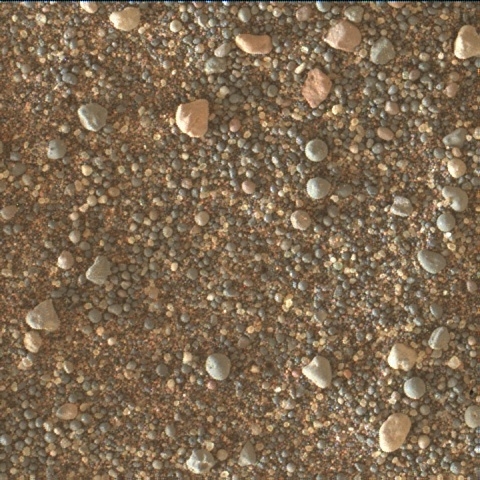
Curiosity acquired this image using its Mars Hand Lens Imager (MAHLI), located on the turret at the end of the rover’s robotic arm, on January 2, 2021, Sol 2989
Credit: NASA/JPL-Caltech/MSSS.
Large sand ripples
Right before the holiday break, the robot had been making its way across rubbly terrain towards a set of large sand ripples located within the Sands of Forvie.
“One of our primary motivations for visiting these ripples was to acquire high-resolution MAHLI images of the sand comprising them,” Baker adds. “When wind blows sand around, it naturally sorts it based on properties such as particle size, so close-up images of sand grains on different parts of a ripple can provide a means to study natural sorting processes and the winds controlling them.”
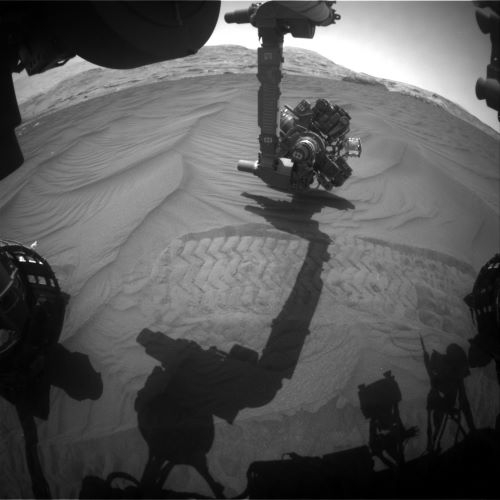
Curiosity Front Hazard Avoidance Camera Left B photo taken on Sol 2993, January 6, 2021.
Credit: NASA/JPL-Caltech
A recent opportunity to study the Sands of Forvie ripples after the rover’s New Year’s “scuff,” a major focus of planning was to obtain a preliminary set of MAHLI images of the crest and trough of a prominent ripple in the robot’s workspace.
These images will allow the team to plan a second set of even higher-resolution MAHLI images.
Change detection
A recent plan made use of other scientific measurements planned including an Alpha Particle X-Ray Spectrometer (APXS) measurement to accompany MAHLI images of the ripple trough, Chemistry and Camera (ChemCam) observations on sand targets “Carsaig East” and “Carsaig Arches,” and Mastcam “change detection” images for tracking sand motion.
“Special morning and evening change detection images were also scheduled to help us better constrain the timing and direction of the winds responsible for shaping the Sands of Forvie ripples,” Baker reports. “A Mastcam stereo mosaic and Mastcam multispectral observation will provide additional data on the ripples in our immediate workspace.”
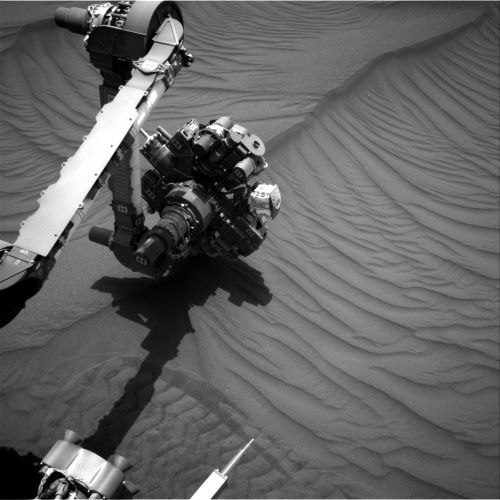
Curiosity Right B Navigation Camera photo acquired on Sol 2993, January 6, 2021.
Credit: NASA/JPL-Caltech
Dynamic Albedo of Neutrons (DAN) and Rover Environmental Monitoring Station (REMS) measurements, as well as a small set of Navcam and Mastcam observations will also allow Mars researchers to probe the current environmental conditions.
“The team is excited to be ringing in the New Year at this interesting – and sandy – spot,” Baker concludes, “and we are looking forward to exploring many more new terrains in 2021 as we continue our traverse up Mount Sharp.”
 Posted in Space News

