 By
By  December 11th, 2020
Curiosity Left B Navigation Camera image taken on Sol 2967, December 10, 2020.
Credit: NASA/JPL-Caltech
NASA’s Curiosity Mars rover is now performing Sol 2968 tasks.
“Curiosity is making her way to ‘Sands of Forvie,’ the large sand field we’ve been seeing in the orbital images,” reports Ashley Stroupe, a mission operations engineer at NASA’s Jet Propulsion Laboratory.
Rover planners are trying to drive as far as possible and expect to reach the “rubbly unit” that is on the way to Sands of Forvie.
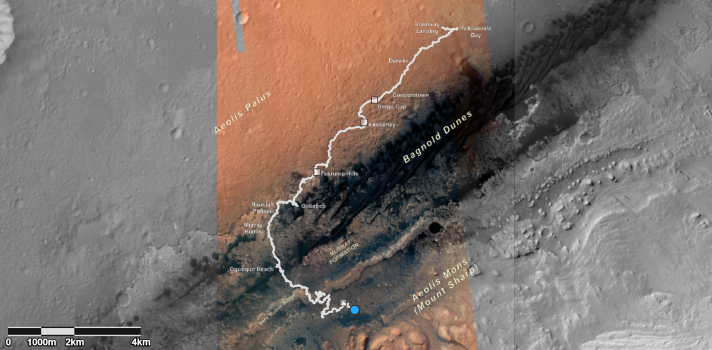
Curiosity’s location on Sol 2965. Distance driven 14.73 miles (23.70 kilometers). Credit: NASA/JPL-Caltech/Univ. of Arizona
“The drive is extending beyond where we can see by making use of guarded driving, allowing the rover to look for hazards and stop if conditions are unsafe.,” Stroupe adds.
The total distance is about 213 feet (65 meters).
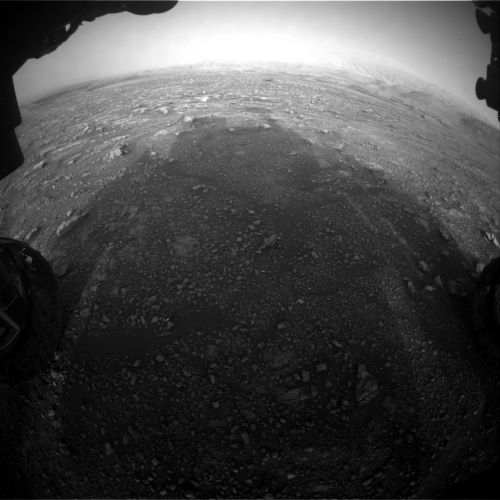
Image taken by Front Hazard Avoidance Camera on December 8, 2020 on Sol 2965. Prior to hitting the road, Curiosity will collect data on a large clast – a fragment of rock, “Dun Eideann,” that is in an otherwise rubbly workspace.
Credit: NASA/JPL-Caltech
Potential meteorites
Prior to hitting the road, Curiosity will collect Mars Hand Lens Imager (MAHLI) and Alpha Particle X-Ray Spectrometer (APXS) data on a large clast – a fragment of rock, “Dun Eideann,” that is in an otherwise rubbly workspace.
“This is part of our regular tracking of compositional changes and will help us characterize the clasts in this area,” Stroupe explains. Also on tap is taking Mastcam multispectral images of “Island Davaar,” and collecting both Mastcam multispectral and Chemistry and Camera (ChemCam) passive spectral data of targets “Obar Dheathaian,” and “Eilean.”

Curiosity Chemistry & Camera Remote Micro-Imager (RMI) photo acquired on Sol 2967, December 10, 2020.
Credit: NASA/JPL-Caltech/LANL
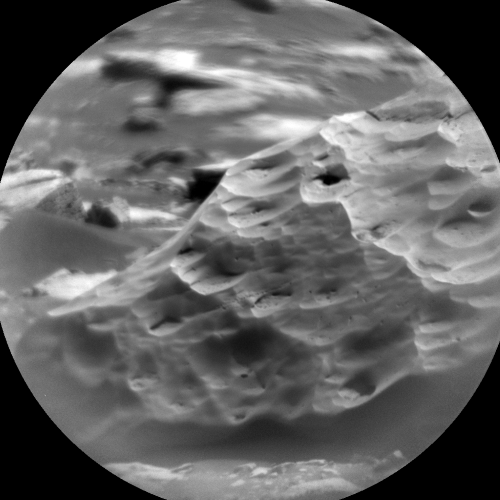
Curiosity Chemistry & Camera Remote Micro-Imager (RMI) photo acquired on Sol 2967, December 10, 2020.
Credit: NASA/JPL-Caltech/LANL
“All three targets are some nearby interesting-looking rocks that potentially could be meteorites,” Stroupe adds.
Distant rocks
On the schedule is taking observations of Shillhope Law with Mastcam and ChemCam Laser Induced Breakdown Spectroscopy (LIBS).
Also Mastcam is slated to take stereo images of the pediment, to get a better sense of its morphology, and distant rocks in areas named “Nairnsire” and “Peerie Minn.”
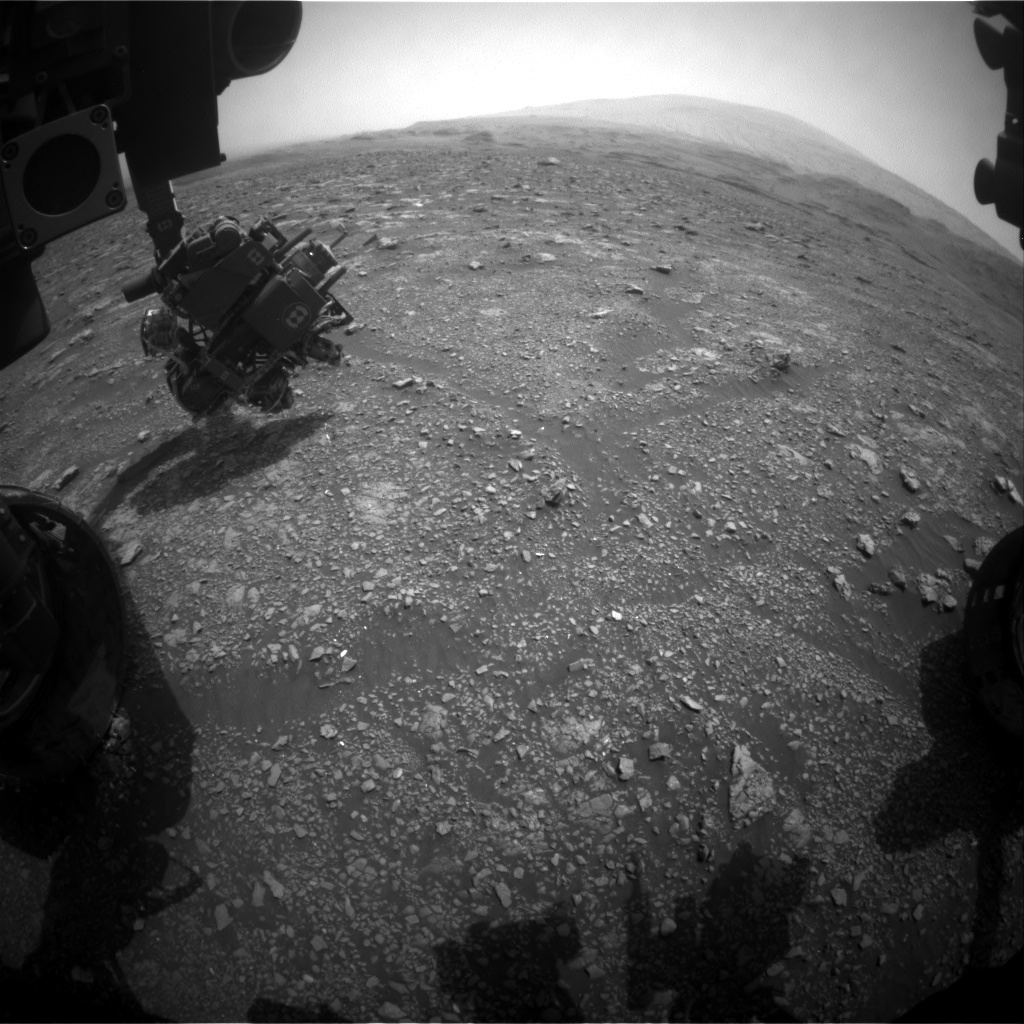
Curiosity Front Hazard Avoidance Camera Left B image taken on Sol 2967, December 10, 2020.
Credit: NASA/JPL-Caltech
“After the drive, on the second sol of the plan, [Sols 2967-2968] we’re doing a lot of untargeted science. We have a lot of environmental observations, predominantly looking for dust devils, and an atmospheric argon measurement by APXS. In addition, we’re letting Curiosity choose her own targets using AEGIS [Autonomous Exploration for Gathering Increased Science]– it is always interesting to see what she finds!”
As always, dates of planned rover activities described in these reports are subject to change due to a variety of factors related to the Martian environment, communication relays and rover status.
 Posted in Space News

