 By
By  December 8th, 2020

China’s returner spacecraft and re-entry capsule containing lunar samples.
Credit: CCTV/Inside Outer Space screengrab
China’s Chang’e-5 ascender vehicle has been purposely ditched on the Moon – the hardware used to transfer lunar samples to the orbiter/returner vehicles.
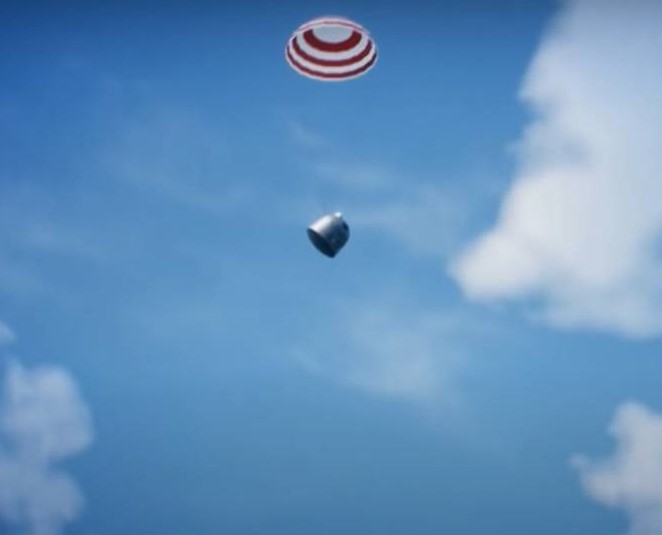
The returner craft will fly back to Earth with its cargo of lunar specimens via an Earth-Moon transfer orbit shortly. After reentering the Earth’s atmosphere, the return capsule is slated to land under parachute in the Siziwang Banner of north China’s Inner Mongolia Autonomous Region.
Credit: CCTV/Inside Outer Space screengrab
The next step in the Chang’e-5 mission is separation between the returner and orbiter prior to the journey back to China.
High-speed dive
According to Ren Junjie, a researcher of Lunar Exploration and Space Program Center under the China National Space Administration (CNSA), the separation is expected to take place in the next few days.
Credit: CCTV/Inside Outer Space screengrab
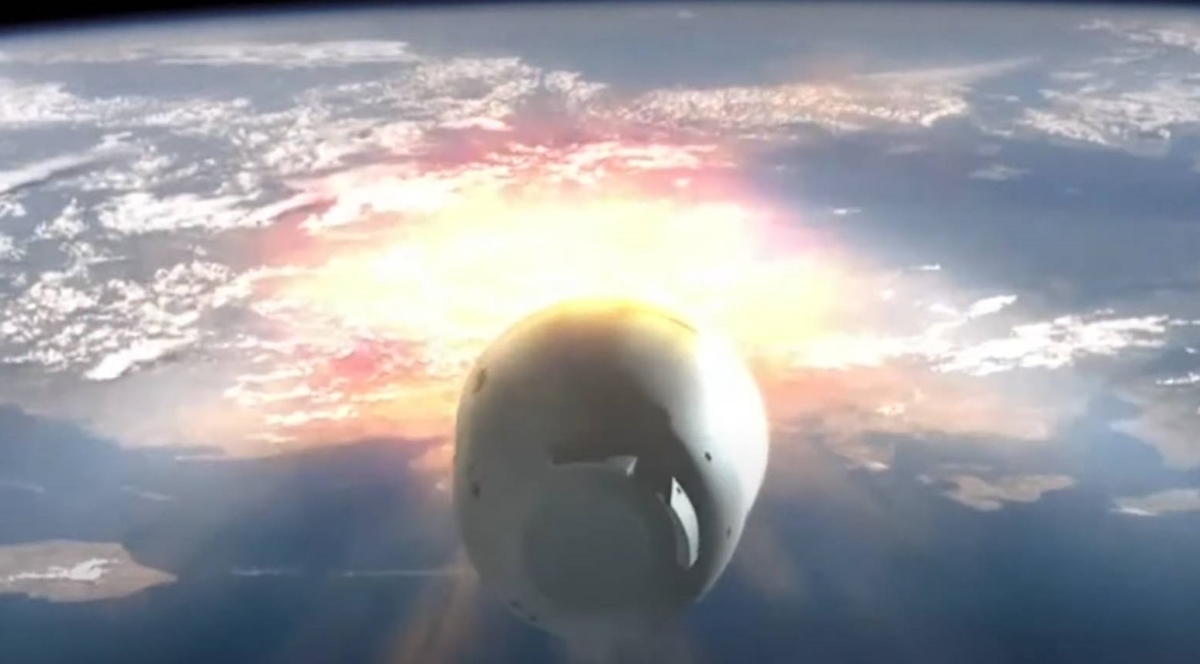
The re-entry capsule will handle the high-speed dive into the Earth’s atmosphere like a stone can skip over water. The return capsule will sprint into the atmosphere and then ascend again out of the atmosphere, reducing its speed to around eight kilometers per second, before landing at its designated site.

“We designed these separations to reduce fuel consumption in the following procedure, Ren said in a China Central Television (CCTV) interview. An inflatable aerodynamic decelerator and thermal protection system (TPS) will be used to control performance.
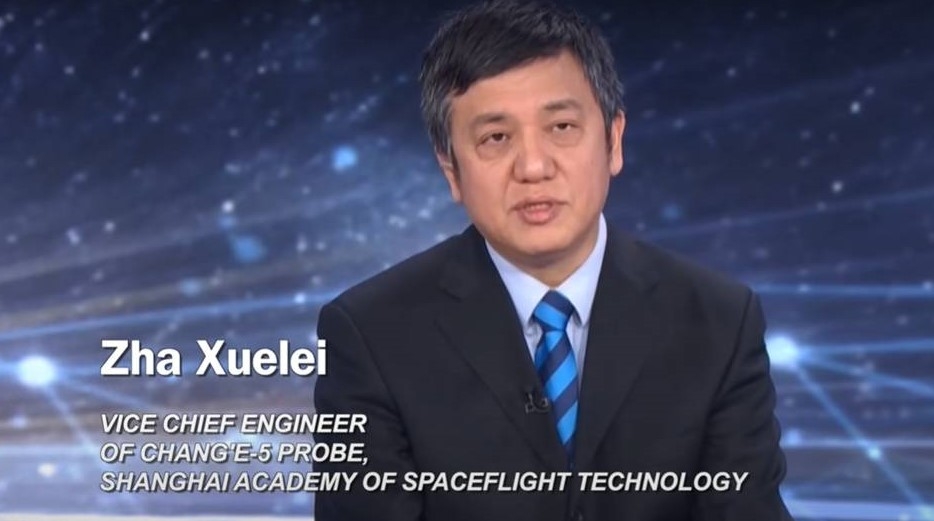
Zha Xuelei, vice chief engineer of Chang’e-5 probe from the Shanghai Academy of Spaceflight Technology, said “we’ve cleverly enabled, by design, the returner to skip the atmosphere and detect how fast the Earth is rotating. It is done in a way similar to how we dealt with the re-entry of Shenzhou spacecraft’s returners when the speed was appropriate for its re-entry.”
Lunar sample laboratory
The Chang’e-5 mission, comprised of an orbiter, a lander, an ascender and a returner, was launched on November 24. The lander-ascender combination touched down at Mons Rümker, a 70-kilometer-wide volcanic mound in the region known as Oceanus Procellarum — Latin for “Ocean of Storms” — on the Moon’s near side.

Part of China’s lunar sample receiving laboratory.
Credit: G. L. Zhang, et al.
According to the China Global Television Network (CGTN), the Chang’e-5 lunar samples will be sent to a lunar sample laboratory at the National Astronomical Observatory (NAO) under the Chinese Academy of Sciences in Beijing, for storage, processing and analysis.
Once it has landed on Earth, the samples will be transferred to the lab in a sealed container. The lab has a special facility that will prevent the sample from being contaminated by the atmosphere and water on Earth, CGTN reports.
Some of the sample will also be set aside for public display, according to Li Chunlai, deputy chief designer of the Chang’e-5 mission.
Go to this recent CCTV video discussing the return of the lunar samples to Earth at:
 Posted in Space News

