 By
By  November 11th, 2020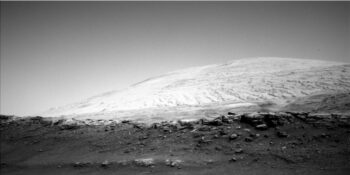
Eyes on the prize. Mt. Sharp as seen by Navigation Camera on Sol 2936, November 8, 2020. Different types of rocks in this area: “recessive” outcrops, which seem to erode more easily (some of these are poking out of the dark, sand-covered slope towards the bottom of the image).
Credit: NASA/JPL-Caltech
NASA’s Curiosity Mars rover is now performing Sol 2939 tasks.
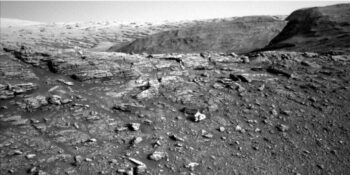
Curiosity Navigation Camera Left B image taken on Sol 2938, November 11, 2020.
Credit: NASA/JPL-Caltech
Curiosity continues to investigate the stair-step-like “rock benches” as the rover climbs higher up Mt. Sharp, reports Melissa Rice, a planetary geologist at Western Washington University in Bellingham, Washington.
The robot is viewing different types of rocks in this area, Rice explains: “recessive” outcrops, which seem to erode more easily (some of these are poking out of the dark, sand-covered slope and “resistant” outcrops, which form the harder caps at the top of the benches (these form the line of broken rock at the top of the dark slope).

Curiosity Navigation Camera Left B image taken on Sol 2938, November 11, 2020.
Credit: NASA/JPL-Caltech
Root cause of differences?
“The difference between the recessive and resistant rock layers is what has allowed the wind to carve them into benches over the eons,” Rice adds. “But what is the root cause of these differences? Are they fundamentally different rock types, or could they be the same material that was altered in different ways after the rock formed?”
To answer these questions, the team will be looking for opportunities to investigate exposures of both the recessive and resistant rocks with multiple instruments.

Curiosity Front Hazard Avoidance Camera Left B image taken on Sol 2938, November 11, 2020.
Credit: NASA/JPL-Caltech
Color panorama
On Sol 2938, Curiosity was scheduled to study a resistant outcrop in front of the rover at a spot called “Hart Fell” with the Mars Hand Lens Imager (MAHLI) and Alpha Particle X-Ray Spectrometer (APXS) instruments, and then will use its Chemistry and Camera (ChemCam) to laser zap two other spots called “Breabag” and “Breck.”
“Using Mastcam, Curiosity will capture a sweeping color panorama of the bench,” Rice reports. “Next, Curiosity will drive onward, to a spot where we hope to encounter a good exposure of the recessive outcrop to study later this week.”

Curiosity Front Hazard Avoidance Camera Left B image taken on Sol 2938, November 11, 2020.
Credit: NASA/JPL-Caltech
Eyes on the prize
On Sol 2939, the plan calls for Curiosity to monitor the environmental conditions with ChemCam and will use Navcam to scan the horizon for dust devils.
“And all the while, we’re keeping our eyes on the prize,” Rice points out, the layers of brighter rocks that tower high on Mt. Sharp.
“As one of the mission’s Long Term Planners, it is my job to remind the team about the big-picture strategic plan to explore Mt. Sharp. So, even amidst these enigmatic rock benches, we will continue moving expeditiously towards the sulfate-bearing unit higher up the mountain,” Rice concludes. “The scenery here is stunning – but the best is yet to come!”
 Posted in Space News

