 By
By  November 7th, 2020
NASA’s Origins, Spectral Interpretation, Resource Identification, Security-Regolith Explorer (OSIRIS-REx) spacecraft.
Credit: NASA/Goddard/University of Arizona
NASA’s Origins, Spectral Interpretation, Resource Identification, and Security–Regolith Explorer (OSIRIS-REx) mission is slated to head back to Earth, delivering its precious cargo of newly acquired Bennu asteroid samples – but the probe may have a new target in 2029.

Credit: USRA/LPI
“We have developed a mission design that allows us to put the OSIRIS-REx spacecraft into orbit around asteroid Apophis in 2029,” reports Dante Lauretta, OSIRIS-REx principal investigator at the University of Arizona, Tucson.
Why Apophis?
The 350-meter asteroid Apophis is an object 5-times larger and 100-times more massive than the Tunguska impactor. Currently, this big bruiser of a space rock is set to miss the Earth on Friday, April 13, 2029.
Apophis is named for the demon serpent who personified evil and chaos in ancient Egyptian mythology.
The object’s close flyby distance at an altitude of 31,000 kilometers (closer than geosynchronous satellites; about one-tenth the lunar distance) provides a once-per-thousand-year natural experiment as a learning opportunity for not only science, but planetary defense.
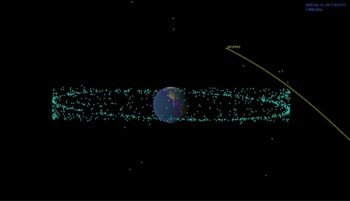
Distance between the Apophis asteroid and Earth at the time of the asteroid’s closest approach. The blue dots are the many human-made satellites that orbit our planet, and the pink represents the crewed International Space Station.
Credit: NASA/JPL-Caltech
Poster child for planetary defense
“Our current challenge is to perform detailed studies of what physical effects, if any, may be induced on Apophis by Earth’s tidal forces,” explains Richard Binzell of the Department of Earth, Atmospheric and Planetary Science at the Massachusetts Institute of Technology in Cambridge, Massachusetts.
The 2029 encounter opportunity makes Apophis the “poster child for planetary defense,” Binzell adds, “transitioning the field to a new era from space situational awareness to space situational understanding.”
Binzell was the scientific lead at last week’s Apophis T–9 Years: Knowledge Opportunities for the Science of Planetary Defense, virtually held November 4–6, organized by the Universities Space Research Association’s Lunar and Planetary Institute, the Nice Observatory in France, and MIT.

Eye of the illustrator captures asteroid Apophis near Earth.
Credit: Dan Durda – FIAAA
Gravity assist
Late last month, OSIRIS-REx successfully stowed the spacecraft’s Sample Return Capsule (SRC) and its stash of asteroid Bennu samples. The spacecraft is targeting delivery of the SRC to Earth on September 24, 2023.
Apophis’ size and gravitational field are comparable in magnitude to those of Bennu, and much of OSIRIS-REx’s concept of operations will be relevant, noted Lauretta of the OSIRIS-REx project.
At Earth return, the spacecraft will have a substantial amount of oomph to allow for the optical acquisition of Apophis on April 8, 2029. An Earth gravity assist maneuver can place the spacecraft on a rendezvous trajectory that arrives at Apophis on April 21, 2029.
Low-cost opportunity
Once in the vicinity of Apophis, the science payload of OSIRIS-REx is capable of characterizing the object’s surface.
“This low-cost opportunity allows for the OSIRIS-REx payload to perform a detailed characterization of this potentially hazardous asteroid, comparable to that achieved at Bennu,” Lauretta reports. Apophis’ size and gravitational field are comparable in magnitude to those of Bennu, and much of OSIRIS-REx’s operational skills would be pertinent, he notes.
The idea is now on the table, but much more work is needed to plot out this potential add-on to the overall mission of OSIRIS-REx, explains Lauretta.
 Posted in Space News


Yhis would be a low-cost, but very worthwhile extention of the OSIRIS-REx mission. Much valuable data would be obtained, which would enhance our understanding of the processes involved in the early formation of the Solar System, and aid planetary protection research.