 By
By  August 24th, 2020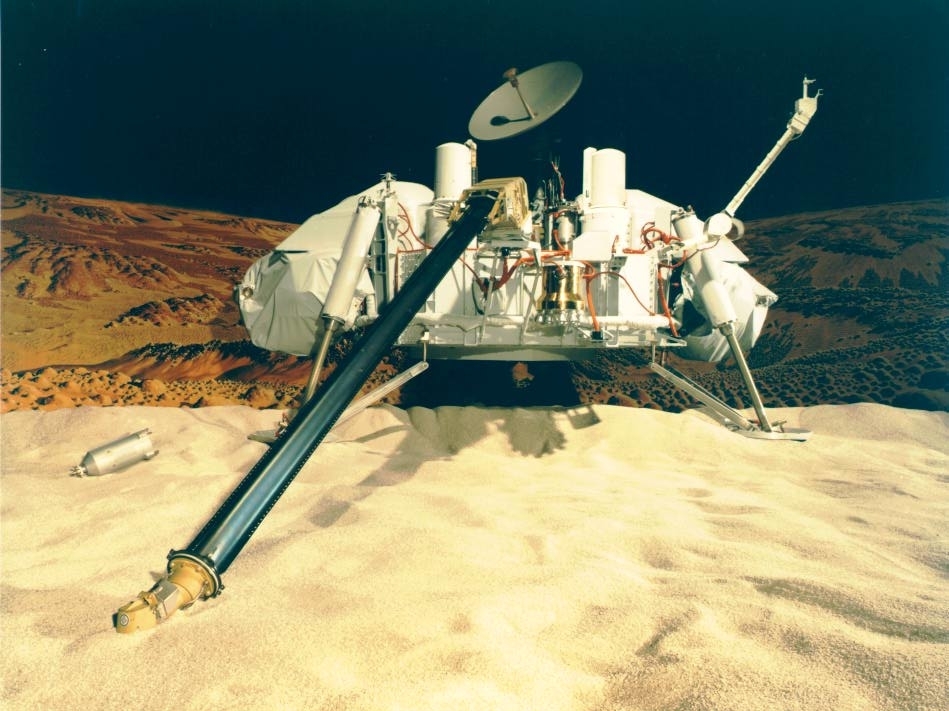
Credit: NASA
Back in 1976, the dual NASA Viking landers came to full stop on the Red Planet.
The assignment: Is there life on Mars?
Gilbert Levin was the principal investigator of the Viking Labeled Release (LR) life detection experiment and he maintains the investigation at both landing locales got positive responses.

Viking 2 Image of Mars Utopian Plain.
Credit: NASA/JPL-CalTech
That said, a consensus of scientists did not agree his results were proof of life. In 1997 Levin concluded that the experiment had, indeed, detected life on Mars – and he’s stuck to his guns ever since.
Strong evidence
In a recent issue of the American Association for the Advancement of Science (AAAS) Science Magazine, Levin once again championed his belief that the Viking LR experiment found strong evidence for extant microbial life on the Red Planet.

Gilbert Levin
Courtesy of G. Levin
Evidence
In an eLetters communiqué, tied to his review comments on a new book —The Sirens of Mars: Searching for Life on Another World — Levin assembled the following evidence supporting life on Mars:
— Amino acids and many other organics have been found all over the reachable cosmos.
— Biological fossils have been found in meteorites by many scientists.
— Liquid water, biologically complex organic compounds, all key elements of life, including CHNOPS [the six essential elements of life–carbon, hydrogen, nitrogen, oxygen, phosphorus and sulfur] have been found on Mars.
— Terrestrial microorganisms have been grown under Martian environmental conditions, and even harsher, even in naked space.
— Microbes on Earth could be impelled to Mars in bolides launched by meteoric impact, and land in viable form (all the parameters have been verified).

Credit: NASA/Ben Clark
— The Viking 1 Mission LR test and a series of increasingly decisive controls exceeded NASA’s pre-mission requirements for the detection of extant life.
— Then, as dictated by the scientific method, the Viking 1 LR repeated the test and imposed even more restrictive controls. This duplication verified the first test and its controls, thereby establishing the grounds for scientific proof.

Big Joe I at Viking landing site.
Credit: NASA/JPL
— In a separate mission, Viking 2 replicated the LR experiment and also duplicated it. All its results confirmed the presence of extant microbes.
— Viking 2 detected greenish patches on some rocks. Analyzed with the six channel Viking Imaging System, the spectrum of the patches completely matched that of terrestrial lichen when analyzed in the same system.
— Precise replicate images of the patches on the rocks taken at yearly intervals for three Martian years showed the shapes had changed, with no changes in the surrounding field, thereby eliminating wind and dust as an explanation.
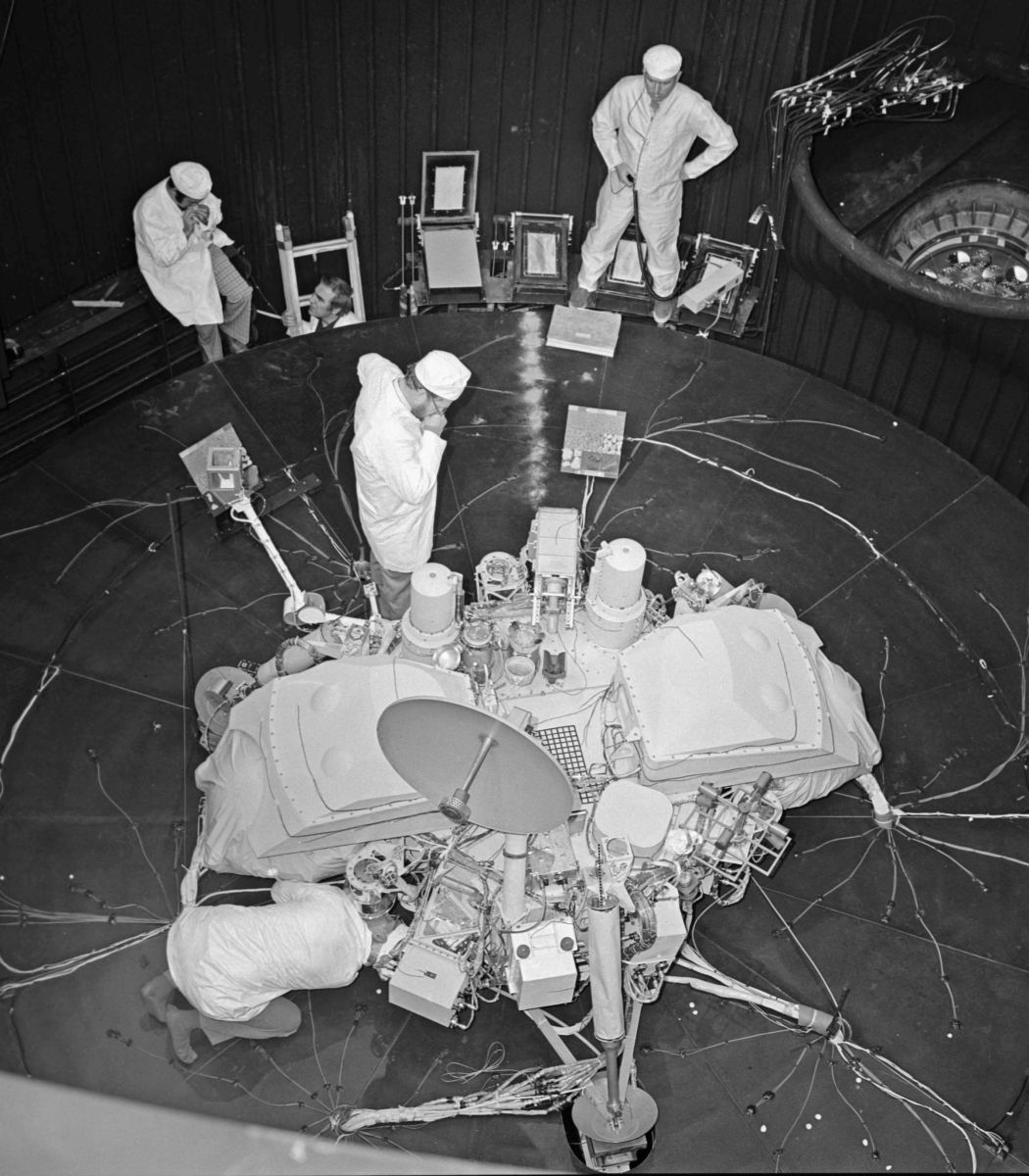
NASA’s two Viking landers were designed and built by Martin Marietta (now Lockheed Martin) at its facility near Denver. This image shows some Martin Marietta employees in a Viking lander test center.
Credit: Lockheed Martin
— Chlorophyll was reported by spectral analysis of the Martian surface and on newly-appearing material on the lander deck. Although the respected scientist who made this claim withdrew the published peer-reviewed publication, coercion is suspected.
— Ultraviolet (UV) activation of the Martian surface material did not, as initially proposed by some, cause the LR reaction: a sample taken from under a UV-shielding rock was as LR-active as surface samples.
— Among complex organics reported on Mars by Curiosity’s scientists, kerogen, which is only of biological origin, was mentioned as possibly included.

NASA Phoenix Mars lander studied the Red Planet in 2008.
Credit: NASA
— Phoenix and Curiosity concluded that the ancient Martian environment was habitable. They did not conclude that it was still not so.
— The excess of carbon-13 over carbon-12 in the Martian atmosphere is strongly indicative of biological activity, which prefers ingesting the latter.
— The presence of O2 in the Martian atmosphere is also indicative of a disequilibrium, requiring constant replacement. This may be regarded as an indication of photosynthetic life as is the source of O2 on Earth.
— The seasonal cycle of O2 requires a rapid sink, which could be supplied by microorganisms.
— Methane has been measured in the Martian atmosphere both cyclically and locally; microbial methanogens could be the source.

NASA Curiosity rover on the Red Planet prowl since August 2012 and assessing the habitability of Mars.
Credit: NASA/JPL-Caltech/MSSS
— The rapid disappearance of methane from the Martian atmosphere requires a sink, possibly supplied by methanotrophs that could co-exist with methanogens on the Martian surface.
— Ghost-like moving lights, resembling will-O’-the-wisps on Earth that are formed by spontaneous ignition of methane, have been video-recorded on the Martian surface.
— Formaldehyde and ammonia, each possibly indicative of biology, are claimed to be in the Martian atmosphere.
— An independent complexity analysis of the positive LR signal identified it as biological.
— A worm-like feature was in an image taken by Curiosity.
— Large structures resembling terrestrial stromatolites (formed only by microorganisms) were found by Curiosity; a statistical analysis of their complex features showed the probability was less than 0.004 that the similarity could be caused by chance alone.

Curiosity self-portrait at “Windjana” drilling site. The Mars rover used the camera at the end of its arm in April and May 2014 to take dozens of component images combined into this space-based selfie.
Credit: NASA/JPL-Caltech/MSSS
— Images sent by Curiosity bear strong resemblances to metazoans (multiple-celled organisms) as assessed by experts.
— Images sent by Curiosity also bear features resembling mushrooms as assessed by experts. The “mushrooms” are seen to expand, and new ones pop up out of the ground in images taken several days apart.
— Nothing inimical to life, even as we know it on Earth, has been found on Mars.
Astonishing fact
In summarizing his point-by-point case for life on Mars, Levin emphasized the Viking positive result, from a test adapted from a standard test used by public health departments daily to test for microbial contamination of drinking water for billions of people in cities around the world.

Firm footing on Mars. Image taken by the first Viking Mars lander.
Credit: NASA
Those tests, Levin continued, confirmed by strong and varied controls; duplication of the LR results at each of the two Viking sites; replication of the experiment at the two Viking sites; with the above copious additional hard and circumstantial evidence for life on Mars – “and the failure for over 44 years of any experiment or theory to provide a scientifically supportable non-biological explanation of the Viking LR results.”
In a final thought, Levin asked: What is the evidence against the possibility of life on Mars?
“The astonishing fact is that there is none,” Levin concluded.
 Posted in Space News

