 By
By  March 11th, 2015
Planting life on Mars – future “Martians” set up habitats on the Red Planet.
Credit: NASA
Student-led looks at performing a makeover of Mars – called terraforming – have blueprinted some provocative ideas for the Red Planet.
Four University of Leicester physics students in the UK have examined the possibility of terraforming Mars by polluting its atmosphere – burning copious amounts of coal to create enough carbon dioxide to alter the Martian atmosphere.
They theorize that the process would increase the atmospheric density and eliminate the need for pressurized spacesuits – making the Red Planet more habitable.
Trips to ship
But their assessment also uncovered major difficulties with this proposal.
For one, there’s need for lots of coal to produce a greenhouse effect. Furthermore, the study group found that the problem is not the amount of coal itself, but the transportation logistics of such a large quantity.
They calculated that using the powerful SpaceX Falcon Heavy it would take 2,390,000,000,000,000 trips to ship the required amount.
The paper can be found from the link*:
http://physics.le.ac.uk/journals/index.php/pst/article/view/749/514
*Special thanks to Alex Longman.
Power stations

Tapping the Leidenfrost-effect on Mars.
Image: Jonathan Sanderson
In a related development, researchers at Northumbria and Edinburgh Universities have developed a new technique to harvest energy from carbon dioxide.The energy-harvesting method may enable the creation of future power stations on the surface of Mars.
The research proposes a new kind of engine for producing energy based on the Leidenfrost effect – a phenomenon which happens when a liquid comes into near contact with a surface much hotter than its boiling point. Blocks of dry ice are able to levitate above hot surfaces protected by a barrier of evaporated gas vapor. Northumbria’s research proposes using the vapor created by this effect to power an engine.
Dry-ice deposits
There is increasing evidence from NASA’s Mars Reconnaissance Orbiter (MRO) that suggests dry ice may be a naturally occurring resource on the Red Planet, as suggested by the seasonal appearance of gullies on the Martian surface.
If utilized in a Leidenfrost-based engine, the dry-ice deposits could provide the means to create future power on Mars.
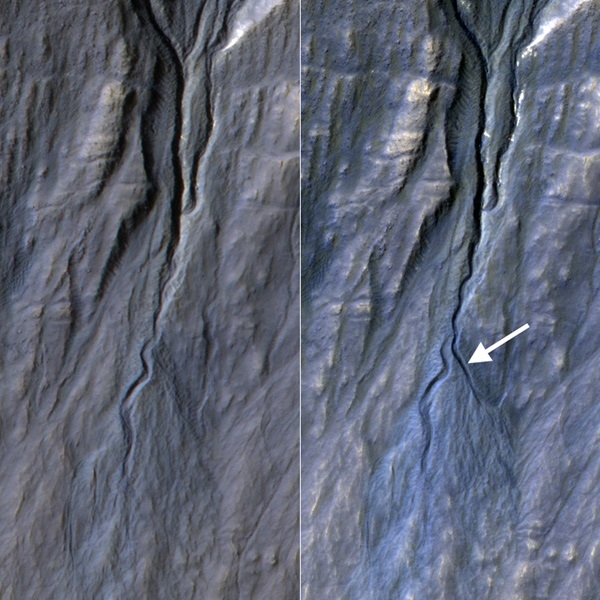
NASA’s Mars Reconnaissance Orbiter (MRO) has documented gully formation on the Red Planet. Researchers contend that these gullies are primarily formed by the seasonal freezing of carbon dioxide – not liquid water.
Credit: NASA/JPL-Caltech/Univ. of Arizona
Increasing evidence from NASA’s Mars Reconnaissance Orbiter (MRO) suggests that dry ice may be a naturally occurring resource on Mars, as suggested by the seasonal appearance of gullies on the surface of the red planet. If utilized in a Leidenfrost-based engine, the dry-ice deposits could provide the means to create future power on the Red Planet.
The working principle of a Leidenfrost-based engine differs from steam-based heat engines; the high-pressure vapor layer creates freely rotating rotors whose energy is converted into power without the need of a bearing, thus conferring the new engine with low-friction properties.
Exploiting natural resources
Explains Rodrigo Ledesma-Aguilar, a Northumbria’s researcher and co-author of the work: “Perhaps future power stations on Mars will exploit such a resource to harvest energy as dry-ice blocks evaporate, or to channel the chemical energy extracted from other carbon-based sources, such as methane gas.”
Ledesma-Aguilar adds that one thing is certain. “Our future on other planets depends on our ability to adapt our knowledge to the constraints imposed by strange worlds, and to devise creative ways to exploit natural resources that do not naturally occur here on Earth.”
For an informative video regarding this idea, go to:
 Posted in Space News

