 By
By  March 10th, 2015
Credit: NASA/Bigelow Aerospace
The wraps are coming off the Bigelow Expandable Activity Module (BEAM) slated for launch to the International Space Station (ISS) later this year.
Space entrepreneur, Robert Bigelow, is holding a major media event at his Bigelow Aerospace’s North Las Vegas facility this Thursday, March 12.
The BEAM is being displayed before it’s shipped to NASA’s Kennedy Space Center in Florida for launch the second half of this year aboard the eighth SpaceX cargo resupply mission to the ISS.
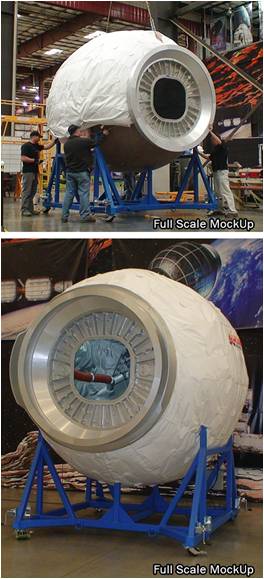
Credit: Bigelow Aerospace
BEAM is to be installed on the aft port of the space station’s Tranquility node.
Scheduled to join Bigelow in the festivities is NASA’s William Gerstenmaier, associate administrator for Human Exploration and Operations.
Wanted: Deep space habitats
According to Bigelow Aerospace, the demonstration of expandable space habitat technology supports NASA’s long-term exploration goals on its journey to Mars, for which the agency will need to develop a deep space habitat for human missions beyond Earth orbit.
Founded in 1999 by Bigelow, Bigelow Aerospace has as a goal the creation of a new paradigm in space commerce and exploration via the development and use of expandable habitat technology. Expandable habitats are viewed as offering dramatically larger volumes than rigid, metallic structures as well as enhanced protection against both radiation and physical debris.
Additionally, expandable habitats are lighter than traditional systems, take up less room in a rocket fairing for launch, and are seen as a less-costly alternative.
Technology demonstration
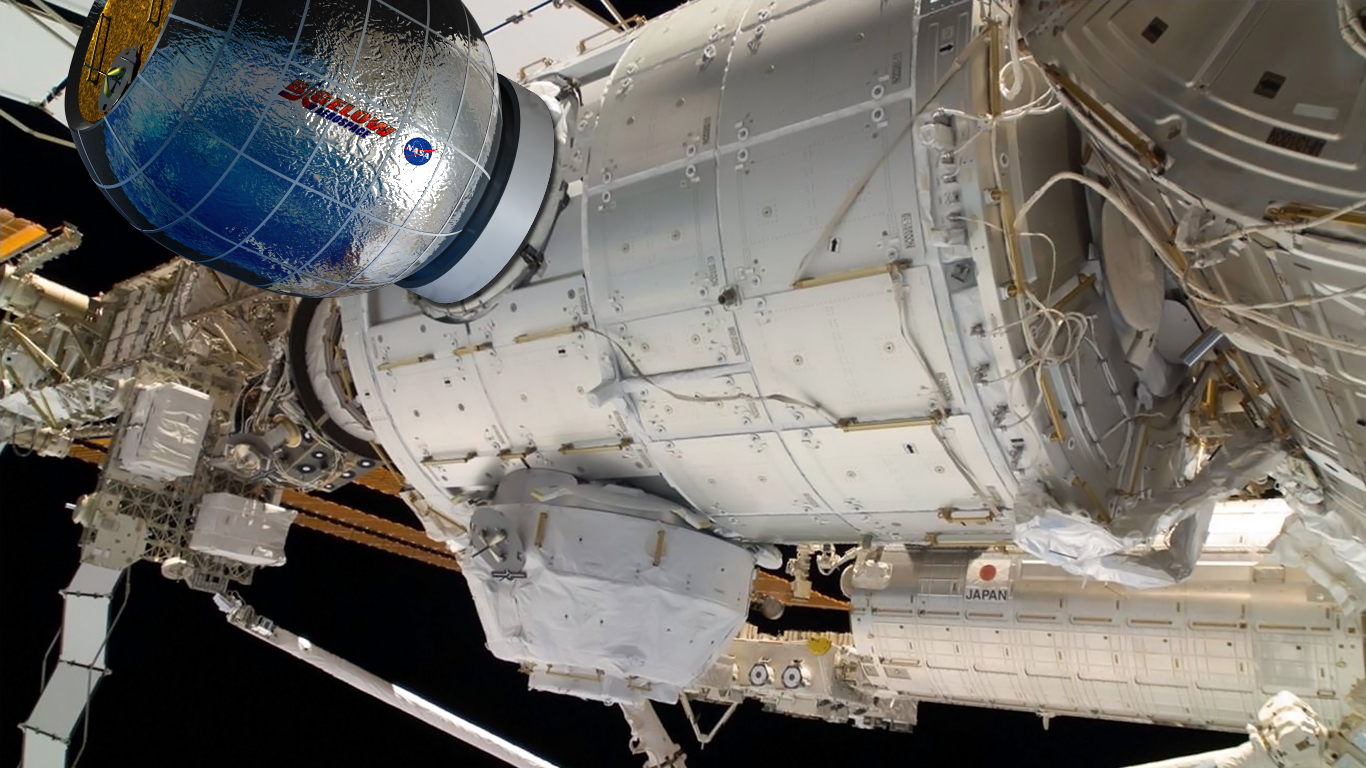
BEAM installed on International Space Station.
Credit: Bigelow Aerospace
NASA awarded a $17.8 million contract to Bigelow Aerospace to provide a BEAM to arrive at the space station in 2015 for a two-year technology demonstration.
After the module is berthed to the station’s Tranquility node, the station crew will activate a pressurization system to expand the structure to its full size using air stored within the packed module.
Astronauts will periodically enter the module to gather performance data and perform inspections. Following the test period, the module will be jettisoned from the station, burning up on re-entry.
Genesis of the idea
Bigelow Aerospace has already fabricated and deployed two subscale pathfinder spacecraft, Genesis I and Genesis II, which were launched in 2006 and 2007, respectively.
In addition to the BEAM, Bigelow Aerospace is pushing forward on development of its full-scale system — the BA 330 — an expandable structure that provides approximately 330 cubic meters of internal volume and will support a crew of up to six.
The Bigelow plan envisions BA 330s to support a variety of public and private activities in and beyond low Earth orbit.
Bigelow Aerospace is also working on even larger spacecraft, such as its “Olympus” module, which will provide 2,250 cubic meters of internal volume.
Looking beyond LEO
In terms of beyond BEAM, Bigelow Aerospace is eyeing future use of their habitats on the Moon.

Space entrepreneur, Robert Bigelow (left) explains company’s plans for commercial operations on the Moon.
Credit: Bigelow Aerospace/Leonard David Archives
“Bigelow Aerospace sees its role in lunar development as the historic equivalent of the Hudson Bay Company, providing the necessary habitats, equipment, and transportation for entrepreneurs to execute their business plans,” explains Michael Gold, Director of Washington, D.C. Operations & Business Growth for Bigelow Aerospace, LLC.
“Bigelow Aerospace wants to enable individuals, companies, and countries to transform the Moon into a dynamic arena for imagination and innovation,” Gold told Inside Outer Space.
Gold says that BEAM will be the first time that an expandable habitat module will become part of a crewed system, followed by deployment of full-scale B330 habitats in Earth orbit.
Destination Moon
“It’s vital to deploy, test, and utilize these habitats in low Earth orbit before landing them on the Moon,” Gold adds, with continued investment by Bigelow Aerospace in lunar development slated.
“While a great deal of work remains to be done,” Gold concludes, “we believe that a private sector lunar settlement could be established much more quickly and affordably than most would suspect.”
For an inside look at Bigelow Aerospace and its plans, go to this video:
 Posted in Space News

