 By
By  March 18th, 2020
Curiosity Mars Hand Lens Imager photo produced on Sol 2706, March 17, 2020.
Credit: NASA/JPL-Caltech/MSSS
Curiosity is “go” for drilling reports Ken Herkenhoff, a planetary geologist at USGS Astrogeology Science Center at Flagstaff, Arizona.
During the acquisition of Mars Hand Lens Imager (MAHLI) images on Sol 2705, an arm hiccup prevented the sequence from completing.

Curiosity Front Hazard Avoidance Left B Camera image acquired on Sol 2706 March 17, 2020.
“But enough images were successfully acquired that it’s not necessary to repeat the MAHLI sequence, and the arm issue is well understood so that no special recovery activities were required,” Herkenhoff adds.

Curiosity Left B Navigation Camera photo taken on Sol 2706, March 17, 2020.
Credit: NASA/JPL-Caltech
Hilltop mosaic
A recent plan scripts use of the robot’s Dust Removal Tool to brush of a bedrock target named “Eshaness.”
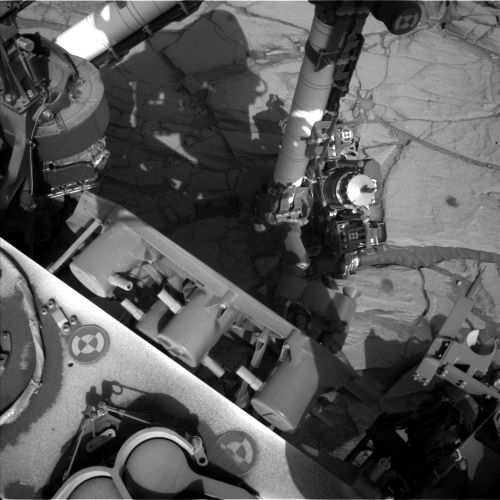
Curiosity Left B Navigation Camera photo taken on Sol 2706, March 17, 2020.
Credit: NASA/JPL-Caltech
Curiosity’s Navcam will be used to search for dust devils and clouds, and Mastcam will take stereo image pairs to extend the mosaic of the hilltop.
Chemistry and Camera (ChemCam) planned a horizontal Laser Induced Breakdown Spectroscopy (LIBS) raster on a bedrock block dubbed “Corstorphine Hill” and another vertical raster on Glen Finglas using tighter point spacing.

Curiosity Mast Camera Right photo taken on Sol 2705, March 16, 2020.
Credit: NASA/JPL-Caltech/MSSS

Curiosity Mast Camera Right photo taken on Sol 2705, March 16, 2020.
Credit: NASA/JPL-Caltech/MSSS
The Right Mastcam is slated to take images of both ChemCam targets and of Glen Feshie, which was obscured by the arm when it was imaged on Sol 2705.
Afternoon nap
After an afternoon nap, MAHLI will acquire a full suite of images of the Eshaness brush spot and images from 25 and 5 cm of a soil patch named “Balliekine.”
The rover’s Alpha Particle X-Ray Spectrometer (APXS) will then hover over Balliekine for an evening integration before the instrument is placed on Eshaness for an overnight integration.
Finally, early on the morning of Sol 2707, Chemistry & Mineralogy X-Ray Diffraction/X-Ray Fluorescence Instrument (CheMin) is slated to perform “funnel piezo” and wheel move activities in preparation for the next drill target.
During recent discussions, the science team concluded that the Mars machinery should go ahead and drill the Edinburgh bedrock target in the next plan.
 Posted in Space News

