 By
By  February 2nd, 2015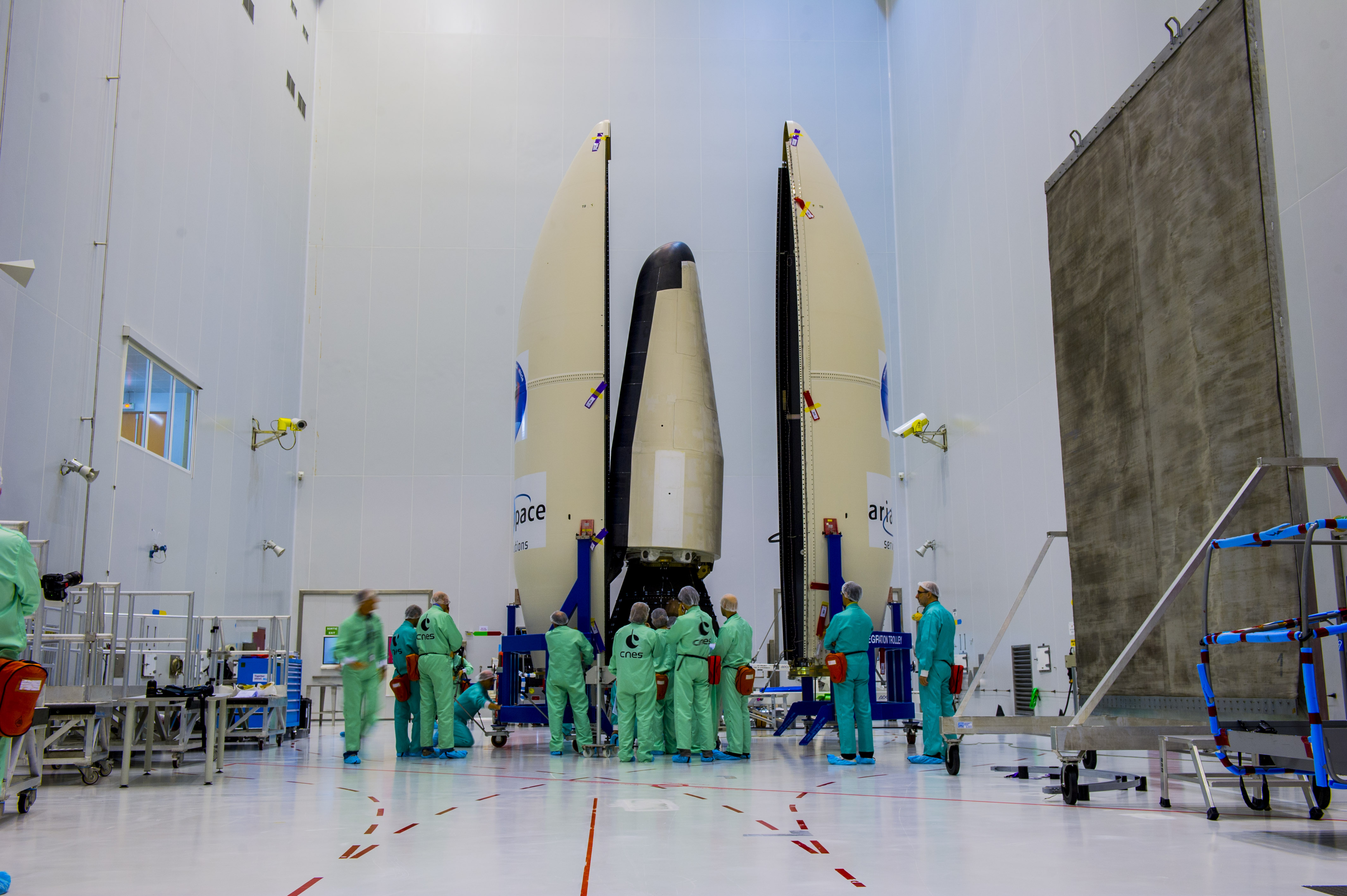
IXV will be launched into space on top of a Vega rocket, VV04, climbing up to 260 miles (420 kilometers) before beginning a long glide back through the atmosphere. In the process, IXV will gather data on reentry conditions to help guide the design of future spaceplanes.
Credit ESA–M. Pedoussaut, 2015
Stand by for flight of the cutting edge Intermediate eXperimental Vehicle, or IXV mission.
The European Space Agency (ESA) has green-lighted the February 11 liftoff of the test vehicle atop a Vega rocket from Europe’s Spaceport in French Guiana.
Here’s what’s cool about this ESA high-speed plunge from space.
This IXV mission will test cutting-edge system and technology aspects to provide Europe with an independent reentry capability. The vehicle is considered a building block for reusable space transportation systems. It will also validate designs for lifting-bodies.
Controllability and maneuverability
According to ESA, the IXV incorporates both the simplicity of capsules and the performance of winged vehicles, with high controllability and maneuverability for precision landing.
Such a capability is a cornerstone for reusable launcher stages, sample return from other planets and crew return from space, as well as future Earth observation, microgravity research, satellite servicing and disposal missions.
Furthermore, the results from the test will be fed into the ESA’s “Program for Reusable In-Orbit Demonstrator for Europe,” long-speak for “Pride” – a reusable spaceplane.
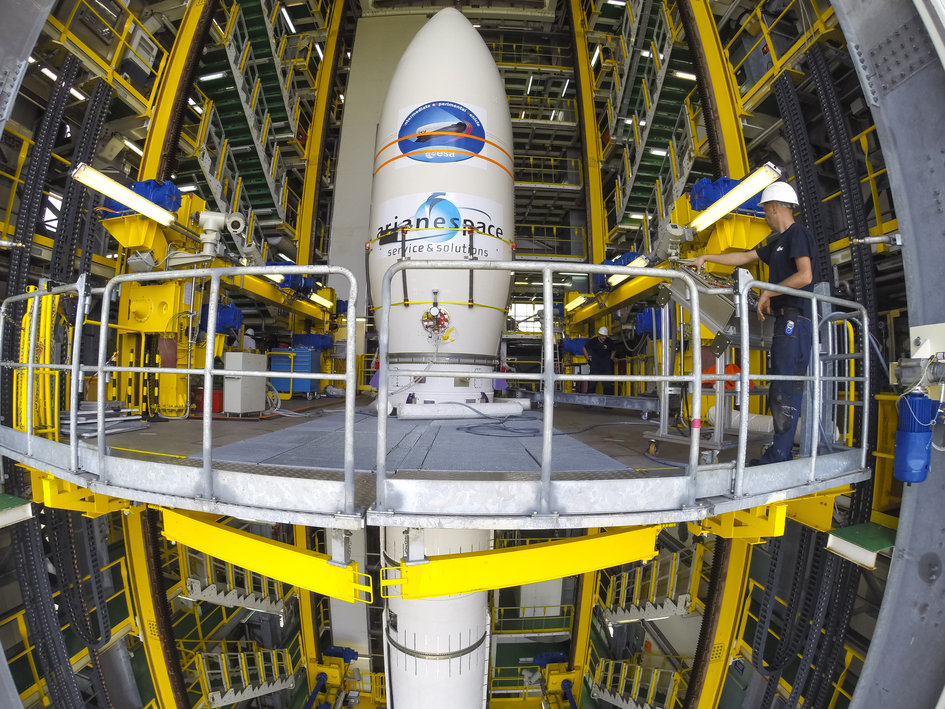
Credit: ESA–M. Pedoussaut
100 minutes
After being boosted skyward, the IXV will maneuver to decelerate from hypersonic to supersonic speeds. Then the IXV will deploy a multistage parachute to slow the descent further. Flotation balloons will keep it afloat after splashdown in the Pacific Ocean, where it will be recovered by a ship for detailed analysis.
The entire flight will last about 100 minutes.
The prime contractor for IXV is Thales Alenia Space Italia, supported by about 40 other European companies. The mission will be controlled from the Advanced Logistics Technology Engineering Centre (ALTEC) in Turin, Italy.
For a video detailing this upcoming mission, go to:
http://www.esa.int/spaceinvideos/Videos/2012/11/ESA_s_IXV_reentry_vehicle_mission
 Posted in Space News

