 By
By  December 7th, 2014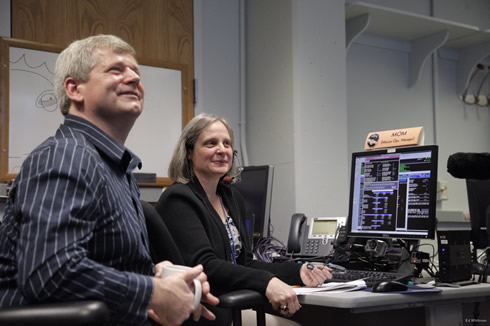
New Horizons Mission Operations Manager Alice Bowman and operations team member Karl Whittenburg watch the screens for data confirming that the New Horizons spacecraft had transitioned from hibernation to active mode on Dec. 6.
Credit: APL
Smiles all around!
That’s the scene at the New Horizons Mission Operations Center at the Johns Hopkins Applied Physics Laboratory (APL) in Laurel, Maryland.
Data has streamed in from a long distance runner – NASA’s New Horizons spacecraft – showing its transition from hibernation to active mode on December 6.
New Horizons is on track for its long-awaited 2015 encounter with the Pluto system. The spacecraft will begin observing the Pluto system on Jan. 15.
The probe’s closest approach to Pluto will occur on July 14. But by mid-May, New Horizon will view the Pluto system better than what the powerful Hubble Space Telescope can provide of the dwarf planet and its moons.
The craft is now more than 2.9 billion miles from Earth, and just over 162 million miles from Pluto. Spacecraft signals take four hours and 26 minutes to reach Earth.
Active mode
Operators at the Johns Hopkins University Applied Physics Laboratory in Laurel, Md., confirmed at 9:53 p.m. (EST) on Saturday that New Horizons, operating on pre-programmed computer commands, had switched from hibernation to “active” mode.
NASA’s New Horizons was launched on January 19, 2006. About two-thirds of its flight time has been in hibernation mode – 18 separate hibernation periods, from mid-2007 to late 2014, slumber times ranging from 36 days to 202 days in length.
The team used hibernation to save wear and tear on spacecraft components and reduce the risk of system failures.
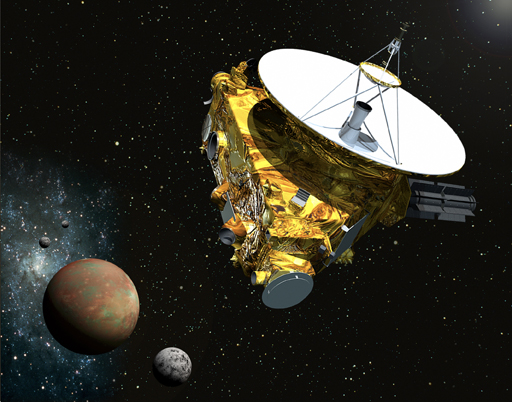
New Horizons en route to Pluto and beyond!
Credit: Johns Hopkins University Applied Physics Laboratory/Southwest Research Institute (JHUAPL/SwRI)
Listen to wake-up call
The Johns Hopkins Applied Physics Laboratory manages the New Horizons mission for NASA’s Science Mission Directorate. Alan Stern, of the Southwest Research Institute (SwRI) is the principal investigator and leads the mission; SwRI leads the science team, payload operations, and encounter science planning.
New Horizons is part of the New Frontiers Program managed by NASA’s Marshall Space Flight Center in Huntsville, Ala.
APL designed, built and operates the New Horizons spacecraft.
Listen to this special musical wake-up call by English tenor Russell Watson, a vocal salute to New Horizons including an inspirational “Where My Heart Will Take Me.”
The song was played in New Horizons mission operations upon confirmation of the spacecraft’s wake-up on Dec. 6.
Give a listen at:
http://pluto.jhuapl.edu/mp3/wakeup.htm
 Posted in Space News

