 By
By  November 14th, 2014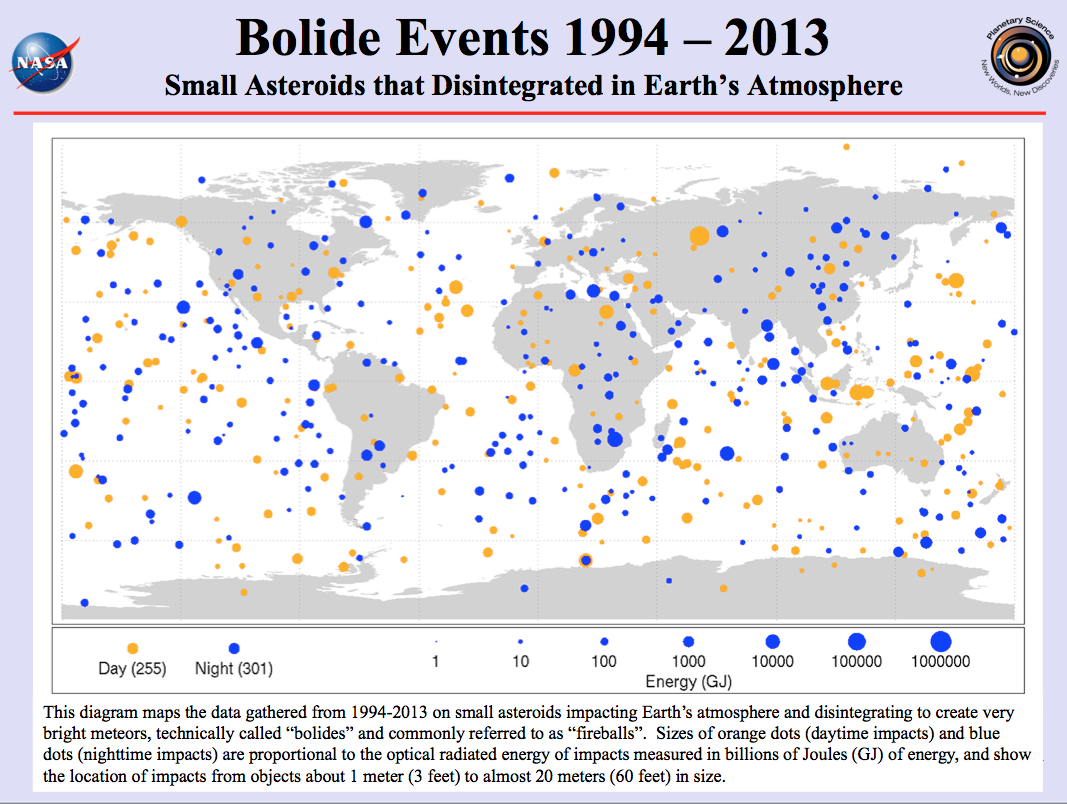
Hush-hush spacecraft are providing new data on incoming objects within the Earth’s atmosphere.
Credit: NASA/JPL
Here’s new news via old data!
Data gathered by U.S. government sensors onboard hush-hush spacecraft — and released to NASA for use by the science community — reveal that small impact events are frequent and random.
A map of these small impact events – known as fireballs or bolides –has been released by NASA and shows the frequency and approximate energy released by bolide events detected from 1994 through 2013. It dwarfs a data-base of small impacts based on infra-sound detections released last fall, but it does not contain all fireballs – objects less than a meter in size – that impacted the Earth during this period.

Update on bolides! Lindley Johnson, program executive for NASA’s Near-Earth Object (NEO) Observations Program, spotlights bolide impacts on Earth’s atmosphere during a recent Secure World Foundation workshop on NEO communications.
Credit: SWF
Take a look at the graphic.
It shows that, over a 20-year interval, U.S. Government assets recorded at least 556 bolide events of various energies. On a world map illustration, the size of the orange dots (daytime events) and blue dots (nighttime events) are proportional to the optical radiated energy of the impact event measured in billions of Joules (GJ) of energy.
An approximate conversion between the measured optical radiant energy and the total impact energy can be made using an empirical relationship provided by Canadian researcher, Peter Brown, and his colleagues in 2002.
Wanted: more complete picture
For example the smallest dot on the map represents 1 billion Joules (1 GJ) of optical radiant energy, or when expressed in terms of a total impact energy the equivalent of about 5 tons of TNT explosives. Likewise, the dots representing 100, 10,000 and 1,000,000 Giga Joules of optical radiant energies correspond to impact energies of about 300 tons, 18,000 tons and one million tons of TNT explosives respectively.
“These newly released data will help NEO scientists construct a more complete picture of the frequency and scope of asteroid impacts with Earth,” said NASA NEO Observations Program Executive Lindley Johnson.
While the new data emphasize that small asteroid impacts with Earth are not unusual, the risk of future impacts is not to be taken lightly. “The aim is to find potentially hazardous asteroids before they find us,” said Donald Yeomans, manager of NASA’s NEO Program Office at the Jet Propulsion Laboratory.
 Posted in Space News

