 By
By  May 4th, 2018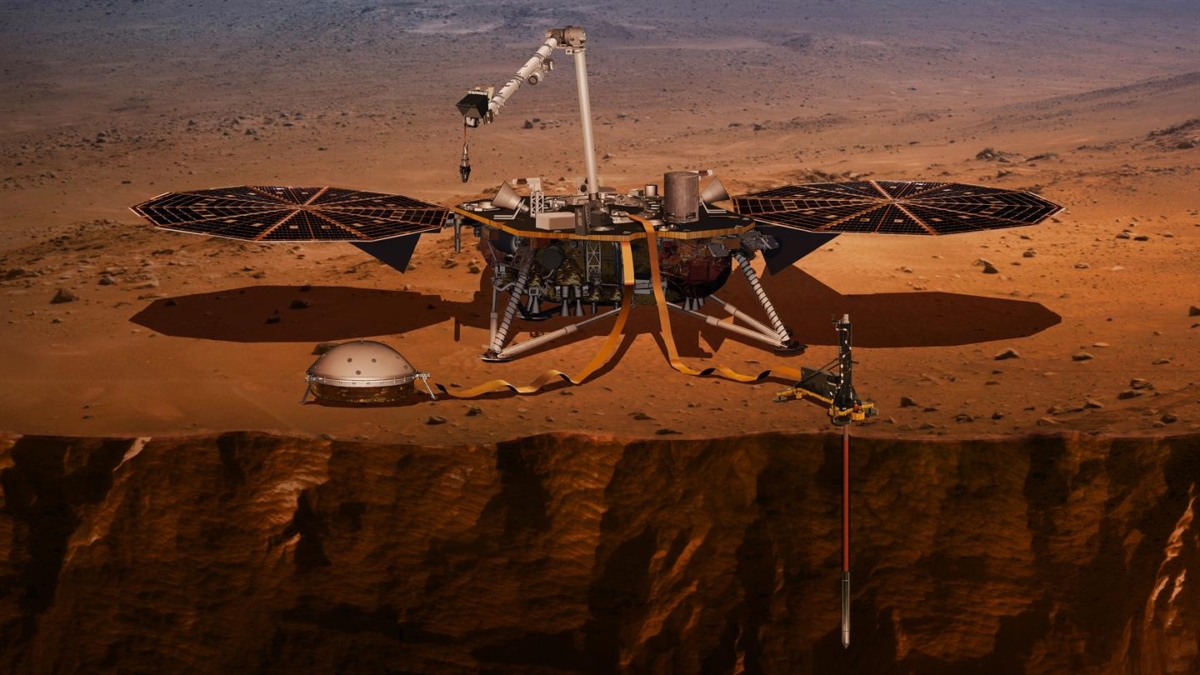
Liftoff approaches for NASA’s next Mars mission: the Interior Exploration using Seismic Investigations, Geodesy and Heat Transport (InSight) lander is ready for a May 5 sendoff from Vandenberg Air Force Base in California at 13:05 CEST (04:05 local time).
Upon its arrival on November 26, 2018, InSight will touch down just north of the equator, on the Elysium Planitia plain, where it will commence its work as a geophysical observatory. This will be the first mission to Mars that focuses on exploring the planet’s interior and its 4.5-billion-year history.

Credit: NASA/JPL
Marsquakes
With the InSight spacecraft firmly planted on Mars, a robotic arm will deploy the French-supplied Seismic Experiment for Interior Structure (SEIS) onto the surface first. The seismometer will be used to record waves propagating through the planet from marsquakes and from sites impacted by meteors.
The German Aerospace Center (Deutsches Zentrum für Luft- und Raumfahrt; DLR) is contributing one of the three principal experiments of the NASA InSight mission, HP3 – a small probe that will hammer five meters deep into the Martian soil to measure temperature and thermal conductivity at various depths to determine the heat flow from deep inside the planet. The resource-saving key technology developed by DLR has already been used in road construction in China, for agriculture in Poland and in avalanche surveillance in Switzerland.
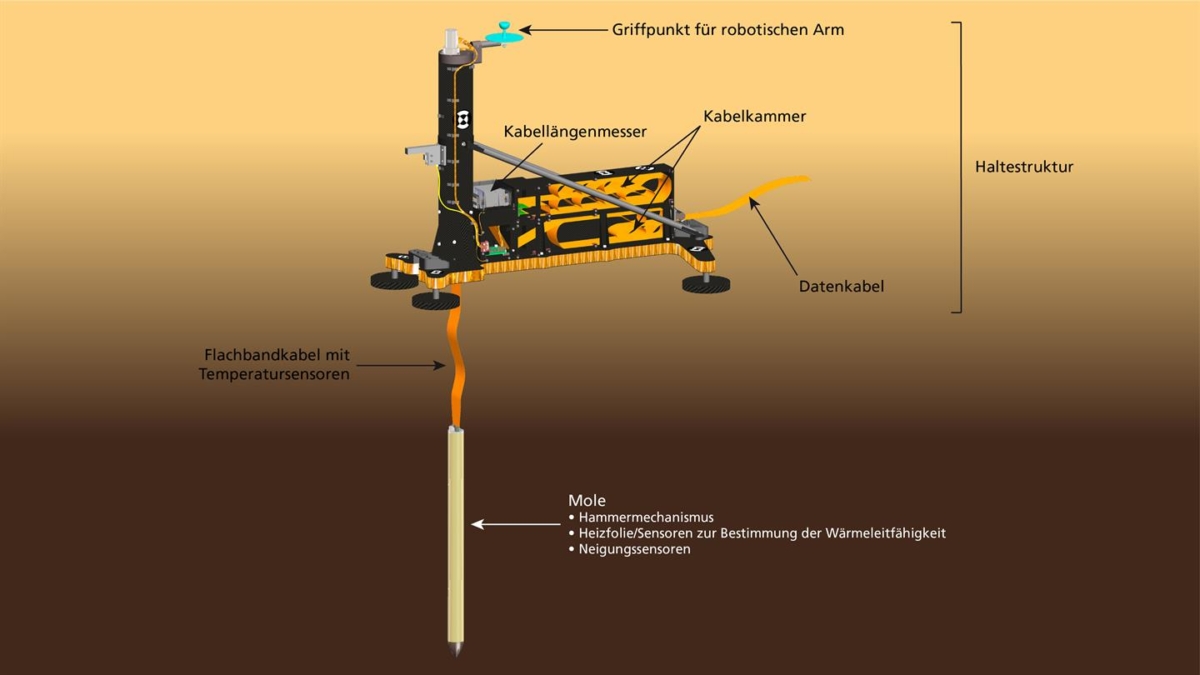
DLR’s HP3 experiment.
Credit: NASA/JPL/DLR
Essential components
HP3 stands for “Heat Flow and Physical Properties Package.”
The experiment is designed for an operational life of two Earth years. Essential components of HP3 are the “Mole” and the ribbon cable with the temperature sensors, which the Mole will pull behind it into the ground to perform measurements.
If all goes well, in early January 2019 the HP3 experiment developed by DLR will be taken from the platform and lowered onto the Martian ground.

Credit: NASA/JPL/USGS (MOLA)
As noted by the DLR, HP3 is not a “drill” as it does not rotate. Instead, the mole advances using a special hammering mechanism in which a spring is repeatedly compressed, causing a hammer to be accelerated forward towards the inner lining of the tip of the “Mole” each time the spring is released. These impacts generate an acceleration of up to 14,000 times that of Earth’s gravity, which is why the sensitive measurement technology inside the probe requires special shock absorption techniques to withstand the stresses.
Go to this informative video:
 Posted in Space News

