 By
By  March 27th, 2018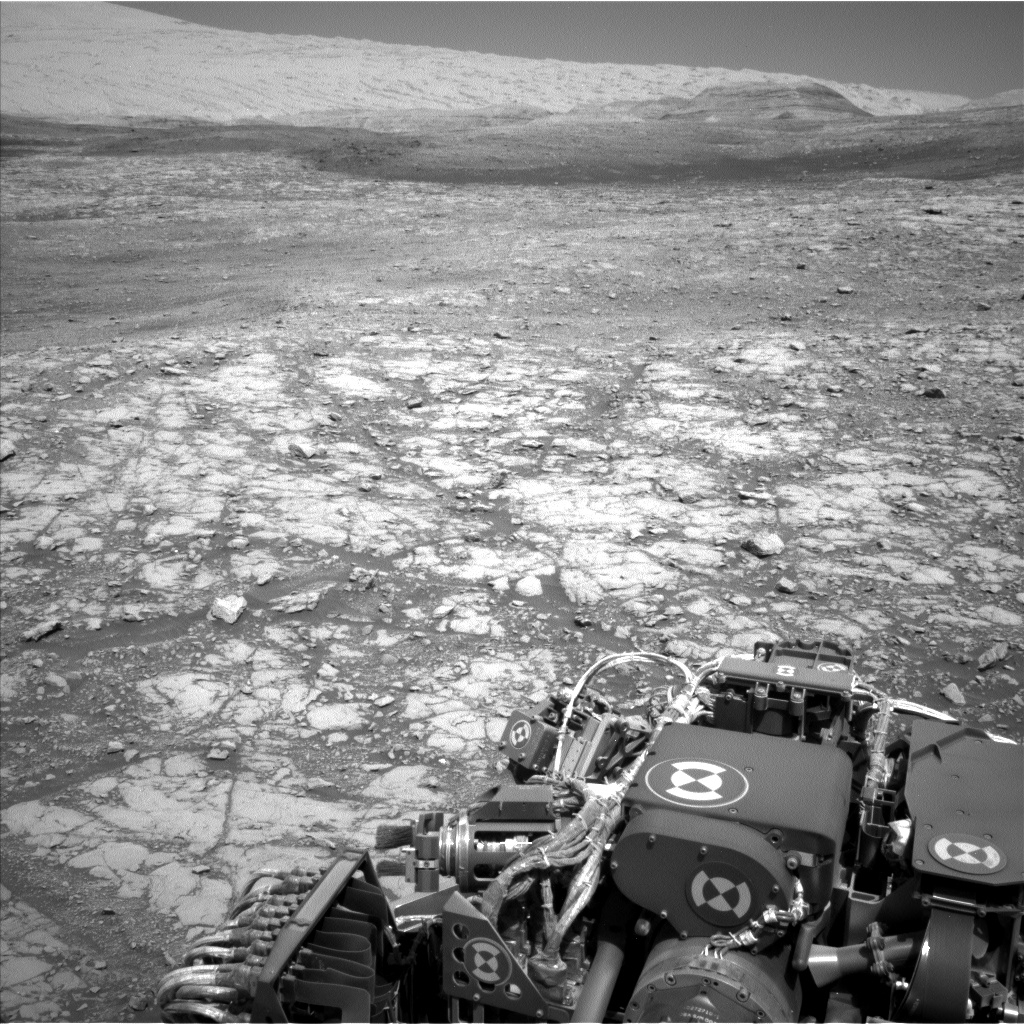
Curiosity Navcam Left B image taken on Sol 2004, March 27, 2018.
Credit: NASA/JPL-Caltech
NASA’s Curiosity Mars rover is now performing Sol 2005 duties.
Reports Abigail Fraeman, a planetary geologist at NASA/JPL in Pasadena, California: A weekend drive stopped after just a few meters due to a high current warning from Curiosity’s right middle wheel.
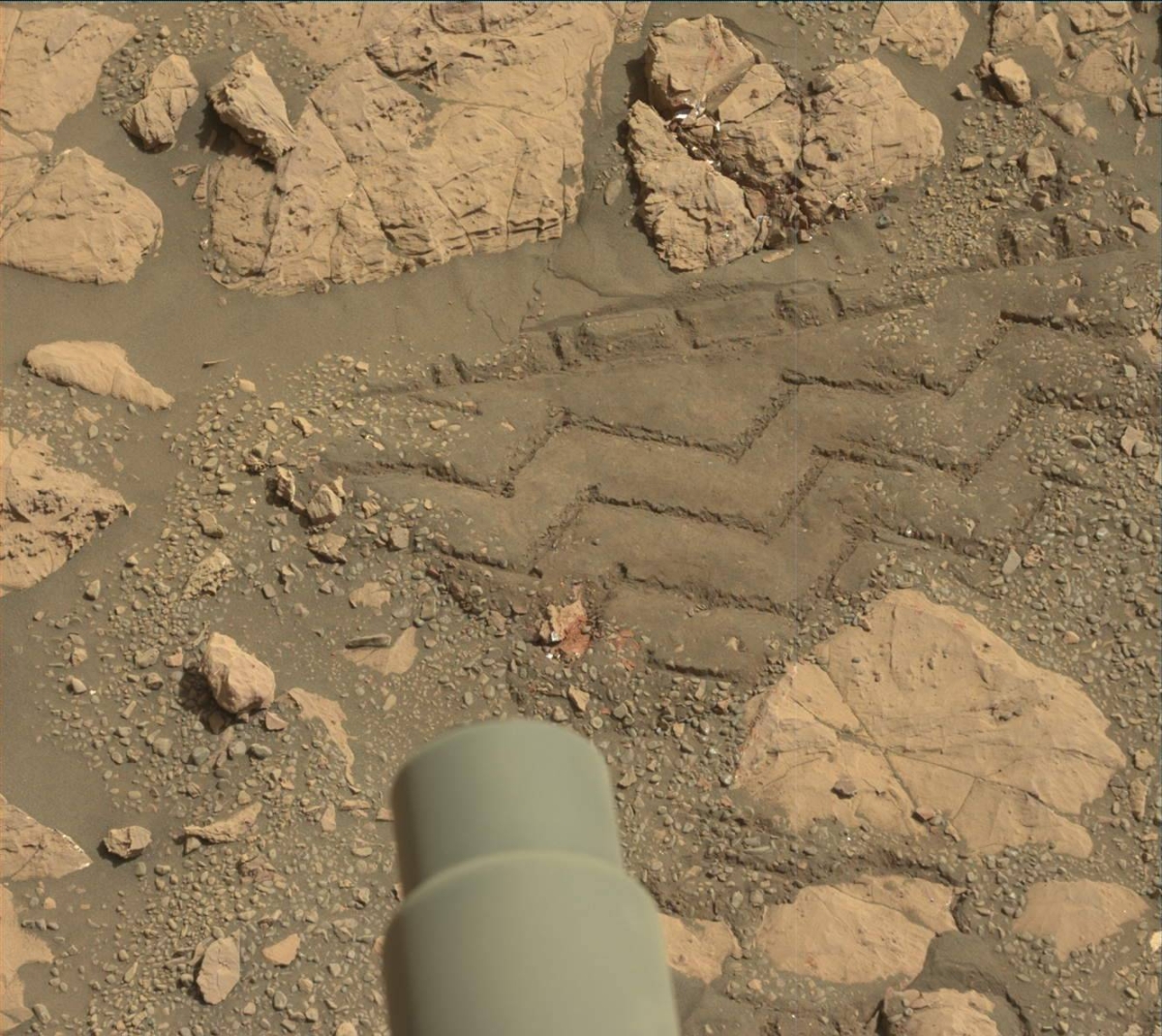
Curiosity Mastcam Left photo acquired on Sol 2003, March 26, 2018.
Credit: NASA/JPL-Caltech/MSSS
“We were able to assess all of the drive data this morning and decided there wasn’t any real risk to the vehicle. Instead, we just got unlucky because the combination of a small rock and the rover orientation made the middle wheel work a little harder than normal, and this tripped the limit warning,” Fraeman adds. “These things happen occasionally when you are autonomously driving a MINI-cooper sized rover on an entirely different planet!”
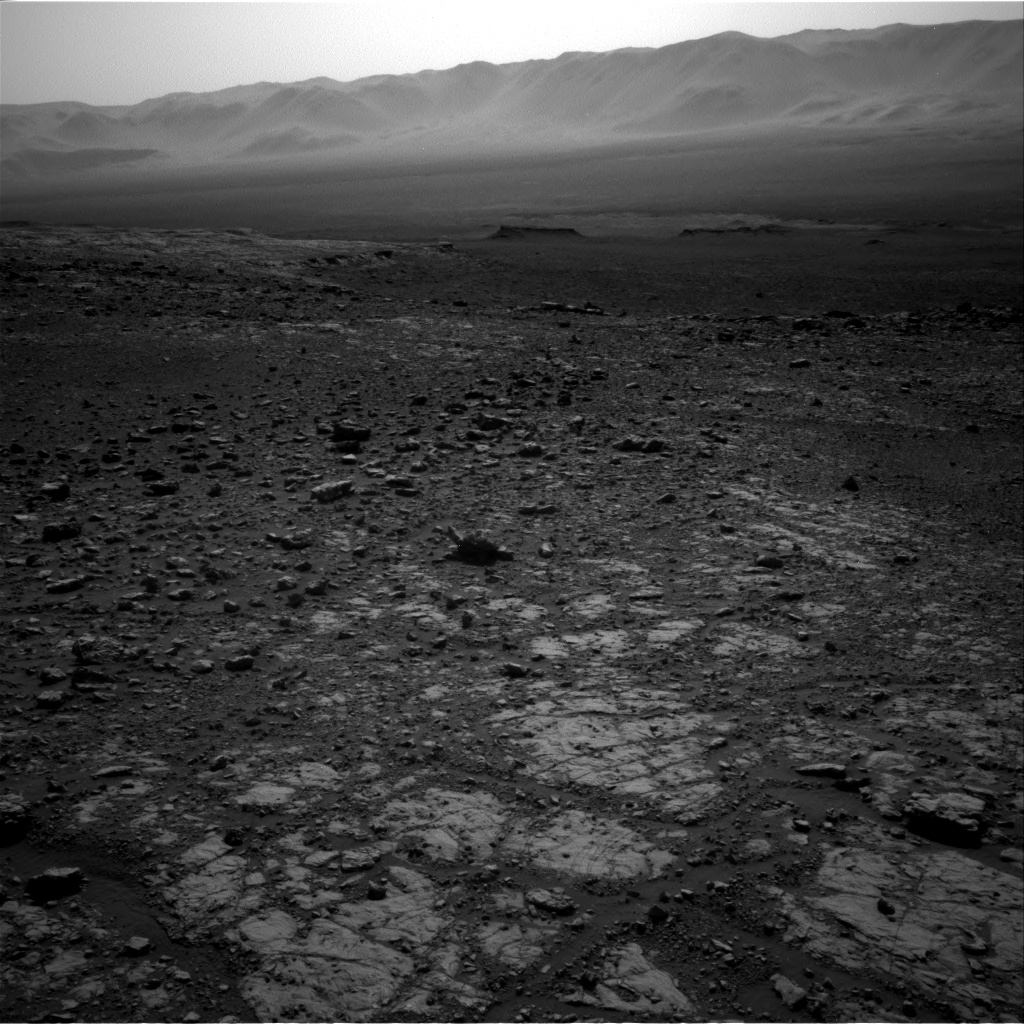
Curiosity Navcam Right B image acquired on Sol 2004, March 27, 2018.
Credit: NASA/JPL-Caltech
Next drive
A new plan was scripted featuring a rover drive that was planned for the weekend.
“We will start by backing up from the area where the weekend drive faulted out, and then continue along our original planned path from the weekend,” Fraeman explained.
Curiosity planning included a very short science block before the drive.
Brick-red rock
Also on tap, investigation of a brick-red rock, “Mousa,” that was turned up by the rover’s wheel using the rover’s Chemistry and Camera (ChemCam) and Mastcam multispectral data.
Additionally, the plan called for taking a high resolution Mastcam image of a rock with an interesting texture named “Duncansby Head.”
After the robot’s drive, on the to-do list is taking post-drive images and use of the AEGIS software, or Autonomous Exploration for Gathering Increased Science.
Concludes Fraeman: “We are headed to the area on the [Vera Rubin] ridge where we see the clearest orbital signature of hematite. I wonder if the bright red rocks at our feet are an indicator of things to come?”
Credit: NASA/JPL-Caltech/Univ. of Arizona
Road map
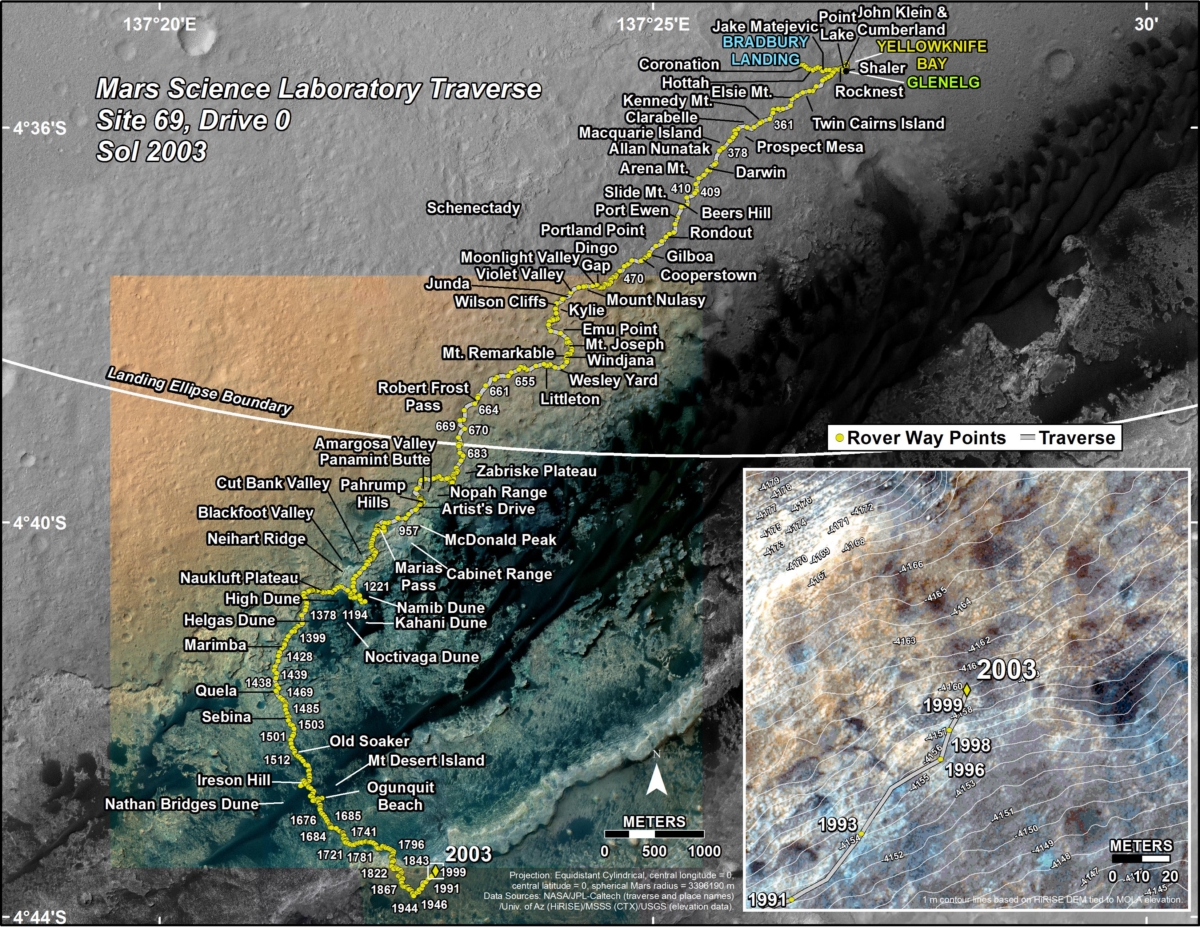
Meanwhile, a new Curiosity traverse map has been issued through Sol 2003.
The map shows the route driven by Curiosity through the 2003 Martian day, or sol, of the rover’s mission on Mars (March 26, 2018).
Numbering of the dots along the line indicate the sol number of each drive. North is up. The scale bar is 1 kilometer (~0.62 mile).
From Sol 1999 to Sol 2003, Curiosity had driven a straight line distance of about 0.37 feet (0.11 meters), bringing the rover’s total odometry for the mission to 11.48 miles (18.47 kilometers).
The base image from the map is from the High Resolution Imaging Science Experiment Camera (HiRISE) in NASA’s Mars Reconnaissance Orbiter.
 Posted in Space News


WATER ON MARS 7
Personally I believe Mars had LIFE in a past / recent, this is something that we should not despise, however much we may believe in this possibility, because this is a fact to which we must be fully aware accepting naturally, because existence of Life in the Earth is not an exclusivity, it is present in all the Universe, in diverse forms.
Possible existence of water on Mars in the not too distant past, as it is shown in these rock sediments that exist in several places of the Martian soil, show us that there were large amounts of Lakes or Oceans, everything is possible this must be seen realistically, because water is present throughout the Universe in various forms.
The presence of evidence that shows us the existence of Water on Mars, in the form of Ice in the polar caps, comes from this planet in past / recent shows had the presence of water on its surface, in the form of Lakes, Oceans being a Habitable Planet as on Earth these days.
We should face reality, because life in TERA is not exclusive, it is present throughout the universe.
There is another aspect that must be faced with realism, because it is a very real possibility.
Mars is a geologically active planet, having its seasonal cycles as shown in several photos taken by Curiusyty on different dates, the proof of this geophysical activity on Mars is the presence of dunes that shows that it is a planet Geophysically active,
If we look at the more recent images of Curiusyty, one can see the presence of rocks with gray color, which for me of the idea of basalt.
Enlarged these photos 1000 times, to better understand its structure and characteristics of these tiny rocks that are scattered on the surface of the Planet.
I do not think I am wrong about the possible composition of the rocks because I think we are in the presence of minerals such as limestone, basalt, or even iron and copper, everything is possible, including microorganisms that at first sight are not visible but are present that I am absolutely right.
It is important to realize that when the dunes cease part of the soil that was covered with sand, is visible, in these places types are perceived rocks that can reveal their geological characteristics.
If we look at the different images collected by Curiusyty during their mission, in more detail, we can see that there is geological activity on the Planet being present not only on the surface, but there may be underground activity that is not perceptible at first sight but if it is used something like a seismograph, can show us the presence of seismic activity, but I believe that this possibility must be considered and studied in more detail because it can reveal the geological history of Mars.
I believe with great conviction that in the not too distant past Mars was a World with an environment very similar to Earth, I believe a lot in this, I think I should not be wrong in my thinking, because this fact obeys the evolution of the Solar System throughout millions of years.
The many findings that have been made by NASA teams, Esa and other scientific agencies show many facts that the scientific community has difficulty accepting, making these findings mere assumptions, but when confronted with reality in a brief future, will realize that the Life is not an uniqueness of the Earth, it may have been present on Mars in the distant past.
The existence of dry ice at the planet’s poles, Mars, is a clear evidence of this, as can be seen in several photos collected by Cassini and Curiosyty in which you can see that these photos are very demonstrative, that’s what comes prove that Mars existed or exists in water, but in various forms, one of them is in the form of dry ice.
In an earlier research that was done, Scientists put the hypothesis that there is water in the Martian basement I consider this absolutely possible.
Never forget that the Earth is never unique Planet that contains water, there are many more Planets or Moons of our Solar System that has presence of water, this is an issue that should never be denied or excluded, being accepted as a reality, to be seen with seriousness.
It is sad that researchers stubbornly only think of hypotheses, hand trying to accept that Mars had water in its recent past, a reality to which we must be aware.
It is important, of course, that we have a very deep knowledge of the Martian Climate, only then we can have the perception of its Geological past.
I’m always biting on this issue until the time comes when there will be evidence in this sense, then everyone will start giving me reason for my thinking.