 By
By  January 15th, 2018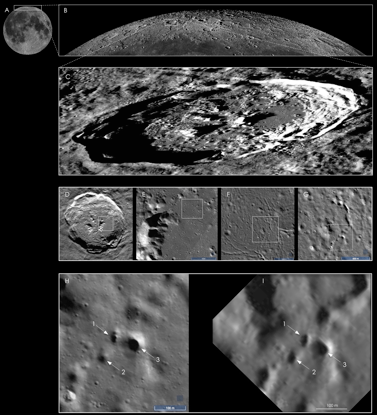
Series of images showing the location of some of the newly discovered lava tube skylight candidates at Philolaus Crater near the North Pole of the Moon (NASA/LunarReconnaissanceOrbiter/SETI Institute/Mars Institute/PascalLee).
Entrance to an underground network of lava tubes on the Moon may have been found – perhaps an underground “watering hole” rife with ice for future explorers.
Using NASA’s Lunar Reconnaissance Orbiter (LRO), the discovery of small pits in a large crater near the Moon’s North Pole could indicate pathways to a subsurface system of lava tubes. The finding was announced by the SETI Institute and the Mars Institute.
Impact crater
Location of the pits is cross-haired on the northeastern floor of Philolaus Crater, a large, 43 mile (70 kilometer)-diameter impact crater.
“The highest resolution images available for Philolaus Crater do not allow the pits to be identified as lava tube skylights with 100 percent certainty, but we are looking at good candidates considering simultaneously their size, shape, lighting conditions and geologic setting” says Pascal Lee, planetary scientist at the SETI Institute and the Mars Institute who made the new finding at NASA’s Ames Research Center in Silicon Valley.
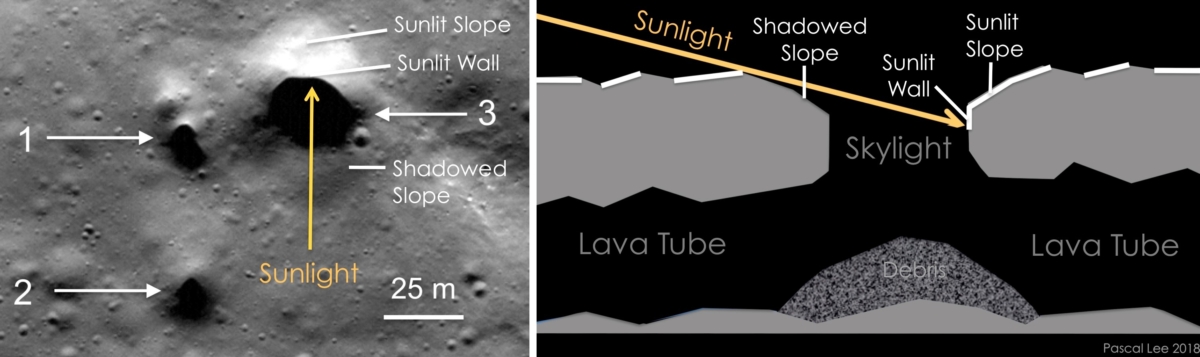
In the polar regions of the Moon, the grazing sunlight would never illuminate the interiors of skylights, making them difficult to identify with 100% certainty. Underlying lava tubes would experience perpetual darkness and extreme cold. Credit: NASA LRO/SETI Institute/Mars Institute/Pascal Lee
Subsurface ice
If water ice is present, these potential lava tube entrances or “skylights” might allow future explorers easier access to subsurface ice, and therefore water, than if they had to excavate the gritty ice-rich “regolith” (surface rubble) at the actual lunar poles, Lee points out.
Lee announced the discovery of the candidate lava tube skylights in Philolaus Crater last week at NASA’s Lunar Science for Landed Missions Workshop convened by the Solar System Exploration Research Virtual Institute (SSERVI) at Ames.
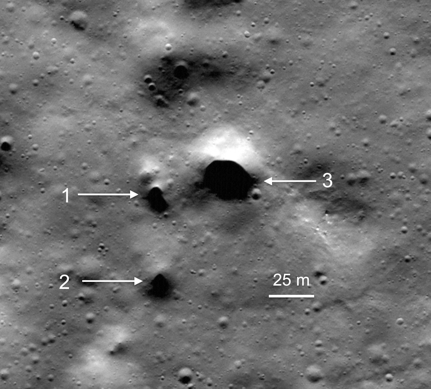
One of the highest resolution NASA Lunar Reconnaissance Orbiter images showing some of the newly discovered lava tube skylight candidates at Philolaus Crater near the North Pole of the Moon (NASA/Lunar Reconnaissance Orbiter/SETI Institute/Mars Institute/Pascal Lee).
Access, extraction, utilizati
The announcement represents the first published report of possible lava tube skylights in the Moon’s polar regions. Over 200 pits had been found elsewhere on the Moon by other researchers, with many identified as likely skylights leading to underground lava tubes along sections of winding channels, known on the Moon as “sinuous rilles.”
Particularly important for future human explorers is the prospect of easier access, extraction and then utilization of lunar polar ice.
First of all, skylights and lava tubes could provide more direct access to the very cold polar underground, alleviating the need to excavate vast amounts of lunar regolith.
Secondly, if ice is present inside the lava tubes – which is not yet known – it could be in the form of massive ice formations as often occur in cold lava tubes on Earth – instead of mixed-in within lunar grit.
Lastly, solar power would be available nearby, just outside each skylight.
BTW: NASA’s Gravity Recovery and Interior Laboratory (GRAIL) mission ended on December 17, 2012 with the two spacecraft GRAIL A (Ebb) and GRAIL B (Flow) impacting the Moon. Both impact sites lie on the southern slope of an unnamed massif (mountain) that lies south of the crater Mouchez and northeast of the Philolaus Crater.
Caving astronauts
Being on the Moon’s near side, Philolaus Crater affords direct communications with the Earth.
“We would also have a beautiful view of Earth. The Apollo landing sites were all near the Moon’s equator, such that the Earth was almost directly overhead for the astronauts. But from the Philolaus skylights, Earth would loom just over the crater’s mountainous rim, near the horizon to the southeast” adds Lee in a press statement.
“This is an exciting possibility that a new generation of caving astronauts or robotic spelunkers could help address” Lee notes. “Exploring lava tubes on the Moon will also prepare us for the exploration of lava tubes on Mars. There, we will face the prospect of expanding our search for life into the deeper underground of Mars where we might find environments that are warmer, wetter, and more sheltered than at the surface.”
Go to these informative videos:
Philolaus Traverse
Polar Caves on the Moon? – Pascal Lee
 Posted in Space News

