 By
By  August 4th, 2017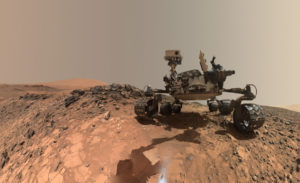
Curiosity Mars rover: On the prowl for science since August 2012.
Credit: NASA/JPL
Two NASA Mars rovers are on the upswing to start operations after a solar conjunction stand-down.
Now in Sol 1776, NASA’s Curiosity Mars rover is “easing back into mission planning” reports Ken Herkenhoff, a planetary geologist at the USGS in Flagstaff, Arizona.
“As the solar conjunction stand-down comes to an end, we are easing back into operations planning, focusing on Sol 1780, which will be planned in detail on Monday,” explains Herkenhoff.
Drill diagnostics continues
“The focus of the Sol 1780 plan will be more diagnostic testing of the drill and our last opportunity to examine the current arm workspace using the remote sensing instruments,” Herkenhoff adds.
This coming Tuesday will be a “soliday,” with no tactical planning.
A Wednesday (Sol 1781) plan for the Mars report was changed to move a drive of Curiosity earlier, allowing return of more data needed for Thursday (Sol 1782) planning.
“This required deleting the remote science block from the Sol 1781 plan, but a touch-and-go is still planned,” Herkenhoff notes. “We received the data we need to plan contact science and discussed potential targets. So we got a good head start on Sol 1780 planning, and look forward to returning to tactical operations next week!”
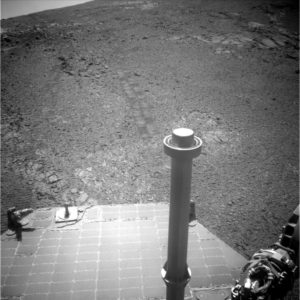
Opportunity Navigation Camera Sol 4793.
Credit: NASA/JPL
Opportunity operations
Meanwhile, also gunning up for more science duty is NASA’s Opportunity rover. It too is back in operation.
“We are at the top of Perseverance Valley, finishing up some stereo and color imaging,” explains Ray Arvidson of Washington University in Saint Louis. He is deputy principal investigator of the rover mission.
Opportunity is on tap to carry out Microscopic Imager (MI) and Alpha Particle X-Ray Spectrometer (APXS) work for the cobble called Parral, and likely will start driving down the valley on Monday’s plan, Arvidson told Inside Outer Space.
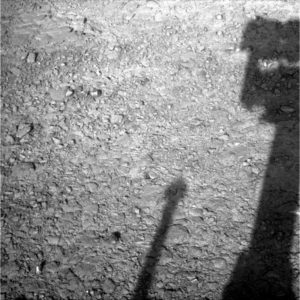
Panoramic Camera Sol 4792.
Credit: NASA/JPL
Arvidson said Opportunity faces minimum insolation on October 31st “so we are in the winter campaign.”
Ahead for the veteran Mars robot is to do roughly a 65 foot (20 meter) drive “down the valley from north facing slope to north facing slope (lily pads), stopping to do stereo and color imaging, and acquiring MI and APXS data for targets of interest,” Arvidson concludes.
 Posted in Space News

