 By
By  June 12th, 2017
Apollo 15 image captures landing locale of China’s Chang’e-5 Moon lander – the Mons Rümker region in the northern part of Oceanus Procellarum.
Credit: NASA
China space officials made use of last week’s Global Space Exploration Conference (GLEX) 2017 meeting in Beijing to provide details of the country’s Moon exploration plans.
Upcoming is the late November liftoff of the Chang’e-5 Moon return sample lander, slated to plunk down within the Mons Rümker region of Oceanus Procellarum. Mons Rümker features a cluster of volcanic domes.
New details of China’s Chang’e-4 far side lander to be launched in 2018 were also provided.
Credit: IAF
Scientific response
Reactions of U.S. scientists regarding China’s pinpointing of a Chang’e-5 lunar site:
“It’s a great target for a sample return mission as we have no Apollo samples from mare less than roughly 3.0 billion years old. I believe the youngest are from the Apollo 12 site,” said Mark Robinson, a leading lunar expert at Arizona State University in Tempe. He is also the principal investigator of the Lunar Reconnaissance Orbiter Camera system now circling the Moon.
“Hopefully, those young mare are their target,” Robinson told Inside Outer Space. Returning samples from that area would be “a super important science return,” he said, “important for understanding the lunar volcanism over time and calibrating model ages from crater counts for the Moon, Mercury Mars, Venus etc…”
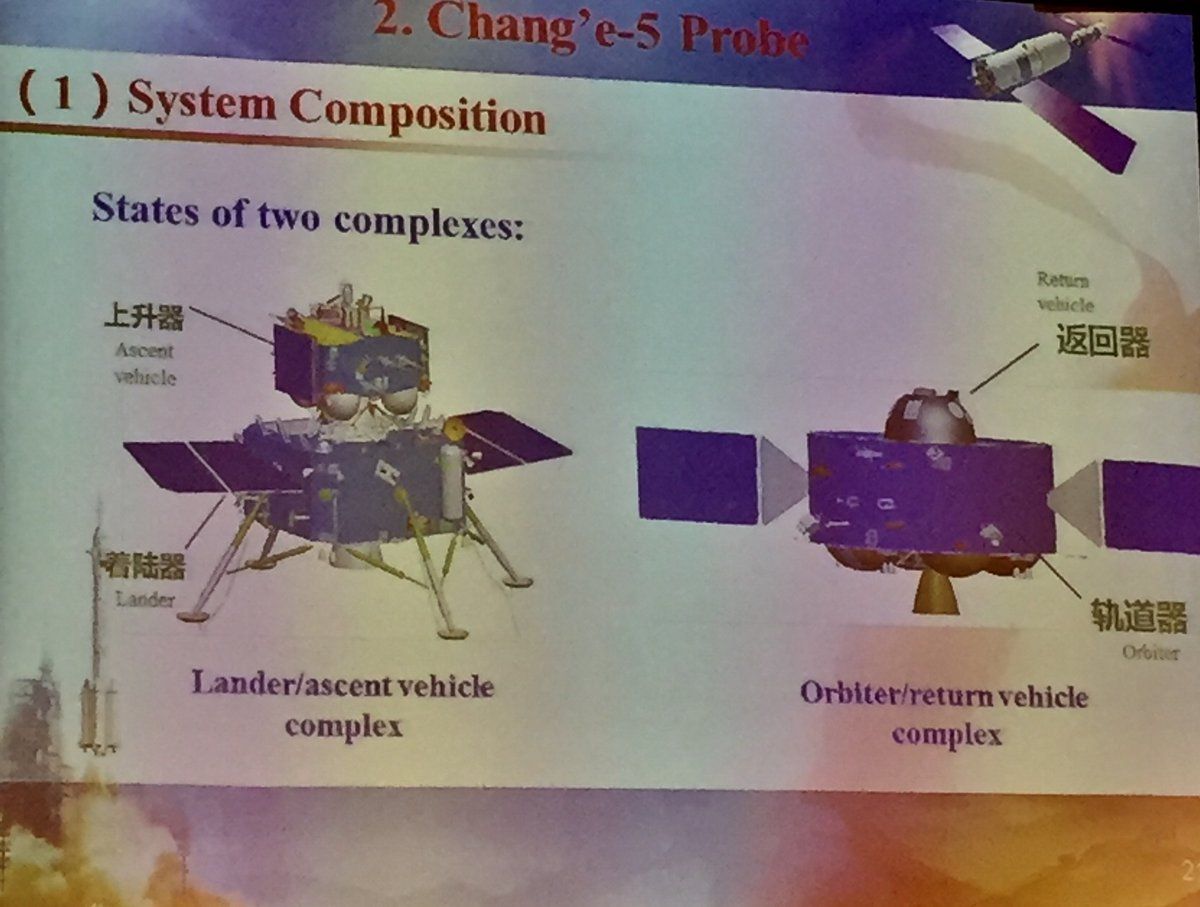
Screen image taken during briefing on China’s Chang’e-5 Moon sample mission.
Credit: Chris Welch
Global community
According to James Head of Brown University’s Department of Earth, Environmental and Planetary Sciences in Providence, Rhode Island: “The distinctive aspects of the Rümker Hills is that it is characterized by mare domes, thought to be the small shield volcanoes that are likely to be the source vents of older lavas, in contrast to the surface lava flows sampled by the Apollo missions and the Soviet Union’s Luna 16 and 24.”
Head advised that the samples to be returned by Chang’e 5 will be of “very significant interest” to the global scientific community. They would serve to provide new perspectives and new insights into the nature of lunar volcanism and the history of the Moon, he said.
Political issue
But if China is successful in hauling back the goods from Mons Rümker there is a political catch-22 for American scientists.
“Mons Rümker is well chosen in terms of understanding the thermal history of the Moon. Young lunar volcanism is important to study so yes…it is exciting but disappointing that the U.S. lunar community can’t directly participate in the study of the returned samples,” said Moon researcher Clive Neal at the University of Notre Dame in Indiana.
NASA won’t provide funds for U.S. scientists to collaborate directly with Chinese scientists because it is illegal so to do, Neal said. “If we want to work on the samples we have to travel to China…they won’t be shipped out for study.”
Logical fashion
In Neal’s view, China is building space capability in a logical fashion. “I am confident they will have humans on the Moon in the next decade.
“Unlike the U.S.,” Neal added, “China has a long term plan to send humans beyond low Earth orbit with a series of capability milestones, not timelines. They are serious about long term human space travel.”
The GLEX 2017 also included updates on the Chang’e-4 mission to the Moon’s far side.

The lunar far side as imaged by NASA’s Lunar Reconnaissance Orbiter using its LROC Wide Angle Camera.
Credit: NASA/Goddard/Arizona State University
Far side science
According to Liu Jizhong, director of Lunar Exploration and Space Engineering Center of Chinese Society of Astronautics, “we will begin in the third quarter of this year building the protocol of the probe proper and its flight mission is scheduled for next year.”
Germany, the Netherlands, Sweden and Saudi Arabia, Liu said, will send scientific detectors to the Moon’s far side courtesy of China’s Chang’e-4.
The Chang’e-4 lunar probe was designed to be a platform for international cooperation.
“There are more than 20 cooperation suggestions from over ten countries. And after comprehensive studies and selections, we confirmed four countries Germany, the Netherlands, Sweden and Saudi Arabia to participate in the task,” Liu said at GLEX 2017.
 Posted in Space News

