 By
By  May 8th, 2017

An ordinary construction brick, left, and an experimental brick made of a protein/lunar regolith mixture. |
Credit: Mia Allende
NASA and civil engineers at Stanford University have teamed up to explore use of a form of concrete to fabricate structures on the Moon and Mars.
David Loftus at NASA’s Ames Research Center reached out to Michael Lepech, an associate professor of civil and environmental engineering at Stanford School of Engineering. Lepech has been working on increasing environmental sustainability in construction, including ways to reduce the energy used in making concrete.
The researchers have used animal protein to make a promising form of concrete.
According to a Stanford press release, in search of a less energy-intensive alternative to make concrete, Loftus and Lepech turned to biology.
Slaughterhouses
Living organisms use proteins to make things as tough as shells, bones and teeth, so the researchers began working on a concrete bound together with a protein from bovine blood. The protein is a fairly cheap by-product of slaughterhouses, and it is known to become very gluey when mixed with soil.
To replicate the conditions on Mars and the Moon, Lepech combined the protein with simulated extraterrestrial soils that are similar to what’s on Mars and the Moon. And because Mars has much lower gravity than Earth – bad for cement mixing – the researchers applied a vacuum technology used to make composite materials in products such as boat hulls.
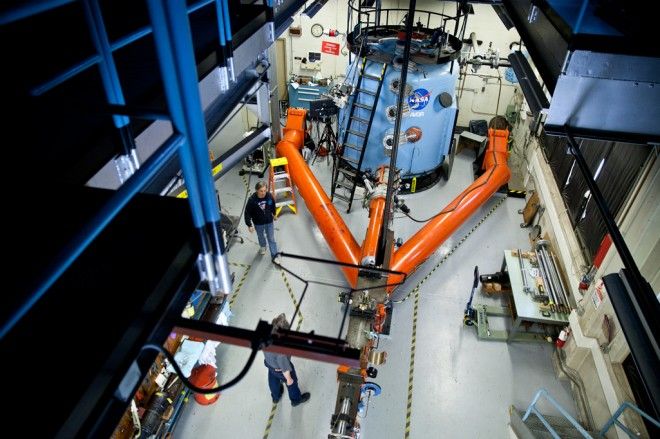
NASA Ames Vertical Gun Range.
Credit: NASA
Recycled organic waste
The first batch was as strong as the concrete used for sidewalks and patios – a good start. It also held up well to a simulated bombardment of micrometeorites, which the researchers replicated by taking the material to the Ames Vertical Gun Range and blasting it with high-speed gas particles.
For the purposes of making concrete off Earth, the idea is to create biological “factories” of organisms that are genetically engineered to produce the protein binder. It’s the same way that biotech companies use genetically engineered bacteria to make synthetic hormones. The feedstock for those organisms would come from the settlement’s recycled organic waste.
Lepech says that bio-concrete isn’t yet ready for buildings and roads on Earth – but that it could be.
 Posted in Space News

