 By
By  May 7th, 2017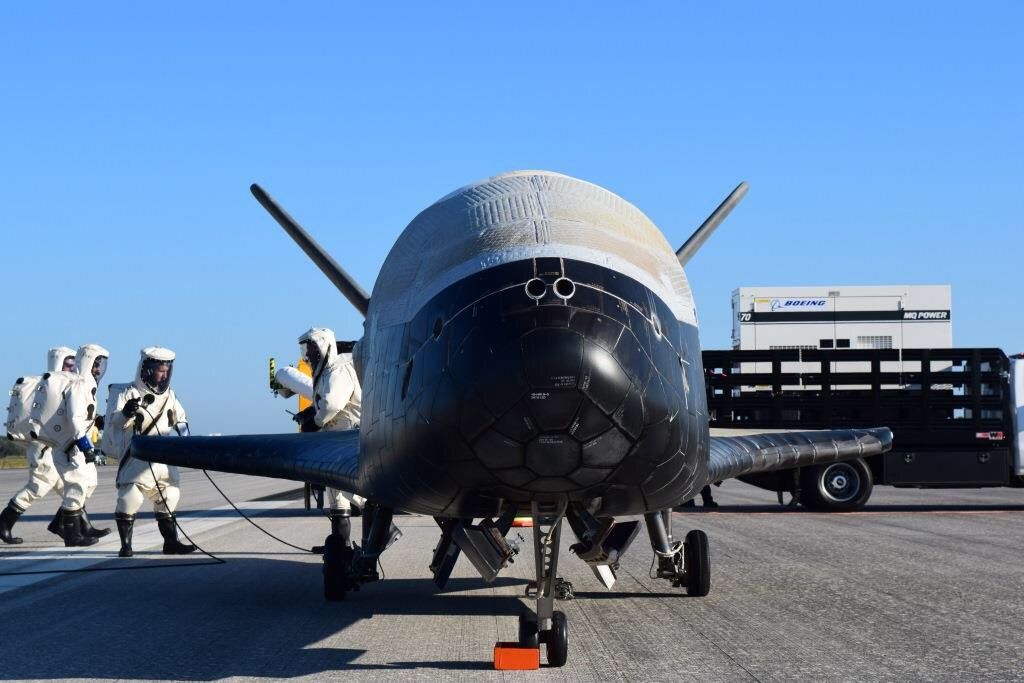
Credit: USAF
The record-setting, hush-hush mission by the U.S. Air Force’s X-37B space plane returned to Earth this morning, touching down for the first time at the Kennedy Space Center (KSC).
Launched from Florida atop an Atlas booster on May 20, 2015, the OTV-4 (Orbital Test Vehicle-4) has performed the program’s longest duration flight.
The Air Force is preparing to launch the fifth X-37B mission from Cape Canaveral Air Force Station later in 2017, according to the Air Force statement released this morning.
The OTV-4 conducted on-orbit experiments for 718 days during its mission, extending the total number of days spent on-orbit for the OTV program to 2,085 days.
The robotic mini-space plane is one of two reusable X-37B vehicles that constitute the space plane “fleet.” The just-ended OTV-4 space trek is the second flight of the second X-37B vehicle built for the Air Force by Boeing.
Credit: USAF
Safe and successful
“Today marks an incredibly exciting day for the 45th Space Wing as we continue to break barriers,” said Brig. Gen. Wayne Monteith, 45th Space Wing commander. “Our team has been preparing for this event for several years, and I am extremely proud to see our hard work and dedication culminate in today’s safe and successful landing of the X-37B,” Monteith said in an Air Force press statement.
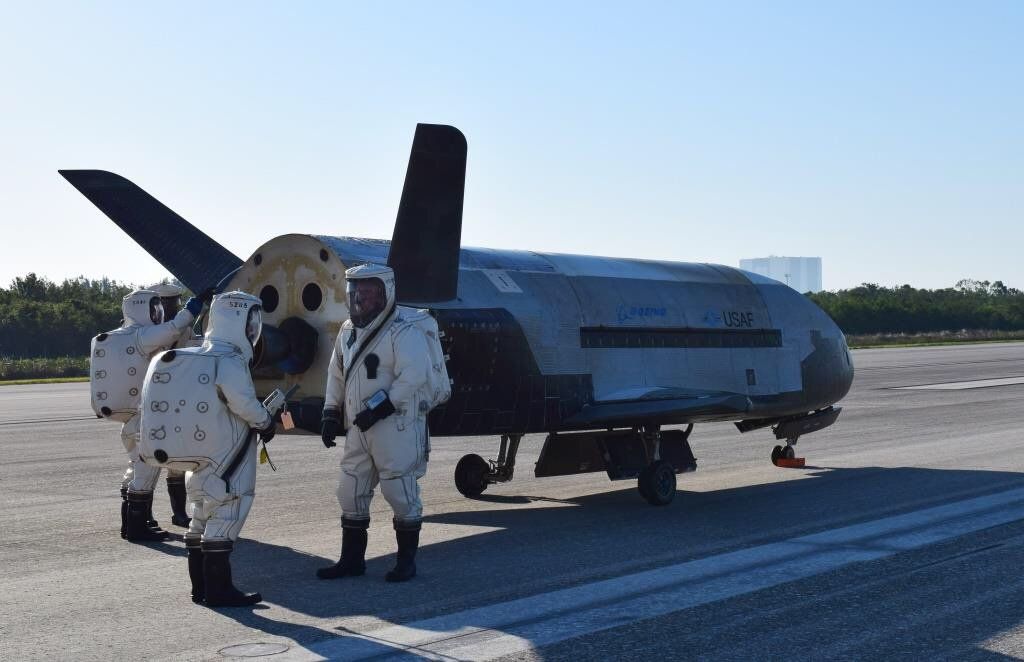
Appearing like a miniature version of NASA’s now-retired space shuttle orbiter, the reusable military space plane is 29 feet (8.8 meters) long and 9.6 feet (2.9 meters) tall, and has a wingspan of nearly 15 feet (4.6 meters).
The space drone has a payload bay about the size of a pickup truck bed that can be outfitted with a robotic arm. It has a launch weight of 11,000 pounds (4,990 kilograms) and is powered on orbit gallium arsenide solar cells with lithium-ion batteries.

The X-37B Orbital Test Vehicle mission 4 (OTV-4), the Air Force’s unmanned, reusable space plane, landed at NASA’s Kennedy Space Center Shuttle Landing Facility May 7, 2017.
Credit: USAF
Tight-lipped affair
A third mission of the Boeing-built X-37B Orbital Test Vehicle was completed on Oct. 17, 2014, when it landed and was recovered at Vandenberg Air Force Base in California following a successful 674-day space mission.
OTV-4 has shattered that previous long-duration flight achievement.
What this “winged warrior” did high above Earth is an on-going, tight-lipped affair. But for this mission, some payloads onboard the OTV-4 craft were previously identified.
For example, Aerojet Rocketdyne has said that its XR-5A Hall Thruster had completed initial on-orbit validation testing onboard the X-37B space plane. Also onboard was a NASA advanced materials investigation.
Track record
The first OTV mission began April 22, 2010, and concluded on Dec. 3, 2010, after 224 days in orbit.
The second OTV mission began March 5, 2011, and concluded on June 16, 2012, after 468 days on orbit.
An OTV-3 mission chalked up nearly 675 days in orbit when it landed Oct. 17, 2014.
KSC landing
Previously, all the OTV craft to date guided their way on auto-pilot to a Vandenberg Air Force Base, California tarmac-touchdown.
That has changed with the OTV-4 mission touchdown at KSC. Work has long been underway to consolidate X-37B space plane operations, including use of NASA’s Kennedy Space Center in Florida as a landing site for the robotic space plane.
A former KSC space-shuttle facility known as Orbiter Processing Facility (OPF-1) was converted into a structure that enables the Air Force “to efficiently land, recover, refurbish and relaunch the X-37B Orbital Test Vehicle (OTV),” according to Boeing.
The X-37B vehicle development falls under the Boeing Space and Intelligence Systems in El Segundo, California, the firm’s center for all space and experimental systems and government and commercial satellites.
The Air Force Rapid Capabilities Office is leading the Department of Defense’s OTV initiative, by direction of the Under Secretary of Defense for Acquisition, Technology and Logistics and the Secretary of the Air Force.
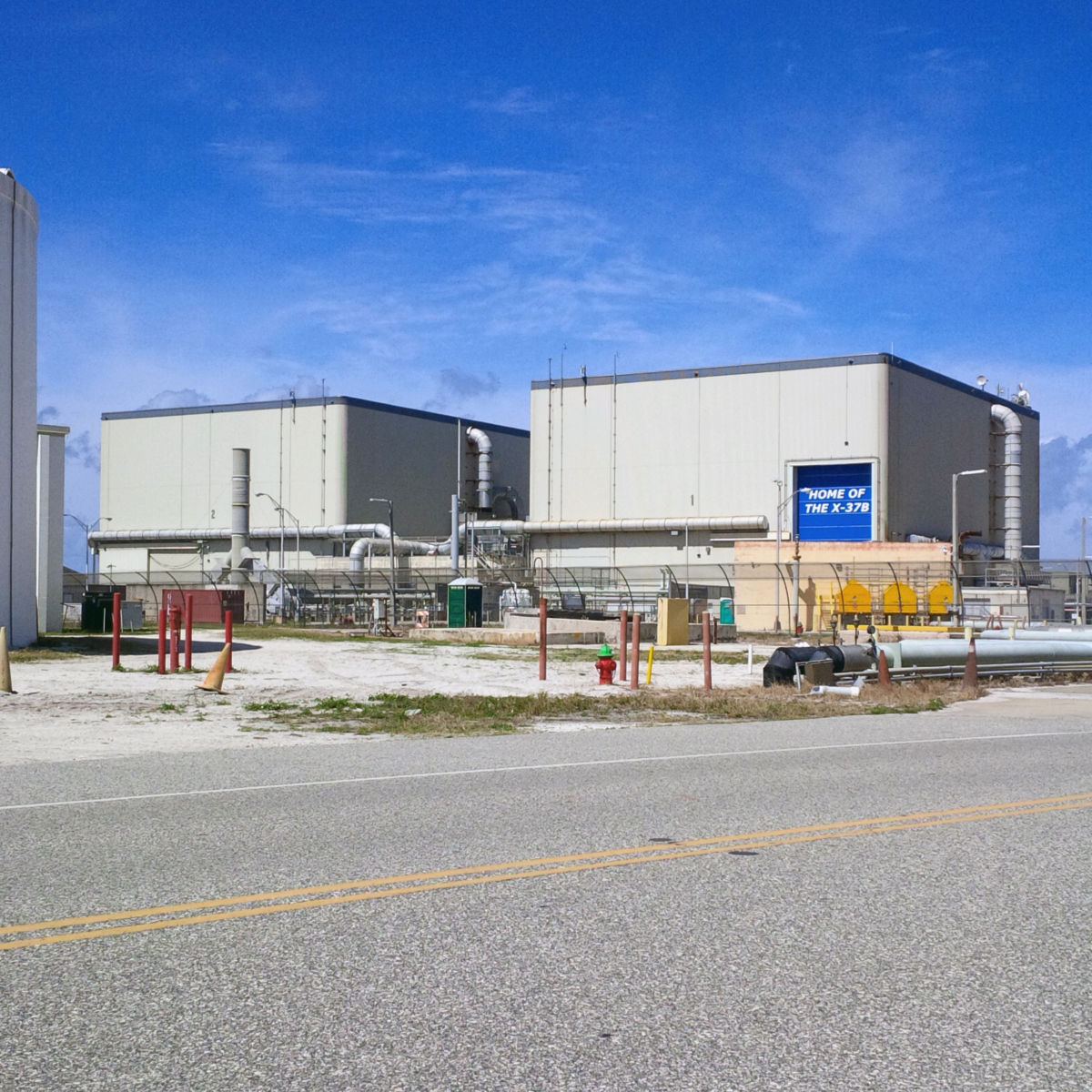
Former shuttle processing area at the Kennedy Space Center has been overhauled by Boeing to prep the military’s secretive X-37B space plane.
Credit: Malcolm Glenn
Pleased with performance
“The landing of OTV-4 marks another success for the X-37B program and the nation,” said Lt. Col. Ron Fehlen, X-37B program manager.
“This mission once again set an on-orbit endurance record and marks the vehicle’s first landing in the state of Florida. We are incredibly pleased with the performance of the space vehicle and are excited about the data gathered to support the scientific and space communities. We are extremely proud of the dedication and hard work by the entire team,” Fehlen said in the Air Force press statement.
“The hard work of the X-37B OTV team and the 45th Space Wing successfully demonstrated the flexibility and resolve necessary to continue the nation’s advancement in space,” said Randy Walden, Director of the Air Force Rapid Capabilities Office.

A previous X-37B being readied for launch atop Atlas booster. Next mission — OTV-5 — is set to fly by close of 2017.
Credit: Boeing
“The ability to land, refurbish, and launch from the same location further enhances the OTV’s ability to rapidly integrate and qualify new space technologies,” Walden said.
Check out this landing view from the Secretary of the Air Force, at:
https://www.dvidshub.net/video/523061/x37b-otv4-landing-runway
Also, go to:
https://www.dvidshub.net/video/523059/x37b-otv4-landing-profile
 Posted in Space News

