 By
By  April 13th, 2017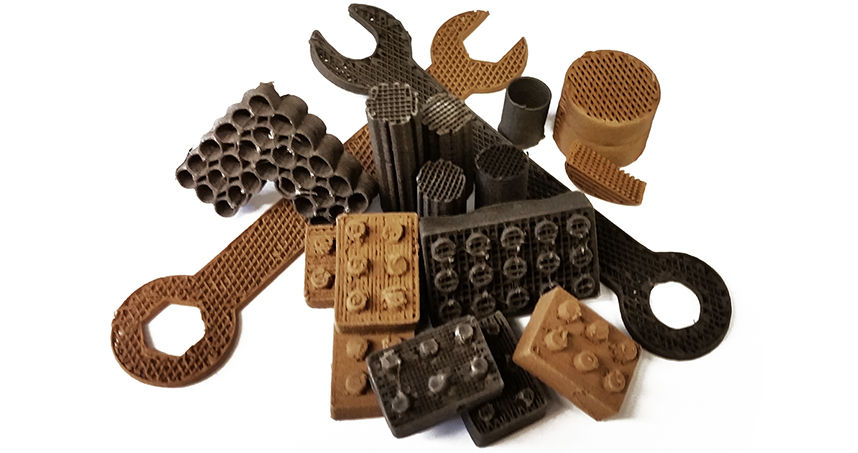
Tools and building blocks made by 3D printing using Moon and Mars simulant.
Credit: Northwestern University
New research demonstrates the ability to use Moon and Mars stimulants to produce 3D-print structures. That ability presents an easy, highly scalable, sustainable manufacturing method for lunar and Red Planet travelers.
3-D printing allows off-planet settlers the wherewithal to make everything from small tools to large buildings using surrounding extraterrestrial resources.
Northwestern Engineering’s Ramille Shah and her Tissue Engineering and Additive Manufacturing (TEAM) Laboratory have demonstrated the ability to 3D-print structures with simulants of Martian and lunar dust.
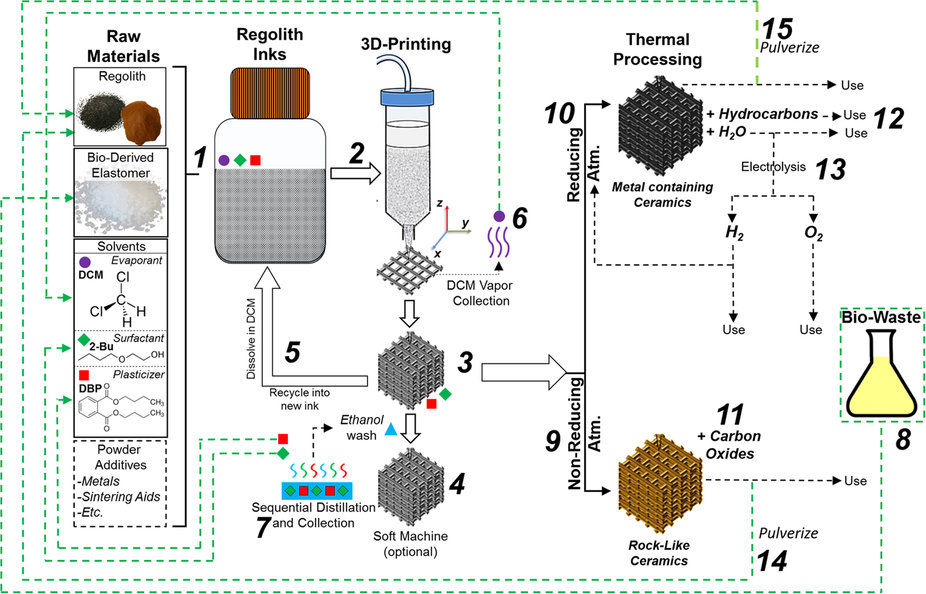
Credit: Northwestern Engineering/Tissue Engineering and Additive Manufacturing (TEAM) Laboratory
3D-painting
This research draws from earlier work of a “3D-painting process,” a term that Shah and her team use for their novel 3D inks and printing method, utilized to print hyperelastic “bone” as well as 3D grapheme, carbon nanotubes, metals and alloys.
“For places like other planets and moons, where resources are limited, people would need to use what is available on that planet in order to live,” said Shah, assistant professor of materials science and engineering at Northwestern’s McCormick School of Engineering and of surgery in the Feinberg School of Medicine.
“Our 3D paints really open up the ability to print different functional or structural objects to make habitats beyond Earth,” Shah added in a press statement.
Stimulating simulant
The innovative research makes use of NASA-approved lunar and Martian dust stimulants. Those materials mimic in particle shape, and size the dusts found on the Moon and at Mars.
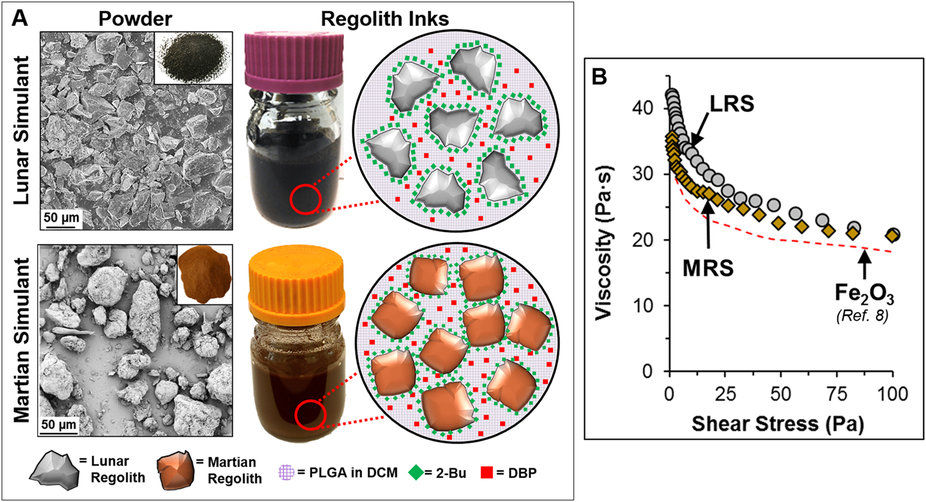
Credit: Northwestern Engineering/Tissue Engineering and Additive Manufacturing (TEAM) Laboratory
Shah’s team created the lunar and Martian 3D paints using the respective dusts, a series of simple solvents, and biopolymer, then 3D printed them with a simple extrusion process. The resulting structures are over 90 percent dust by weight, according to the research team.
The resulting 3D-painted material is flexible, elastic, and tough — similar to rubber.
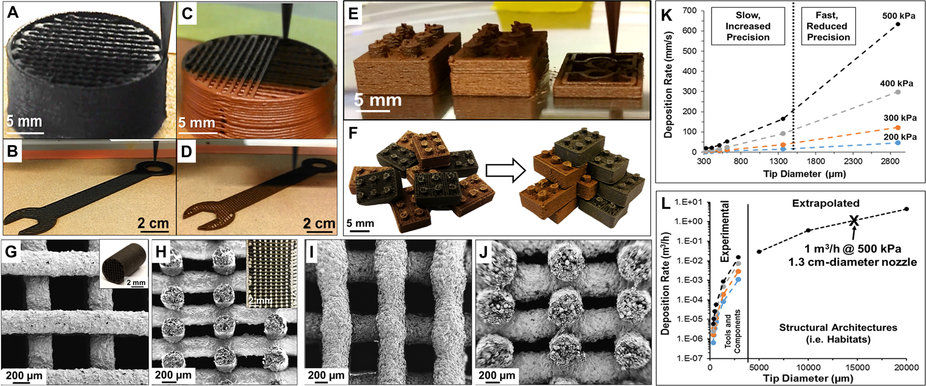
Credit: Northwestern Engineering/Tissue Engineering and Additive Manufacturing (TEAM) Laboratory
Roll me, fold me, shape me
This is the first example of rubber-like or soft materials resulting from lunar and Martian simulant materials. The material can be cut, rolled, folded, and otherwise shaped after being 3D painted, if desired. In addition, Shah said that Lego-like interlocking bricks can be made by the process.
Partially supported by a gift from Google and performed at Northwestern’s Simpson Querrey Institute, the research was recently published in Nature Scientific Reports.
For that scientific research paper – “Robust and Elastic Lunar and Martian Structures from 3D-Printed Regolith Inks” – go to:
 Posted in Space News

