 By
By  November 9th, 2020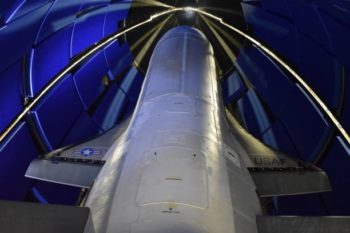
Pre-launch photo shows X-37B ready for 6th mission of the space plane program.
Credit: Boeing
A secretive military X-37B space plane has flown over 175 days in Earth orbit and is now under the wing of a newly established U.S. Space Force unit called Delta 9.
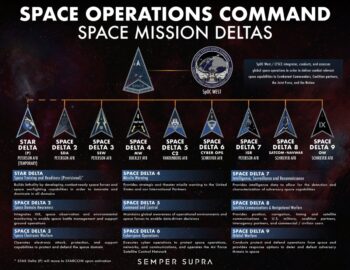
Delta 9, a component of the U.S. Space Force, was established and activated July 24, 2020.
Credit: U.S. Space Force
“Delta 9 Detachment 1 oversees operations of the X-37B Orbital Test Vehicle, an experimental program designed to demonstrate technologies for a reliable, reusable, unmanned space test platform for the U.S. Space Force,” according to a fact sheet issued by Schriever Air Force Base in Colorado. Delta 9 consists of three active duty squadrons headquartered at Schriever.
“The mission of Delta 9 is to prepare, present, and project assigned and attached forces for the purpose of conducting protect and defend operations and providing national decision authorities with response options to deter and, when necessary, defeat orbital threats,” the fact sheet explains. “Additionally, Delta 9 supports Space Domain Awareness by conducting space-based battlespace characterization operations and also conducts on-orbit experimentation and technology demonstrations for the U.S. Space Force.”

Credit: Boeing/Inside Outer Space Screengrab
The Drive’s “The War Zone” website first reported X-37B’s new home.
Milestone-setting space plane
Here’s a roster of X-37B missions, also labeled as Orbital Test Vehicles (OTVs):
OTV-1 launched on April 22, 2010 and landed on December 3, 2010, spending over 224 days on orbit.
OTV-2 launched on March 5, 2011 and landed on June 16, 2012, spending over 468 days on orbit.

Credit: Boeing/Watch U.S. Fly
OTV-3 launched on December 11, 2012 and landed on October 17, 2014, spending over 674 days on-orbit.
OTV-4 launched on May 20, 2015 and landed on May 7, 2015, spending nearly 718 days on-orbit.
OTV-5 launched on September 7, 2017 and landed on October 27, 2019, spending nearly 780 days on-orbit.
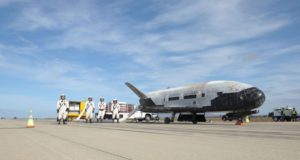
Technicians tend Air Force X-37B space plane after tarmac touchdown.
Credit: U.S. Air Force
Launchers and landings
The first four missions launched from Cape Canaveral Air Force Station, Florida atop an Atlas V booster.
The fifth mission launched from Kennedy Space Center on a SpaceX Falcon 9 booster.
The now orbiting OTV-6, also called USSF-7 for the U.S. Space Force, was launched by an Atlas-V 501 booster.
OTV-1, OTV-2, and OTV-3 missions landed at Vandenberg Air Force Base, California, while the OTV-4 and OTV-5 missions landed at Kennedy Space Center, Florida.
Total time on orbit for all five previous missions adds up to 2,865 days – or 7 years and 10 months.

Naval Research Laboratory (NRL) has pioneered “sandwich” modules that are far more efficient for space solar power.
Credit: NRL/Jamie Hartman
Payloads
The currently flying OTV-6 mission was lofted on May 17, 2020 and is the first to use a service module to host experiments. The service module is an attachment to the aft of the vehicle that allows additional experimental payload capability to be carried to orbit.
One experiment onboard the space plane that was announced is from the U.S. Naval Research Laboratory (NRL), an investigation into transforming solar power into radio frequency microwave energy. The experiment itself is called the Photovoltaic Radio-frequency Antenna Module, PRAM for short.
Along with toting NRL’s PRAM into Earth orbit, the X-37B also deployed the FalconSat-8, a small satellite developed by the U.S. Air Force Academy and sponsored by the Air Force Research Laboratory to conduct several experiments on orbit.
The FalconSat-8 is an educational platform that will carry five experimental payloads for the United States Air Force Academy (USAFA) to operate.
In addition, two NASA experiments are also onboard to study the effects of the space environment on a materials sample plate and seeds used to grow food.
 Posted in Space News

