 By
By  October 11th, 2020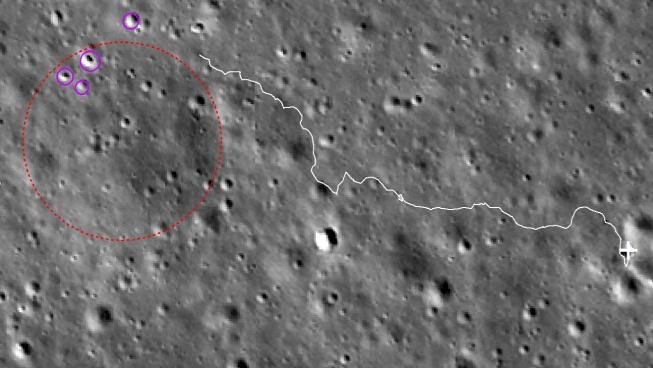
The purple circled area is the closest impact crater with brighter reflectivity, the red circle is the location of the rock block, and the white line is the planned driving path. Image source:
Credit: CCTV/Official Weibo of China Lunar Exploration Project
Sources with China’s Lunar Exploration and Space Program Center of the China National Space Administration state that the country’s Chang’e-4 farside mission has resumed work for the 23rd lunar day.

Chang’e-4 farside mission – lander and Yutu-2 rover
Credit: CNSA/CLEP
A lunar day is equal to 14 days on Earth, and a lunar night is of the same length. That calls for the farside hardware to move into dormant mode during the bitterly cold lunar night.

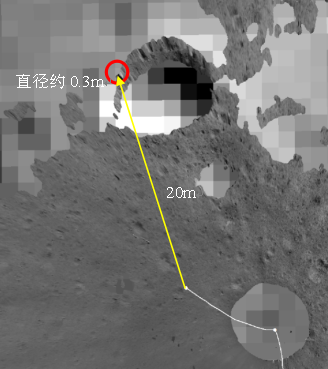
The location of the rock block to be detected.
Credit: CCTV/Official Weibo of China Lunar Exploration Project
The Chang’e-4 lander woke up at 11:56 a.m. Sunday, Beijing Time. The Yutu-2 rover, or Jade Rabbit-2, woke up at 6:57 p.m. Saturday.
Future duties
According to China’s Xinhua news agency, during the 23rd lunar day, Yutu-2 will move northwest toward a basalt area or impact craters with high reflectivity, both of which are located northwest of the current detection point of the rover.
Credit: CCTV/Official Weibo of China Lunar Exploration Project
The wheeled rover will also use an infrared imaging spectrometer onboard to carry out scientific scrutiny of a lunar rock, which has a diameter of roughly a foot across (30 centimeters), according to the center.

Chang’e-4’s farside landing zone.
Credit: NASA/GSFC/Arizona State University
In addition, near noon on the Moon, the plan for the Yutu-2 lunar rover is to carry out panoramic camera ring shooting, infrared imaging spectrometer and neutral atom detector investigations. Also, the rover-carried radar system will perform synchronous detection duties during the driving.
Touching down on the Moon on January 3, 2019, the Chang’e-4 mission has survived about 647 Earth days surveying the lunar landscape.
 Posted in Space News

