 By
By  March 8th, 2024
Taking out the trash. Multi-ton pallet tossed off years ago returns to Earth.
Image credit: NASA/Mike Hopkins
A nearly 3-ton leftover tossed overboard from the International Space Station is nearing its plunge toward Earth.
The multi-ton Exposed Pallet 9 (EP9) was jettisoned from the space station back in March 2021.
At the time, it was reported to be the most massive object ever tossed overboard from the International Space Station. Disposing of used or unnecessary equipment in such a way is common practice aboard the space station, as the objects typically burn up harmlessly in Earth’s atmosphere.

Image credit: Federal Office for Civil Protection and Disaster Relief, National Warning Center 1
Ahead of EP9’s reentry, the Federal Office for Civil Protection and Disaster Relief, National Warning Center 1 in Bonn, Germany issued this information:
“Luminous phenomena or the perception of a sonic boom are possible. According to current information, the probability of debris hitting Germany is considered to be very low. If the risk increases, you will receive new information.”
Design for demise
Over the years, work has been done on designing spacecraft that have less chance of leftovers reaching Earth – an engineering effort dubbed “design for demise.”
Regarding what types of materials survive an atmospheric re-entry, information from the German Aerospace Center (Deutsches Zentrum für Luft- und Raumfahrt (DLR) is instructive.
DLR experts note that so-called fiber-ceramic composite materials are significantly more heat-resistant over metal materials.
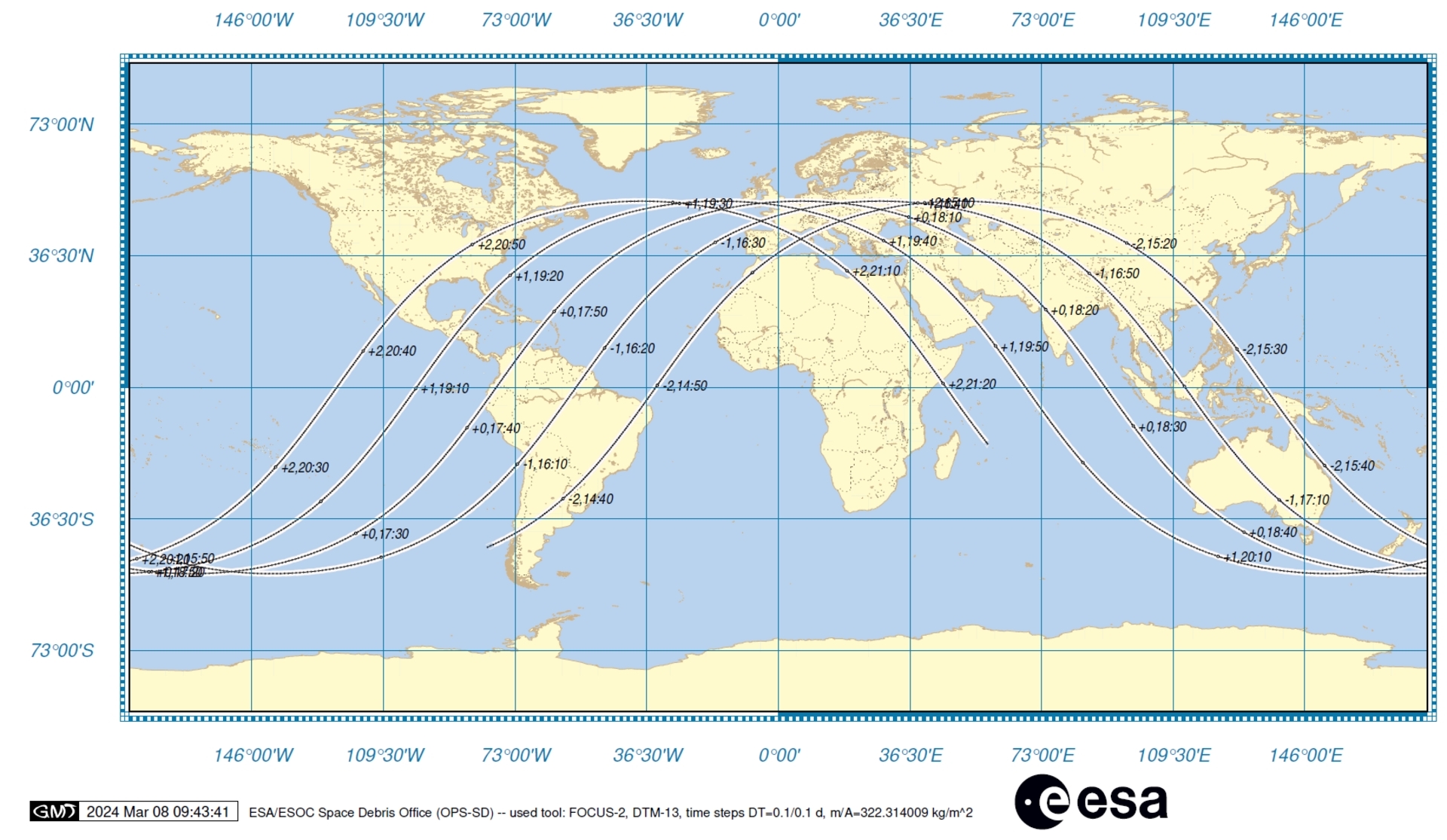
Chart shows ground track of a set of used Nickel-Hydrogen batteries jettisoned from the International Space Station in 2021. Chart indicates situation as of March 8, and forecasts a reentry between approximately 15:35 CET and 22:25 CET on Friday March 8. The reentry zone effectively stretches from -51.6deg south to 51.6deg north.
Image credit: ESA
Natural reentry
The European Space Agency (ESA) Space Debris and Independent Safety Offices are closely monitoring the reentry of the pallet of used ISS batteries.
The batteries, nine in total, will undergo “a natural reentry,” which is now predicted between approximately 15:35 CET and 22:25 CET on March 8.

Image credit: NASA
“The total mass of the batteries is estimated at 2.6 metric tonnes, most of which may burn up during the reentry,” the ESA statement adds. “While some parts may reach the ground, the casualty risk – the likelihood of a person being hit – is very low.”
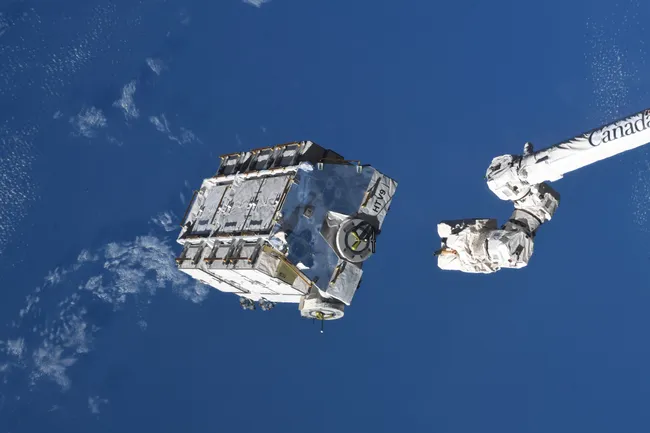
Catch and release. ISS robot arm is used for grabbing and letting lose space hardware.
Image credit: NASA
The reentry will occur between -51.6 degrees South and 51.6 degrees North.
ESA further notes that there are large uncertainties, primarily driven by fluctuating levels of atmospheric drag, that prevent more precise predictions.
“The closer we get to the expected reentry window, the better the concerned region can be geographically constrained,” ESA says, and also explains that a large space object reenters the atmosphere in a natural way approximately once per week. The majority of the associated fragments “burning up” before reaching the ground.
“Most spacecraft, launch vehicles and operational hardware are designed to limit the risks associated with a reentry,” ESA reports.

Image credit: The Aerospace Corporation/CORDS – Yellow Icon – location of object at midpoint of reentry window
Blue Line – ground track uncertainty prior to middle of the reentry window (ticks at 5-minute intervals)
Yellow Line – ground track uncertainty after middle of the reentry window (ticks at 5-minute intervals)
Pink Icon (if applicable) – vicinity of eyewitness sighting or recovered debris
Note: Possible reentry locations lie anywhere along the blue and yellow ground track. Areas not under the line are not exposed to the debris.
For more information, go to my Space.com update – “5,800 pounds of batteries tossed off the ISS in 2021 will fall to Earth today” – at:
 Posted in Space News

