 By
By  November 15th, 2025
Image credit: CCTV/CMSA/Inside Outer Space screengrab
China’s Shenzhou-20 crew arrived in Beijing on Saturday, fresh from their touch down at the Dongfeng landing site in north China’s Inner Mongolia Autonomous Region on Friday, November 14.
The space traveling threesome — Chen Dong, Chen Zhongrui and Wang Jie — landed back on Earth aboard the Shenzhou-21 spacecraft after spending 204 days in orbit.
China’s Xinhua news agency noted that the trio made “the first successful implementation of an alternative return procedure in the country’s space station program history.”
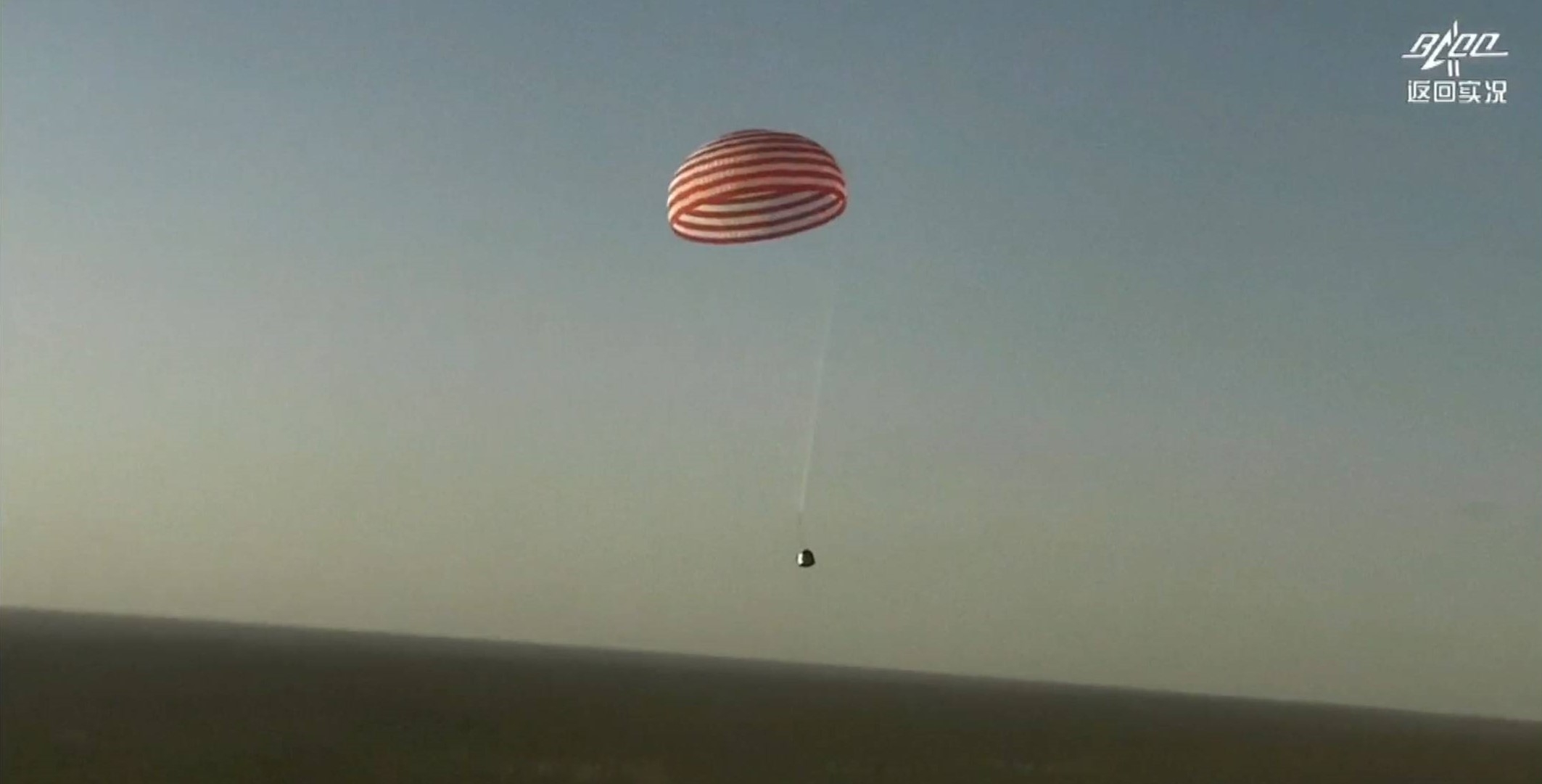
Image credit: CCTV/Inside Outer Space screengrab
Window damage
That alternative plan was put in place after the original return vessel, the Shenzhou-20 spacecraft, experienced a suspected impact in the return vessel’s window from space debris, reported the China Manned Space Agency (CMSA).
Tiny cracks were found in the Shenzhou-20 return capsule’s viewport window which are most probably caused by external impact from space debris, the CMSA added.
The agency said that the Shenzhou-22 spacecraft will be launched at an appropriate time in the future, also ferrying a fresh cargo batch to the station.
“The launch capacity is precious, so we make full use of it,” said Zhou Yaqiang, an expert from the CMSA. “This flight will bring the crew new food supplies as well as devices and equipment for the station.”
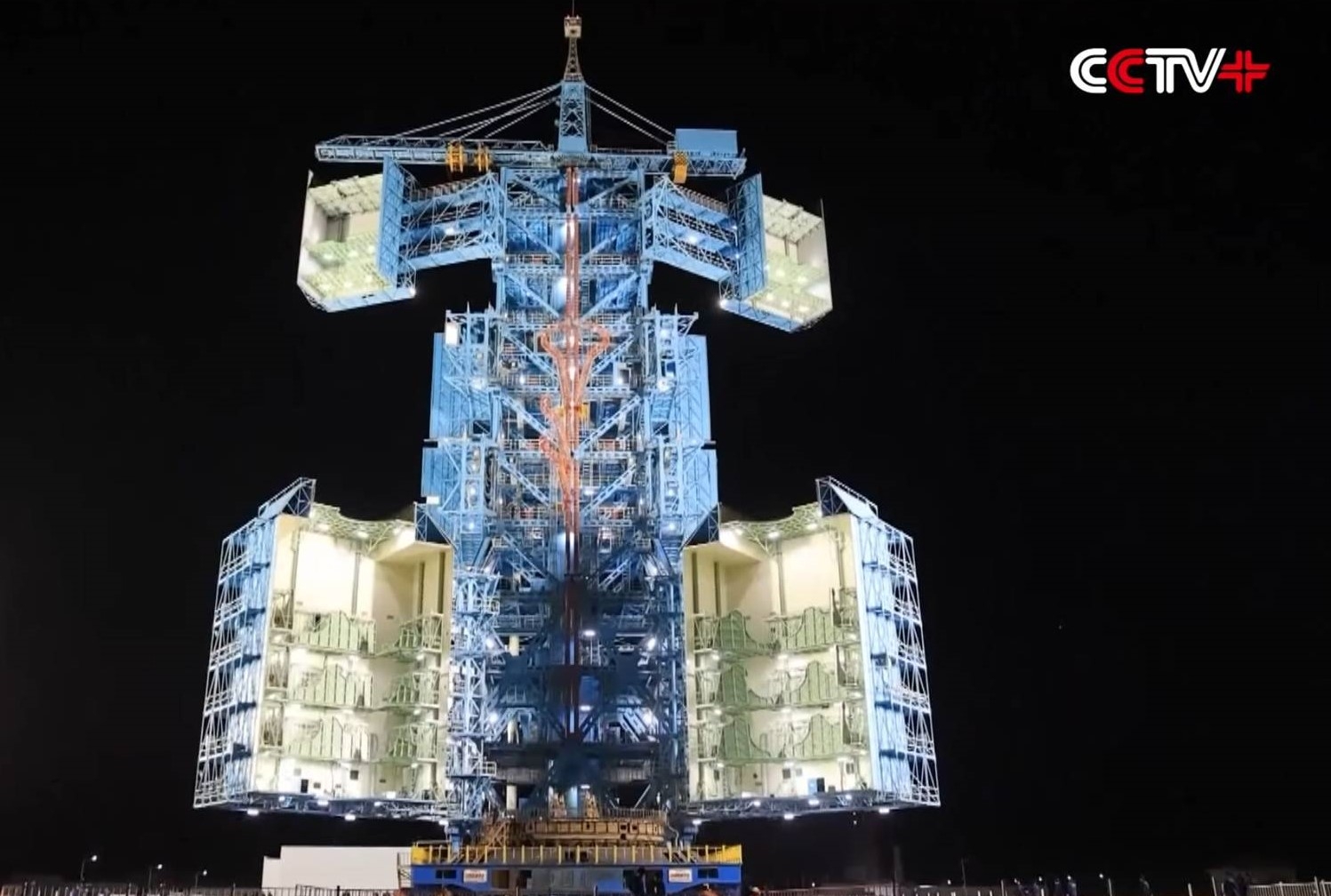
Work appears underway to launch a Shenzhou-22 spacecraft to replace the debris damaged Shenzhou-20 vessel.
Image credit: CCTV/Inside Outer Space screengrab
Experimental samples
Along with the crew whisked to Beijing from the landing zone, so too were a new batch of experimental samples flown aboard China’s Tiangong space station.
Medical experimental samples from the Shenzhou-20 mission, as well as the Tianzhou-9 cargo spacecraft which docked with Tiangong space station in July were transferred to scientists in Beijing.

Shenzhou-20 crew return to Beijing.
Image credit: CCTV/Inside Outer Space screengrab
The returned package contained 199 individual samples across seven categories: blood, urine, feces, saliva, throat swabs, microorganisms and cells, all of which will support the research and implementation of 19 space medical experiment projects designed for the space station.
Return of experiments
Samples from 26 scientific experiments carried out aboard China’s space station, totaled roughly 46.67 kilograms, according to Xinhua.
Upon landing, mice from a life science investigation underwent immediate field processing, according to the Technology and Engineering Center for Space Utilization (CSU) under the Chinese Academy of Sciences (CAS).
While these four mice were having their physiological data collected in space, another group of mice — serving as the control group — were housed in identical raising facilities in a laboratory on Earth.
“These samples allow us to deeply analyze the effects of weightlessness and spaceflight on humans from multiple dimensions and in a comprehensive manner by using integrated cutting-edge omics and other technologies,” said Li Yinghui, a researcher with the China Astronaut Research and Training Center.

Image credit: CCTV/Inside Outer Space screengrab
“On the other hand, we can analyze the brain homeostatic control, biological rhythms, and bone metabolic regulation, all of which are closely related to human health,” Li told China Central Television (CCTV.) “Meanwhile, we await new understanding and discoveries regarding heart failure and aging in people on Earth with the use of our newly established models.”
Other biological samples – such as zebrafish, hornwort, streptomyces, planarians and brain organoids — along with select materials science and combustion experiment samples, were transported to the CSU.
Lunar infrastructure experiment
Additionally, returned materials science samples — such as tungsten-hafnium alloys, soft magnetic materials and relaxor ferroelectric single crystals – are to be appraised, focused on how gravity influences material growth, composition segregation, solidification defects, and overall performance, while also revealing the in-service performance of materials under space conditions.
According to CCTV these results are anticipated to advance several applications: protective materials for high-performance solar cells, high-gain radiation-resistant optical fibers, and innovative material processing techniques for lunar infrastructure.

Image credit: CCTV/Inside Outer Space screengrab
International influence
Zhang Lu, a CSU researcher told CCTV: “China’s in-orbit experiments have been carried out continuously over the long term. Currently, the space laboratory has entered a very normal and fully productive operating state.”
Zhang added that the hope is, “through these experimental samples and subsequent ground-based research, we can further follow up and achieve more original scientific results with international influence.”
For CCTV-provided videos showcasing the Shenzhou-20 crew return to Beijing, as well as the handover of experiments returned to Earth, go to:
https://www.facebook.com/reel/4186492614945148
 Posted in Space News

