 By
By  January 28th, 2026
Artwork depicts Cluster satellite reentry.
Image credit: ESA/David Ducross
Reentering space clutter and its influence on Earth’s stratosphere continues to draw research attention.
“We’re really changing the composition of the stratosphere into a state that we’ve never seen before,” said John Dykema, an applied physicist at Harvard’s School of Engineering and Applied Sciences (SEAS), who warns that scientists today poorly understand many of the impacts.
Dykema is focused on research at the intersection of atmospheric chemistry and atmospheric radiation.
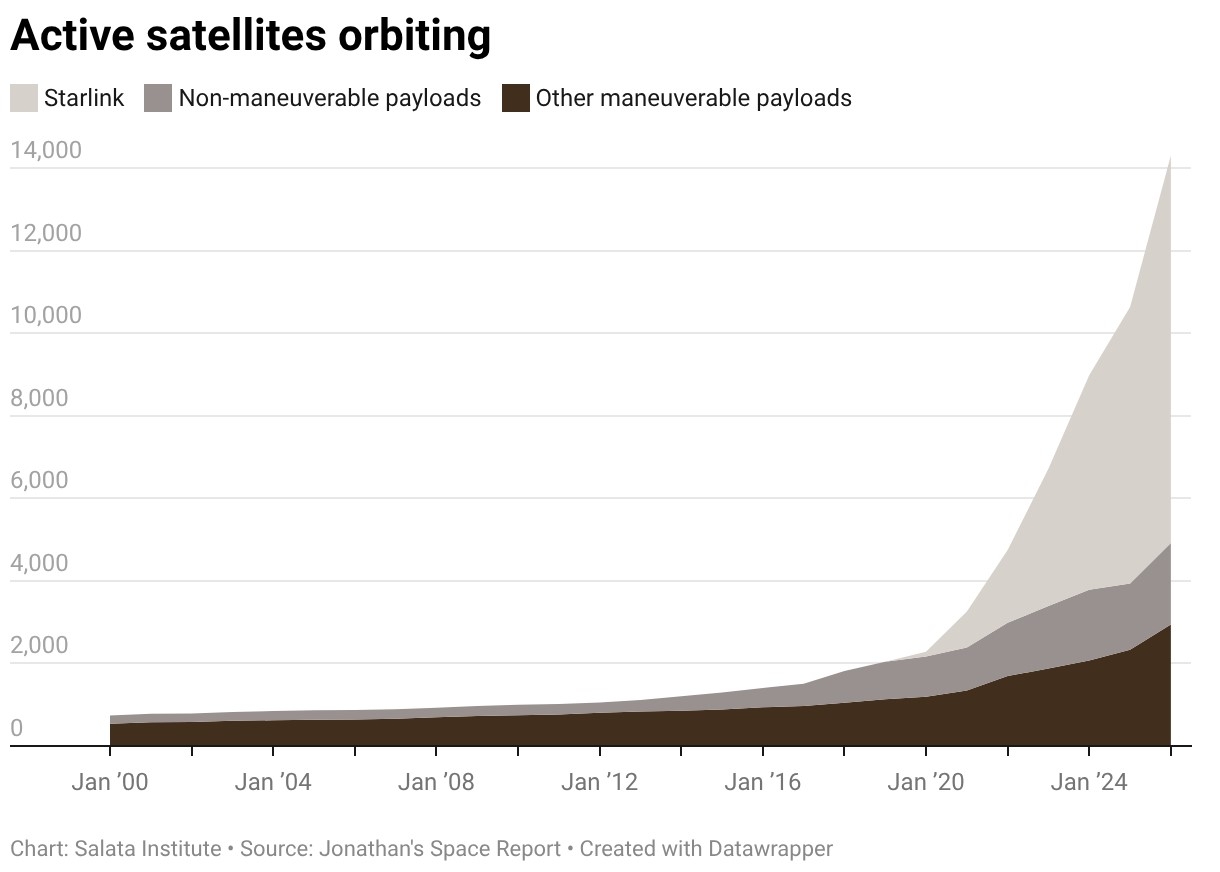
Image credit: Salata Institute; Source: Jonathan’s Space Report; image created with Datawrapper
Active satellites
There were 14,300 active satellites orbiting at the start of January.
Of active units today, over 9,200 belong to SpaceX, which in December filed a request with the Federal Communications Commission to launch another 15,000.
Amazon has plans for more than 3,000, while Amazon founder Jeff Bezos’s Blue Origin this month announced plans for a network of 5,408 more.
Similarly, China has also begun launching mega-constellations of spacecraft.
Dykema notes the fact that, because these satellites are relatively inexpensive and the technology is rapidly improving, many are scuttled after just five or 10 years: directed to reenter the atmosphere so they don’t litter space real estate above Earth.

Launch and reentry particle emissions in the Earth’s stratosphere.
Image credit: The Aerospace Corporation
Action/reaction
That reentry action means they release a mix of heavy metal and carbon particles that float down closer to Earth, into the otherwise chemically stable stratosphere and where ozone screens our planet.
What is becoming apparent, Dykema said in a January 27 Harvard Climate Blog posting, is that satellite reentry risks disrupting the global climate system and further depleting the ozone layer, which shields all living things from DNA-destroying ultraviolet radiation.
The high-speed of reentry ignites a satellite, organic materials onboard – such as plastics or carbon-fiber composites – releasing particles of black carbon, the same fine soot in wood or coal smoke.
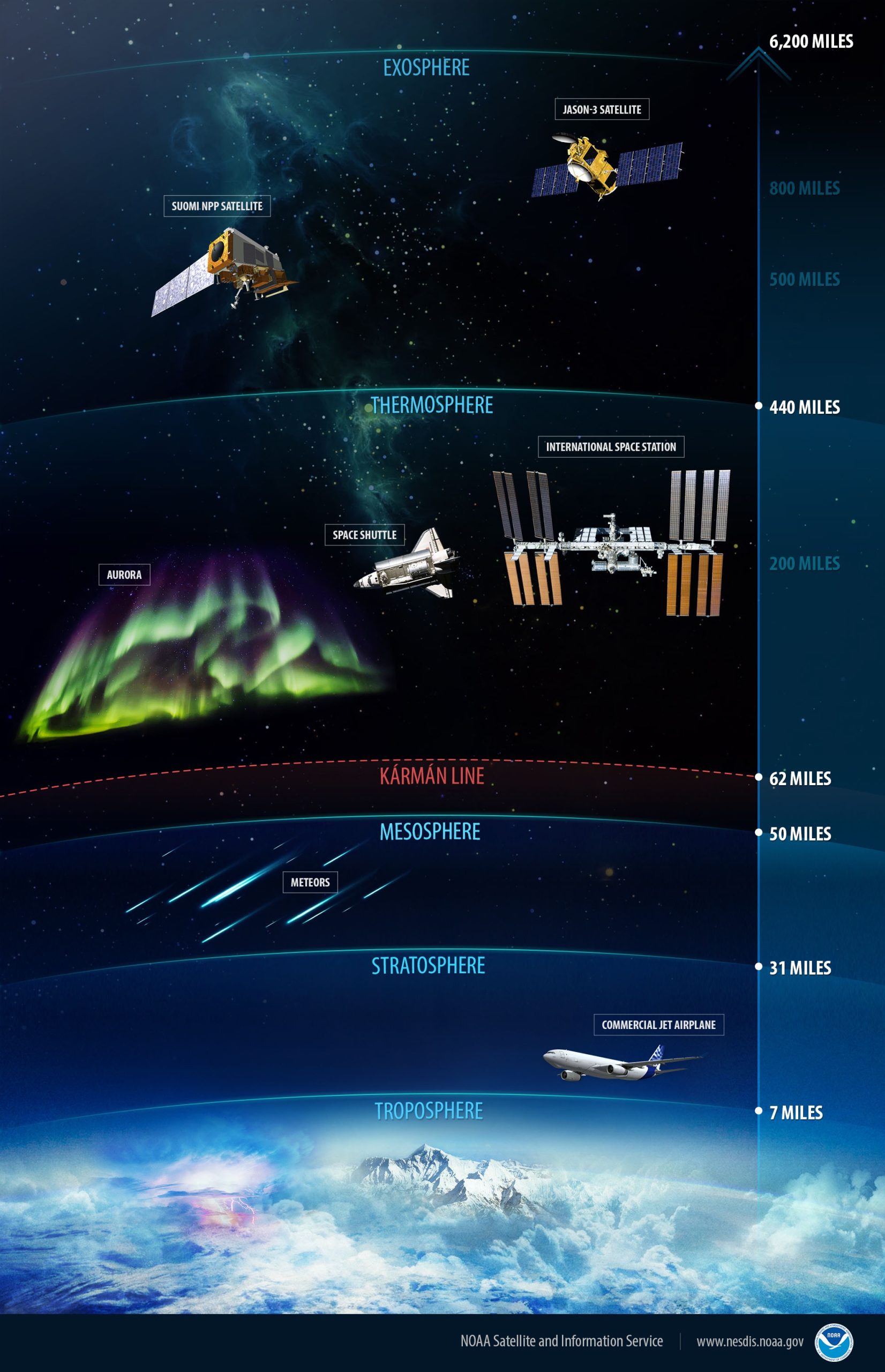
Image credit: NOAA
Structural and chemical differences
Black carbon comes in different forms. Some particles follow repeating patterns and are “crystalline,” like graphite, Dykema reports. Others are random, or “amorphous.”
Those structural and chemical differences – including how the carbon atoms bond with elements like hydrogen – determine how the black carbon affects incoming sunlight.
Some particles scatter sunlight; some absorb it. Some absorb infrared light, but not ultraviolet.
Thermal energy
Dykema adds that how this process plays out in the stratosphere, and the impact on the climate, remains uncertain.
“We’re putting thermal energy into the Earth’s climate system, but we’re putting it in new places,” Dykema said. “We don’t really understand the implications of changing stratospheric circulation. It could cause storm tracks to move. Maybe it could shift climate zones, or possibly be a new source of droughts and floods.”
The key question: what happens as humanity puts more and more material into orbit, much of it eventually returning as debris? If aluminum oxide continues to accumulate, ozone loss could become more serious.

Taking the fall. Space hardware dives into Earth’s atmosphere with some fragments making their way to the ground.
Image credit: ESA/D.Ducros
“It’s not the most efficient way to create an ozone hole, but it does cause additional ozone erosion, which slows the recovery,” said Dykema.
What should policymakers do?
Dykema suspects that changes to stratospheric circulation may ultimately prove more consequential than the additional ozone loss, because the outcomes are so uncertain and potentially far-reaching.
For the moment, many questions “are not really amenable to straightforward, linear analysis,” Dykema said, cautioning that “the ozone loss is significant, and we’re putting so much stuff up there that it could grow in ways that are not proportional.”
Governments and regulators could push for a more sustainable use of space, from the materials used in satellite construction to the types of propellants powering rockets.
Solid fuels, for example, produce aluminum and aluminum oxide in exhaust, suggesting that decisions about solid versus liquid propellant, and about which regions and seasons to launch in, could have real atmospheric consequences.
The question, Dykema suggests, as the satellite launch rate accelerates, is whether policymakers will act on those concerns before the invisible wake of our spacefaring ambitions becomes impossible to ignore?
Read the entire blog here:
Burning satellites in the stratosphere: Emerging questions for climate
 Posted in Space News

