 By
By  May 20th, 2025
Confirmed SpaceX debris found in Australia.
Photo courtesy: Brad Tucker
Space junk that came to rest in New South Wales, Australia has undergone analysis by NASA orbital debris specialists.
Back in July 2022, the trunk section from the SpaceX Dragon Crew-1 mission reentered and over the following month, several fragments were recovered. One of the surviving fragments located was a portion of the Dragon’s trunk, constructed largely of carbon fiber-reinforced polymer composite.

Hefty piece of SpaceX space junk found in Australia last July.
Image courtesy: Brad Tucker
Use of that material “has garnered profound interest from the space safety community in recent years due to the nature of the material to not completely demise upon reentry,” reports the NASA Orbital Debris Program Office at NASA’s Johnson Space Center.
The results of a look at the debris has been noted in the May 2025 Orbital Debris Quarterly News.
Sites of interest
To obtain the debris, NASA’s Orbital Debris Program Office worked with SpaceX and the Australian Space Agency to characterize the extent of the reentry damage experienced by the fragment and compare it to reentry model predictions.
Under scrutiny, some 32 sites of interest were identified for study including exposed carbon fiber/epoxy composite, thermal protection material, melted metal surfaces, and fractured metal surfaces.
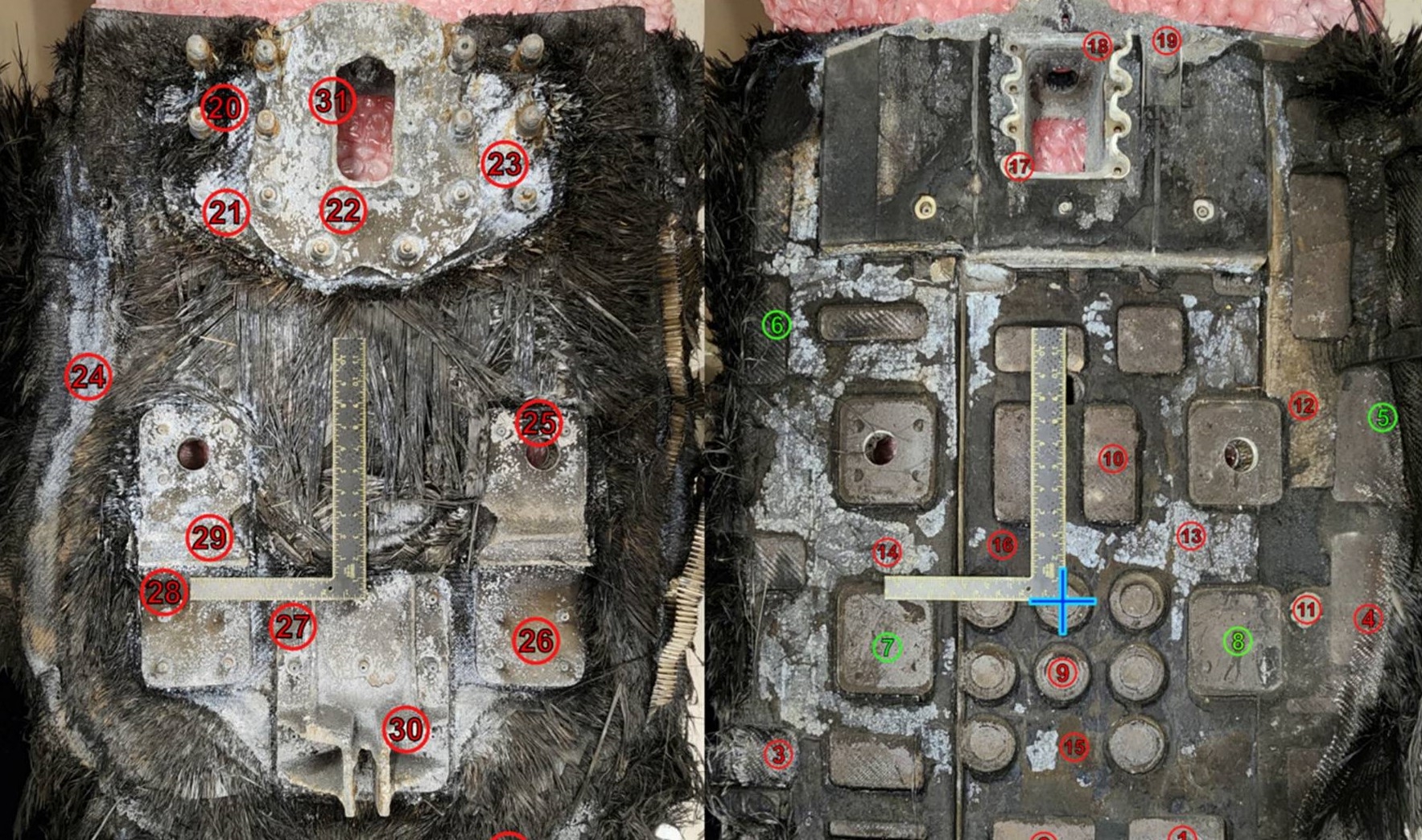
SpaceX trunk fragment under study.
Image credit: A. Dougherty/B. Greene/C. Ostrom
Microscope observations of composite surfaces showed a striking variability in degree of charring, “indicative of extended periods of protection of some parts of the trunk structure from reentry heating,” the study team reports.
Breakup and demise process
The images collected did provide a glimpse into the conditions faced by the trunk materials during the tumble to Earth.
Several preliminary conclusions have been drawn about the reentry environment experienced by the Dragon Crew-1 trunk using initial microscope measurements.
Primarily, given the large difference in charring on the inside versus the outside surface, “it seems that the trunk was not tumbling significantly during most of the reentry, and even after breakup, the recovered fragment seems to have had a relatively stable attitude at least during the peak heating period,” the debris analysis experts report.

SpaceX Dragon “trunk.”
Image credit: SpaceX
This research and subsequent work will provide insight into the reentry breakup and demise process for structures composed predominantly of carbon fiber/epoxy and carbon fiber/phenolic composite materials, they add, as well as “validate computational models for reentry human casualty risk from modern orbital debris.”
 Posted in Space News

