 By
By  December 5th, 2023
Pre-launch image shows parachute installation in the OSIRIS-REx sample return capsule.
Image credit: Lockheed Martin
The NASA OSIRIS-REx asteroid sample return capsule that parachuted into the Utah desert on September 24 also was a case of high-altitude drama.
Going over descent video of the capsule and other extensive documentation, project officials have determined that the landing sequence did not go according to plan, with a small parachute called a drogue not unfurling as scripted.
According to a December 5 statement from NASA’s Goddard Space Flight Center, Greenbelt, Maryland, it was found that “inconsistent wiring label definitions in the design plans likely caused engineers to wire the parachutes’ release triggers such that signals meant to deploy the drogue chute fired out of order.”
Out of order
In NASA’s statement, the word “main” was used inconsistently between the device that sends the electric signals, and the device that receives the signals.
“On the signal side, ‘main’ meant the main parachute. In contrast, on the receiver side ‘main’ was used as a reference to a pyrotechnic that fires to release the parachute canister cover and deploy the drogue. Engineers connected the two mains, causing the parachute deployment actions to occur out of order,” the NASA posting explains.

OSIRIS-REx capsule on main chute headed for landing.
Image credit: UTTR/NASA
In order to confirm the root cause of the parachute problem, NASA will be able test the system responsible for releasing the parachutes.
“This hardware is currently inside one of the glove boxes with the Bennu sample at NASA’s Johnson Space Center in Houston. Once the curation team there completes processing the sample material—the mission’s top priority at present—NASA engineers will be able to access the parachute hardware and verify the cause,” says the NASA statement.
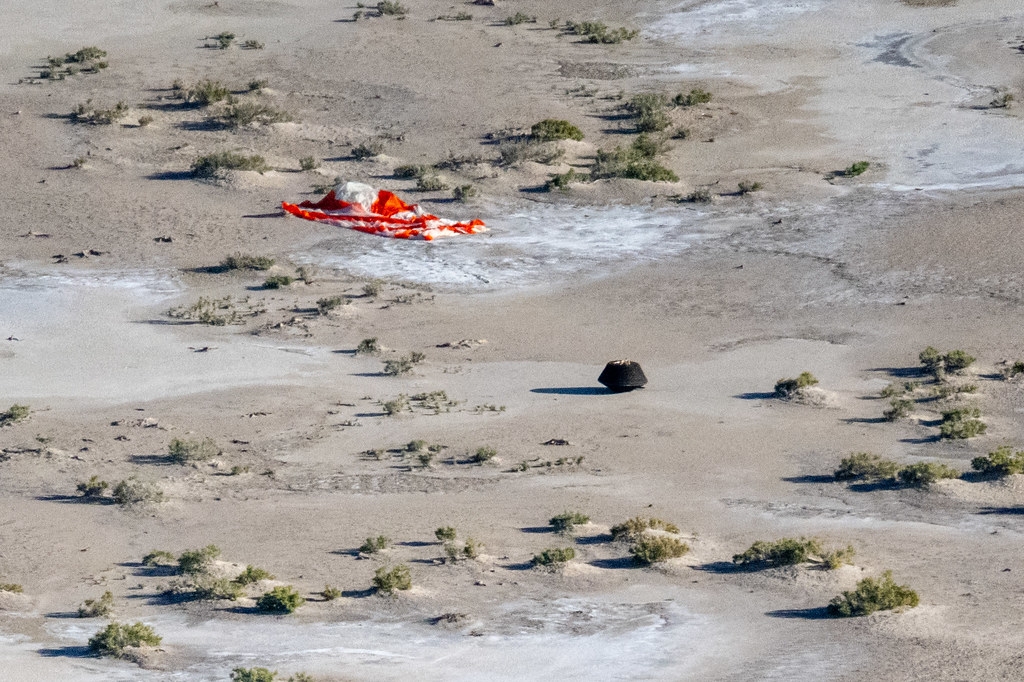
Following its high-speed re-entry, the OSIRIS-REx sample return capsule served as an artificial meteor before parachuting into the desert landscape of the Department of Defense’s Utah Test and Training Range.
Image credit: NASA/Keegan Barber
Technical hiccups
Even on capsule landing day in Utah, there was early suspicion that something in the parachute progression did not go as planned.
There may have been some technical hiccups in the capsule’s speedy and red-hot descent through Earth’s atmosphere, said Tim Priser, Lockheed Martin’s chief engineer for deep space exploration, in a post-capsule landing press conference in Utah.
Lockheed Martin designed and built the OSIRIS-REx spacecraft, asteroid sampling system and sample return capsule at its facilities near Denver. The company also operated the spacecraft from launch through sample return.
“Some things in our sequence may or may not have behaved itself exactly the way we expected it to but the subsequent things in the sequence made up for the fact,” Priser said. “At the end of the day when that main chute deployed it basically corrected any of the sins that may have happened ahead of it,” he said at the time.

Image credit: University of Arizona/Heather Roper
Reconstruct what happened
While there was now-confirmed drogue trouble, the return capsule’s dive through Earth’s atmosphere did perform a “soft as a dove” touchdown in Utah.
One of the advantages of landing at the Utah Test and Training Range, Priser added in the Utah press gathering, is the ground and aerial imagery capability used to monitor the capsule’s sky-rocketing re-entry.
“You have your data. You have your models. You have your observations and you’ve got to put all those pieces together so you reconstruct what happened,” Priser told Inside Outer Space at that September press event.

Genesis return capsule crash in Utah desert.
Image credit: NASA
Blast from the past
But in a blast from the past, that same stretch of Utah landscape has been witness to both calamity and victory.
In September 2004, NASA’s Genesis spacecraft, toting samples of solar wind, failed to deploy its parachutes due to a Lockheed Martin engineering error. A Mishap Investigation Board later identified that a likely cause was improper orientation of gravity-switch sensors that were to set off the capsule’s landing system. Those G-switch sensors had been installed upside down in the spacecraft so they did not detect the capsule’s deceleration and begin the parachute sequence. Also, the mishap board noted that this blunder wasn’t found early by oversight processes. This issue led to a severely banged up capsule and contamination of its prized shipment of solar wind particles.
This mishap was followed in January 2006 by NASA’s Stardust mission – also engineered by Lockheed Martin. Stardust successfully parachuted to Earth its capsule of particles spewed out by comet P/Wild 2, a rich bonanza of material for intense laboratory scrutiny.
 Posted in Space News

