 April 3rd, 2015
 Author:
In the “what are they?” department of strangeness. Over the past several years, Mars-orbiting spacecraft have spotted dark, fingerlike features that scientists call “recurring slope lineae,” or RSL for short. These are dark flows, possibly caused by liquid water, found at many locations throughout low and middle latitudes on Mars. Yet another eye-catching […]
 Posted in

New progress has been reported on the Asteroid Terrestrial-impact Last Alert System, or ATLAS. The ATLAS effort is dedicated to providing one day’s warning for a 30-kiloton “town killer,” a week for a 5-megaton “city killer,” and three weeks for a 100-megaton “county killer.” ATLAS is an asteroid impact early warning system being developed by […]
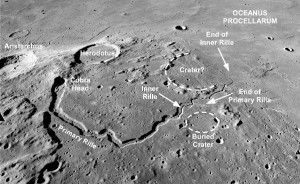
Data from NASA’s Gravity Recovery And Interior Laboratory (GRAIL) mission suggests that lava tubes on the Moon could have diameters in excess of more than half a mile (1 kilometer). These features could support future long-term human exploration on the moon, offering shelter from cosmic radiation, meteorite impacts and the wild temperature swings […]
A research project has been started designed to explore a critical question in the Search for Extraterrestrial Intelligence (SETI): “If we discover intelligent life beyond Earth, should we reply, and if so, what should we say?” Earth Speaks is a project of the SETI Institute of Mountain View, California. According to the Principal Investigator […]

Crew members aboard the International Space Station have assisted in picking spots on Mars for investigation by the Opportunity robot now wheeling about on that distant world. The Expedition 43 crew “had a great chance to ‘target’ some Martian rocks for sampling by the Opportunity rover,” recently tweeted ISS commander, Terry Virts. NASA’s Virts, along […]
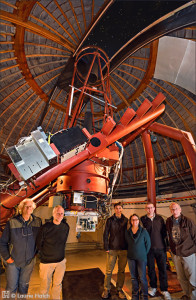
The Search for Extraterrestrial Intelligence (SETI) has shifted to the infrared. Called NIROSETI — short for Near-Infrared Optical Search for Extraterrestrial Intelligence — the instrument saw its “first light” last month at the University of California’s Lick Observatory atop Mt. Hamilton east of San Jose. NIROSETI technicians are making use of Lick Observatory’s Nickel 1-meter […]

Here’s a profile I have written for SpaceNews newspaper, an interview with Joanne Irene Gabrynowicz Professor Emerita, University of Mississippi School of Law. Government legal and regulatory regimes, which operate within the framework of the Outer Space Treaty, have yet to catch up in some areas, says renowned space law expert Joanne Gabrynowicz. The evolution of […]
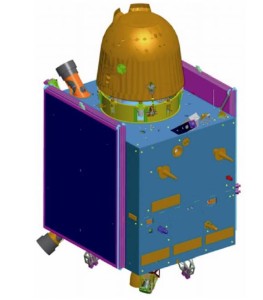
New details have become available regarding China’s circumlunar return and reentry spacecraft. That vehicle was launched on October 24, 2014 (Beijing Time). After nearly 196 hours of flight, the reentry capsule landed safely at Siziwangqi in Inner Mongolia of China on November 1st, recovered and delivered to Beijing on the same day. That mission mimicked […]

Landing on Mars in August 2012, NASA’s Curiosity rover continues on its mission to assess whether Mars ever had an environment able to support life. Indeed, the robot has gathered compelling information regarding the planet’s habitability for life. New imagery of Curiosity’s wheels show the wear and tear of trekking across the rocky surface of […]
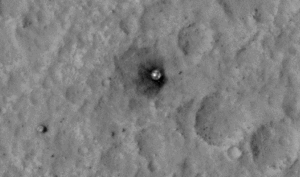
A series of observations from Mars orbit show how dark blast zones that were created during the August 2012 landing of NASA’s Curiosity rover have faded inconsistently. Images were taken by the High Resolution Imaging Science Experiment (HiRISE) camera on NASA’s Mars Reconnaissance Orbiter. The observations were taken on multiple dates from Curiosity’s landing to […]

