 January 22nd, 2016
 Author: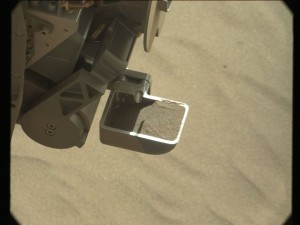
Today, the Curiosity rover on Mars is at work on Sol 1231. Mars researchers are continuing their campaign to analyze “Namib Dune” – geared to dropping off a specimen of collected sand in the rover’s Sample Analysis at Mars (SAM) Instrument Suite. Earlier, the sol 1230 plan called for a science block with […]
 Posted in

Forget that overused, hackneyed query: Are we alone? Arguably, the real question at hand may be how to cope with crowds of extraterrestrial civilizations. With increasing regularity we learn of exo-planet detection. But with those observations, is the prospect of locating other starfolk a sure bet? For more details, […]

It’s no wonder we haven’t heard from extraterrestrials. That’s because they are long-gone, extinct. Astrobiologists from Australian National University (ANU) call it the “Gaian bottleneck” – life on other planets would likely be brief and become extinct very quickly. “Early life is fragile, so we believe it rarely evolves quickly enough to survive,” contends Aditya […]

Researchers at Caltech have found evidence of a giant planet tracing a bizarre, highly elongated orbit in the outer solar system. Caltech’s Konstantin Batygin and Mike Brown discovered the planet’s existence through mathematical modeling and computer simulations. However, the object has yet to be observed directly. The new research is reported in the February […]

If you’re a woman looking for inspiration to pursue a career in the space and technology industries, take a look at the Rocket Women website. The site provides a platform through which women interested in the space and technology industries can gain information about a career and have questions answered. “My mission is to inspire […]
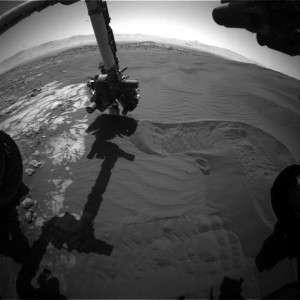
NASA’s Curiosity Mars rover is now in Sol 1228 and Ryan Anderson, a planetary scientist at the USGS Astrogeology Science Center in Flagstaff, Arizona, reports the campaign to analyze the Bagnold dunes continues! This dune field is along the northwestern flank of Mount Sharp. Sand dune selfie The plan for Sol 1228 involves extensive […]

China is pushing the throttle forward in its 2016 space exploits, an agenda that includes a piloted space mission and the maiden flights of two new boosters. According to state-run news agencies, the China Aerospace Science and Technology Corporation has spotlighted plans to launch this year the Tiangong 2 space laboratory and the […]

NASA’s Curiosity Mars rover has entered Sol 1225. The robot carried out a series of arm activities on Sols 1223-1224, “scuffing” up dune sand. They all went well, explains Lauren Edgar, a research geologist at the USGS Astrogeology Science Center in Flagstaff, Arizona and a member of the Mars Science Laboratory (MSL) science team, […]
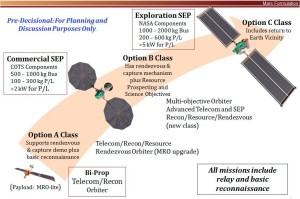
NASA is reviewing the idea of a multi-function next-generation Mars Orbiter. If approved, this orbiter could be launched as early as 2022. One of the orbiter’s functions could be focused on the preparation for exploration by humans at Mars. A Science Analysis Group (SAG) of the Mars Exploration Program Analysis Group dubbed NEX-SAG reports […]
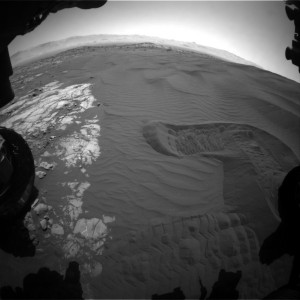
On Mars, the Curiosity rover’s Sol 1221 drive went well, notes USGS’s Ken Herkenhoff at the Astrogeology Science Center in Flagstaff, Arizona. That drive included “a wheel scuff” in the dark sand dune, and the rover is in a good position for contact science,” he adds. At this moment, the robot is engaged in […]

