 By
By  March 13th, 2019
Credit: DLR/ESA/NASA
Effective countermeasures are needed for astronauts to be able to live in space, on the Moon or on Mars for long periods of time in the future.
Artificial Gravity as a countermeasure (AGBRESA) is a major long-term bed-rest study that will be carried out by the German Aerospace Center (Deutsches Zentrum für Luft- und Raumfahrt; DLR), in cooperation with the European Space Agency (ESA) and NASA.
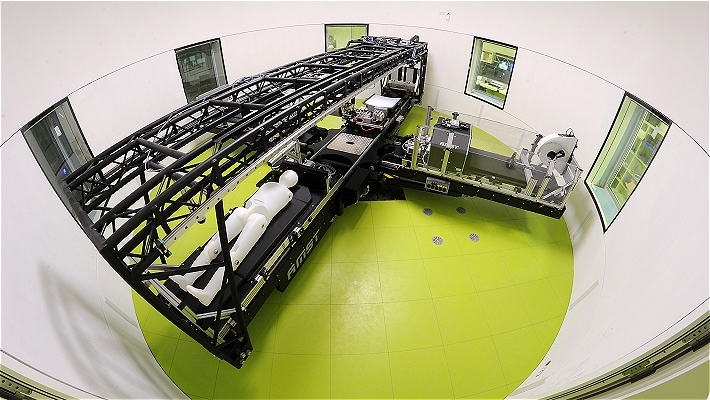
DLR’s short-arm human centrifuge.
Credit: :envihab
To be launched later this month, a first is use of artificial gravity as a possible means of overcoming the negative effects of weightlessness on the human body. The artificial gravity will be created by having the test participants lie down in the DLR short-arm human centrifuge once per day.
State-of-the-art facility
This unique research effort makes use of :envihab (from the words “Environment” and “Habitat”), a one-story, 3500-square-meter, state-of-the-art facility.
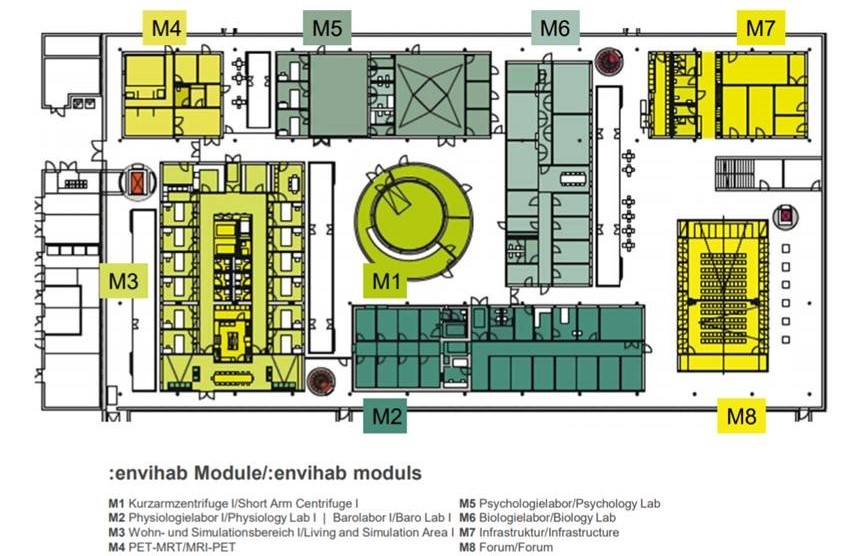
Eight separate modules are used in a “house within a house” design.
Credit: :envihab
:envihab includes a short-arm human centrifuge to, for instance, conduct cardiovascular, bone and muscle research, laboratories for studying the effects of oxygen reduction and pressure decrease on test subjects, MRI/PET analysis facilities, rooms for psychological stress simulations and rehabilitations, microbiological and molecular biological research tools, as well as places to house and monitor test subjects.
At :envihab, super-targeted research is conducted in space and flight physiology, radiation biology, space psychology, operational medicine, biomedical research and analogous terrestrial situations.
 Posted in Space News


We remain supportive of human AG studies as a countermeasure.