 By
By  May 16th, 2023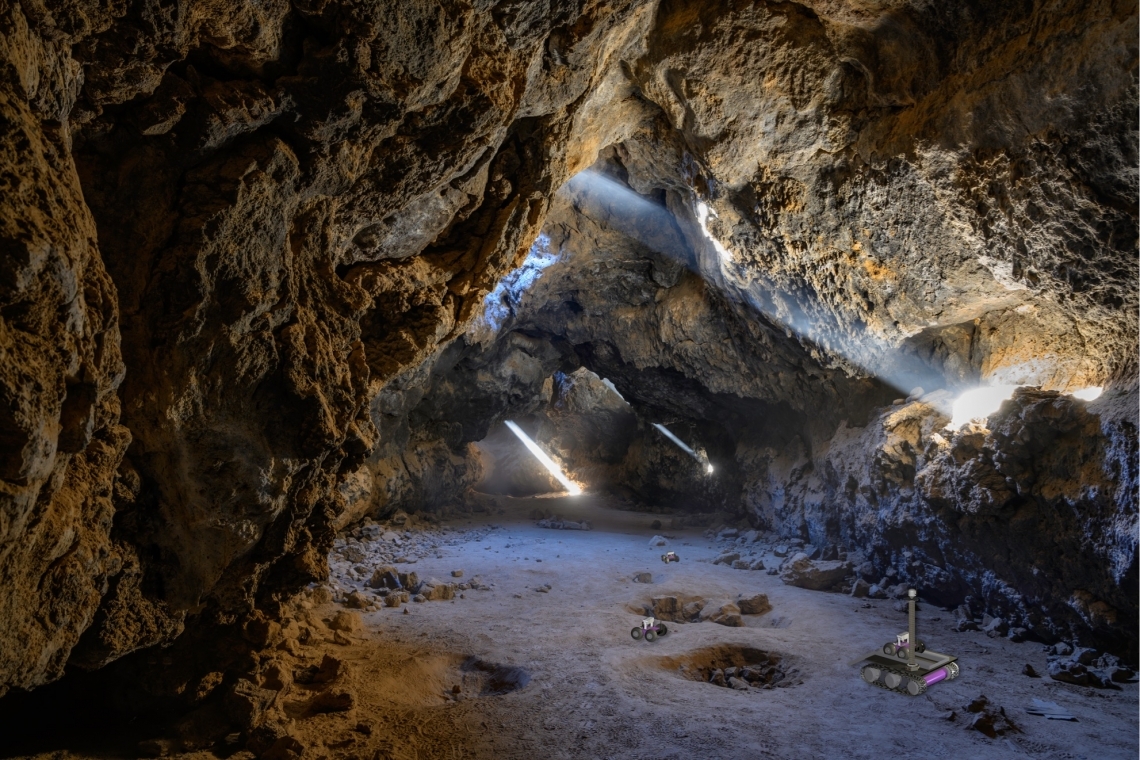
Artist’s impression of the breadcrumb scenario, autonomous rovers can be seen exploring a lava tube after being deployed by a mother rover that remains at the entrance to maintain contact with an orbiter or a blimp. Image credit: John Fowler/Wikimedia Commons, Mark Tarbell and Wolfgang Fink/University of Arizona
Engineers have developed a system that allows autonomous vehicles to scout out underground habitats for astronauts.
Researchers at the University of Arizona’s College of Engineering have developed technology that would allow a flock of robots to explore subsurface environments on other worlds.
Their patent-pending concept the “Breadcrumb-Style Dynamically Deployed Communication Network” paradigm is admittedly a nod to the fairy tale “Hansel and Gretel.”
Maintaining awareness
According to a university statement, continuously monitoring their environment and maintaining awareness of where they are in space, the rovers proceed on their own, connected to each other via a wireless data connection, deploying communication nodes along the way. Once a rover senses the signal is fading but still within range, it drops a communication node, regardless of how much distance has actually passed since it placed the last node.

Cave opening on Mars as imaged by the Mars Reconnaissance Orbiter’s powerful HiRISE camera. Protected from the harsh surface of Mars, such pits are believed to be good candidates to contain Martian life, making them prime targets for possible future spacecraft, robots and even human interplanetary explorers.
Image credit: NASA/JPL/University of Arizona
Wolfgang Fink, associate professor of electrical and computer engineering at the University of Arizona, explains that the breadcrumb approach provides a robust platform allowing robotic explorers to operate underground or even submerged in liquid environments.
One idea detailed by Fink and colleagues is sending an orbiter carrying a balloon and a lake lander to study one of the hydrocarbon seas on Saturn’s moon Titan.
Such swarms of individual, autonomous robots could also aid in search and rescue efforts in the wake of natural disasters on Earth, Fink adds.
Search for off-Earth life
The communication network approach has the potential to herald a new age of planetary and astrobiological discoveries, said Dirk Schulze-Makuch, president of the German Astrobiological Society, as noted in the university statement.
“It finally allows us to explore Martian lava tube caves and the subsurface oceans of the icy moons – places where extraterrestrial life might be present,” Schulze-Makuch adds.
For more information on this intriguing concept, go to:
To read the research paper – “A Hansel & Gretel breadcrumb-style dynamically deployed communication network paradigm using mesh topology for planetary subsurface exploration” – at:
https://www.sciencedirect.com/science/article/abs/pii/S0273117723001187?via%3Dihub
 Posted in Space News

