 By
By  November 1st, 2022
Boulder-size blocks of water ice can be seen around the rim of an impact crater on Mars. Image taken by the High-Resolution Imaging Science Experiment (HiRISE camera) aboard NASA’s Mars Reconnaissance Orbiter (MRO). The crater was formed Dec. 24, 2021, by a meteoroid strike in the Amazonis Planitia region.
Credits: NASA/JPL-Caltech/University of Arizona
Meteorite impacts on Mars not only toss up dirt and ice, but also produce important data on the structure of the Martian crust.
For example, on December 24, 2021 a meteorite strike on the Red Planet generated surface waves that sped along the planet’s surface. At one point, on the receiving end of those waves was NASA’s InSight Mars lander, recording the hit at a distance of about 2,175 miles (3,500 kilometers) from the lander’s sensitive seismic gear.
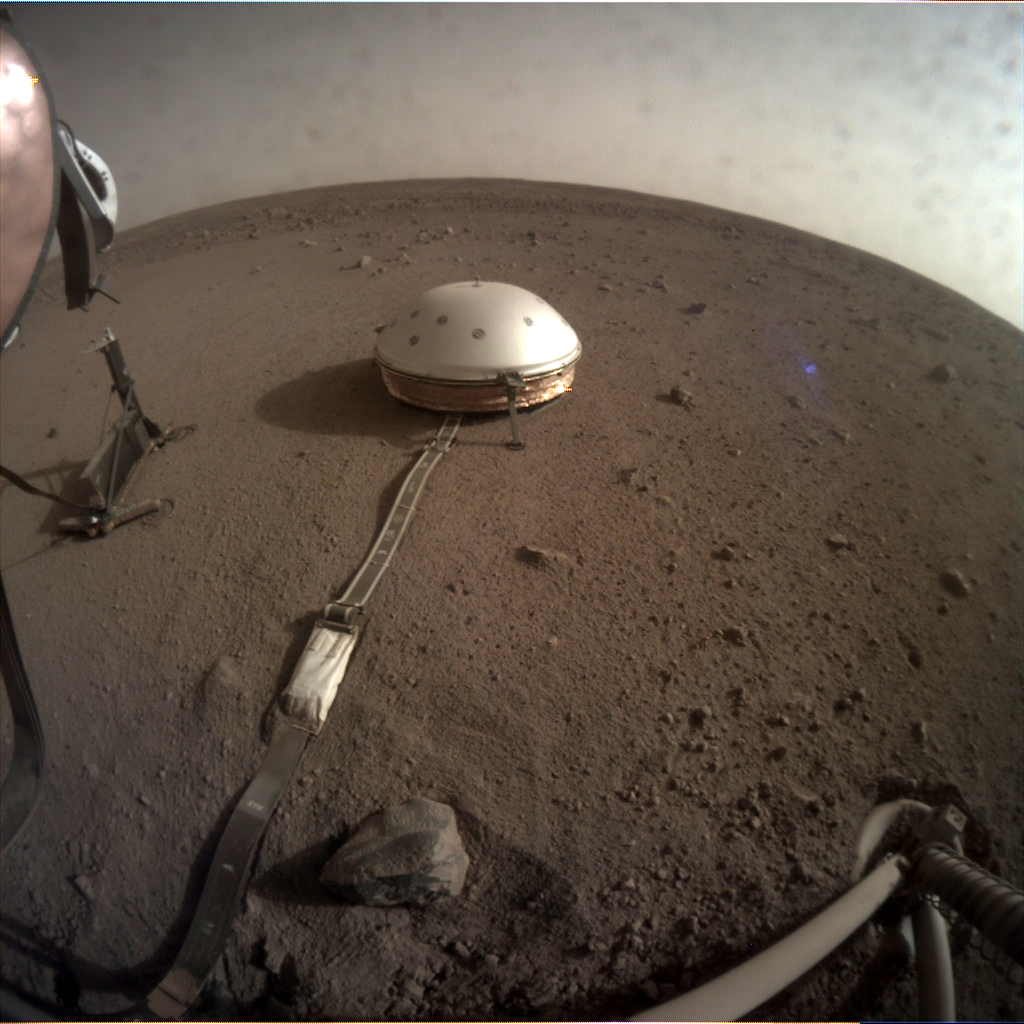
InSight’s Instrument Deployment Camera (IDC) acquired this image showing the HP3 experiment and SEIS seismometer (Seismic Experiment for Interior Structures) on Sol 99, March 8, 2019.
Credit: NASA/JPL-Caltech
Thanks to the Mars-circling NASA Mars Reconnaissance Orbiter, a crater more than 100 meters in diameter was later imaged.
Researchers also identified a meteorite impact at a distance of just under 4,600 (7,500 kilometers) from InSight as the source of a second shock.
Uniform structure
This research has been captured in a new paper published in Science – “Surface waves and crustal structure on Mars” – led by Doyeon Kim of the Institute of Geophysics, ETH Zürich, Zürich, Switzerland.

Cross section of the S1094b surface wave path through Mars.
Credit: Doyeon Kim, et al.
“Until now, our knowledge of the Martian crust was based on only one point measurement under the InSight lander,’ said Kim.
The result of the surface wave analysis: between the impact sites and InSight’s seismometer, the Martian crust has, on average, a very uniform structure and a high density.
“The new findings are so interesting because a planet’s crust provides important clues about the formation and evolution of the celestial body. It is the result of early dynamic processes in the mantle and subsequent magmatic processes,” explained a co-author colleague, Brigitte Knapmeyer-Endrun at the Bensberg Observatory, University of Cologne, Bergisch Gladbach, Germany.

Locations of two large meteorite impacts (yellow circles) identified in MRO images.
Credit: Doyeon Kim, et al.
InSight landing site
According to the Kim, the study lead, the structure of the crust beneath the InSight landing site may have formed in a unique way, like when material was ejected during a large asteroid impact more than three billion years ago.
“If so, the structure beneath the lander is probably not representative of the general crustal structure of Mars.”
For access to the paper — “Surface waves and crustal structure on Mars” – go to:
https://www.science.org/doi/10.1126/science.abq7157
 Posted in Space News

