 By
By  August 21st, 2022
Credit: Mars Guy
Two new episodes of Mars Guy flag new developments in NASA’s Perseverance rover exploration at Jezero Crater.
In one episode of Mars Guy, there’s a review of the fact that Perseverance has picked up unidentified foreign object debris.
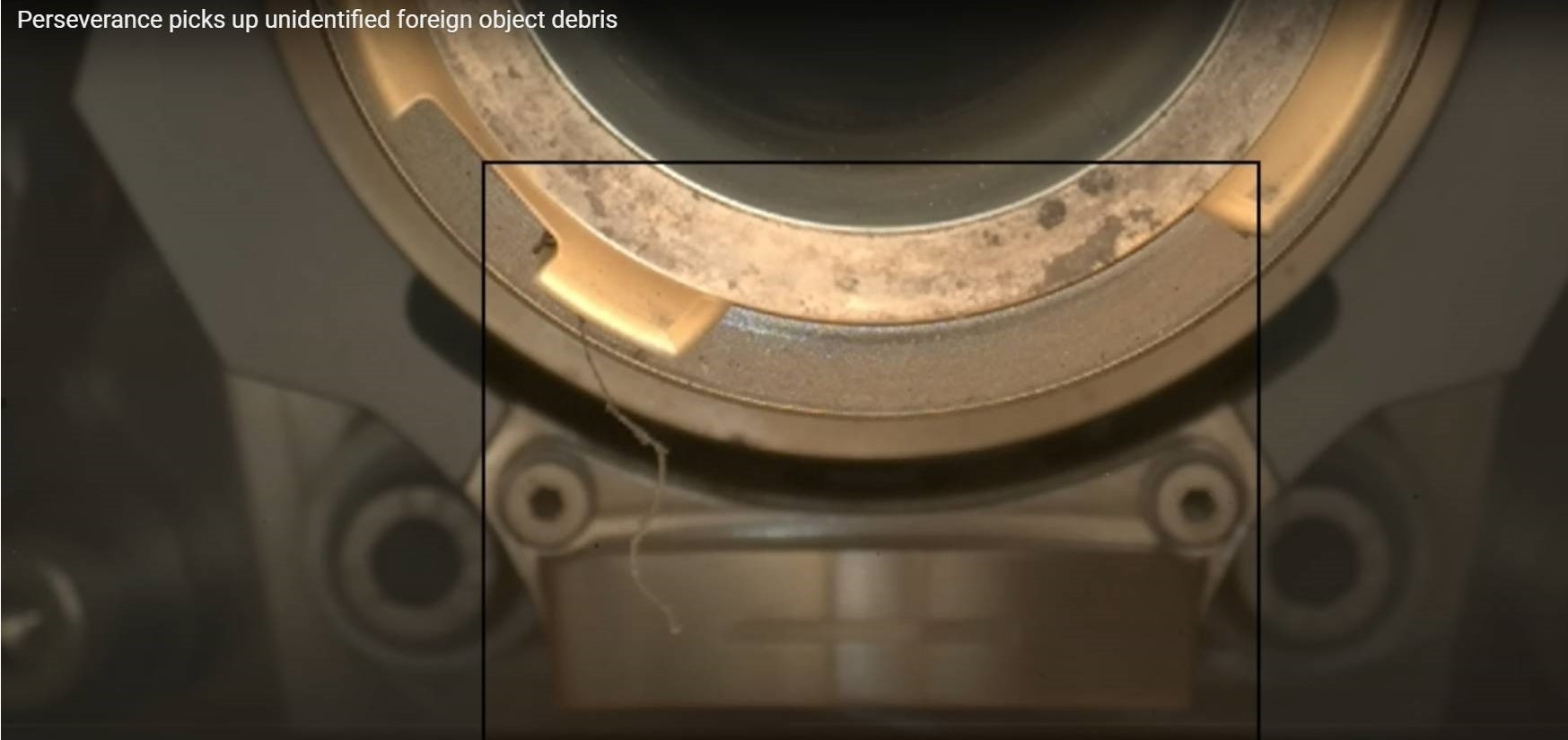
Credit: Mars Guy
“Following another successful rock coring operation, a routine inspection of the hardware revealed hair-like objects in two places. Now the search is on to figure out what they are and if they jeopardize the mission,” explains Mars Guy, aka Steve Ruff, a planetary geologist with a focus on the mineralogy of Mars at Arizona State University in Tempe.

Credit: Mars Guy
Microbial activity?
In another episode, Ruff discusses the prospect that the Perseverance rover has inspected a rock coating that may be evidence of microbial activity.

Evidence of microbial activity?
Credit: Mars Guy
“Thin dark coatings known as desert varnish are common on rocks in arid regions on Earth and they’re thought to form in part from microbial activity,” Ruff explains. “Now, on Mars, the Perseverance rover has found similar coatings.”
Go to these episodes of Mars Guy at:
Also, go to my related story for Space.com — “Probing the Red Planet: Finding past life at Jezero Crater” — at:
 Posted in Space News


My take on Mn rock varnish on Mars? That it is mediated by Mn oxidizing microorganisms just like it is on Earth. In 2010 I discovered microbial mediated rock varnish coatings that were less than 100 years old near the Erie Canal – the fastest known rate of varnishing. This is astonishing considering most of the varnish literature says it can only form a 1-10 micron layer in a thousand years or more. The Erie canal varnish is a significant finding with typical thicknesses around 15 μm formed in a century. I offered to send a sample of this varnish to NASA astrobiologists and my offer was ignored – no reply.
I note that both Curiosity and Perseverance rover teams have reported varnish coatings on some Martian rock outcrops however I have noticed a lack of reporting by the rover about it in recent months. Why? Because it demonstrates that microorganisms are still actively making it on Mars today. The evidence for this is in the paper below and in my book DISCOVERY ON VERA RUBIN RIDGE: TRACE FOSSILS ON MARS?
Mn-Fe-Enhancing Budding Bacteria in Century-Old Rock Varnish, Erie Barge Canal, New York
March 2017The Journal of Geology 125(3):000-000
DOI:10.1086/691147
Abstract
Fossil remnants of bacteria involved in the enhancement of manganese and iron rarely occur within the microstratigraphy of rock varnishes collected from warm desert environments, because varnish formation processes ultimately destroy these microfossils through remobilization of Mn-Fe and reprecipitation in a clay-mineral matrix. In contrast, Mn-Fe encrustations on budding bacteria commonly occur within varnishes that formed within just a century along the Erie Barge Canal, New York. Nanoscale imagery and elemental analyses reveal that these budding bacterial forms greatly enhance Mn, Fe, or both in encrustations surrounding hyphae and cells. The Mn and Fe precipitates have a granular texture on the scale of <1 nm to ∼10 nm. The precipitates also have a stringy texture, where strings are typically only a few nanometers wide. These in situ observations are consistent with expectations from studies of budding-bacteria cultures and with the polygenetic model of varnish formation. Given that the Erie Canal site presents the fastest known rate of varnishing, with typical thicknesses around 15 μm formed in a century, only one or two budding bacteria encrusting Mn-Fe oxides each year would be sufficient to generate the observed Erie Canal varnish. This contrasts with one bacterium growing every ∼400 y being needed to generate observed rates of varnishing in typical warm desert settings.
Also, other papers.
https://www.researchgate.net/scientific-contributions/Barry-DiGregorio-81203305
Barry E. DiGregorio – Director for ICAMSR