 By
By  March 6th, 2015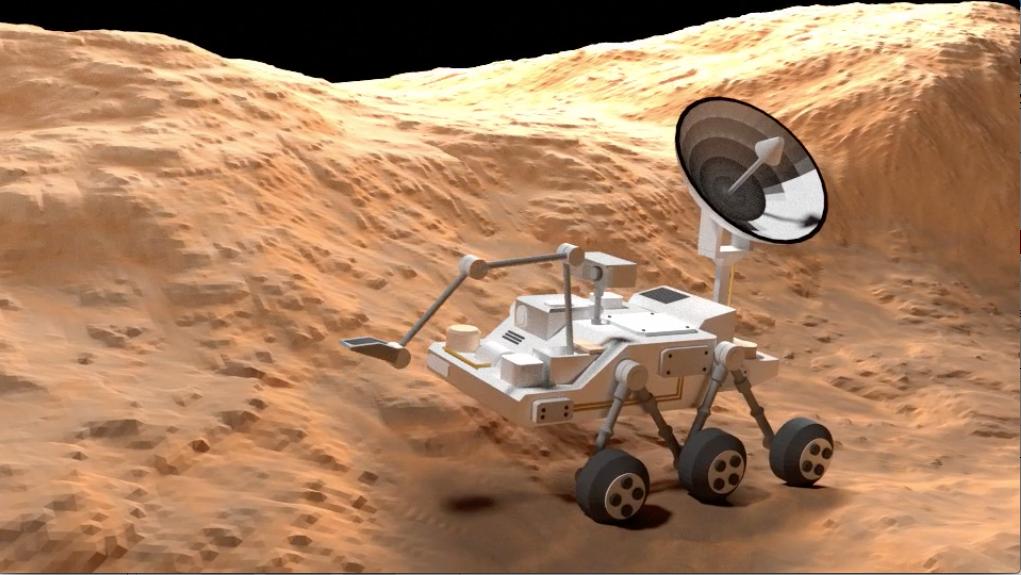
Credit: Sandor Kasas/EPFL
Looking for life on other planets usually relies on chemical detection. But that might be limited or even irrelevant to alien biology.
However, motion is a trait of all life, and can be used to identify microorganisms without any need of chemical foreknowledge.
Scientists from the Swiss Federal Institute of Technology in Lausanne (EPFL) have developed an extremely sensitive yet simple motion detector – accurate for detecting bacteria, yeast, and even cancer cells, and the rapid testing of drugs. And it could be used for the detection of extraterrestrial life.
The idea comes from the technology behind an existing microscope: the atomic force microscope, according to an EPFL press statement.
This powerful microscope uses a “cantilever” to produce pictures of the very atoms on a surface. The cantilever scans the surface like the needle of a record player and its up-and-down movement is read by a laser to produce an image.
Good vibrations
For example, a bacterium attaches to the cantilever. If the bacterium is alive, it will inevitably move in some way, e.g. move its flagellum or simply carry out normal biological functions.
That motion also moves the much smaller and sensitive cantilever and it is captured by the readout laser as series of vibrations.
Bottom line: The signal is taken as a sign of life.
In ground testing, researchers were able to accurately detect and isolate vibration signatures from living cells.
Chemistry-free system
In terms of space exploration, EPFL scientists, Giovanni Dietler, Sandor Kasas and Giovanni Longo, envision a large array of cantilever sensors used in future space exploration probes like a Mars rover.
As it relies on motion rather than chemistry, the cantilever sensor would be able to detect life forms in mediums that are native to other planets, such as the methane in the lakes of Titan.
“The system has the benefit of being completely chemistry-free,” says Dietler.
The work represents a collaboration of EPFL’s Laboratory of Physics of Living Matter with the University of Lausanne and the Vlaams Institute for Biotechnology.
For more information on “Detecting nanoscale vibrations as signature of life” go to:
http://www.pnas.org/content/112/2/378.abstract
A brief animation showing how the nanoscale cantilever could be implemented to detect life on samples from other planets can be found here:
https://www.youtube.com/watch?v=0Eft7cmi26I
 Posted in Space News

