 By
By  March 9th, 2015
Map shows the single area under continuing evaluation as the InSight mission’s Mars landing site, as of a year before the mission’s May 2016 launch.
Image Credit: NASA/JPL-Caltech
Thanks to two Mars orbiters, a landing site for NASA’s InSight Mars lander has been selected: NASA has now picked as the prime landing site one location in Elysium Planitia, a region where ancient lava flows cover the ground.
The landing-site selection process evaluated four candidate locations selected in 2014.
The Interior Exploration using Seismic Investigations, Geodesy and Heat Transport (InSight) is slated for a March 2016 launch date.
Legged landing
Within the flat-lying Elysium Planitia, less than five degrees north of the equator, all four landing areas appear safe for InSight’s legged touchdown on the Red Planet on Sept. 28, 2016.
The single site will continue to be analyzed in coming months for final selection later this year. If unexpected problems with this site are found, one of the others would be imaged and could be selected.
The favored site on Mars is centered at about four degrees north latitude and 136 degrees east longitude.
Select sweet spot
The landing area is smooth, flat, with very few rocks in the highest-resolution images, said InSight’s site-selection leader, Matt Golombek of NASA’s Jet Propulsion Laboratory (JPL) in Pasadena, California.
Both NASA’s Mars Odyssey orbiter and images from the University of Arizona’s High Resolution Imaging Science Experiment on NASA’s Mars Reconnaissance Orbiter were used to select the sweet spot for landing InSight.
Infrared and visual images of the Martian surface taken by Arizona State University’s Thermal Emission Imaging System (THEMIS) onboard Odyssey is mapping dust and rocks at the projected InSight landing site.
“Picking a safe place means the landing site can’t be full of big rocks or covered in a thick layer of dust,” said Jonathon Hill of Arizona State University’s Mars Space Flight Facility — part of ASU’s School of Earth and Space Exploration.
By measuring how quickly the ground cools at night or warms in sunlight, THEMIS can tell the proportion of rocks and dust on the ground and thus help paint a picture of what awaits the lander at the surface.
Not a rover
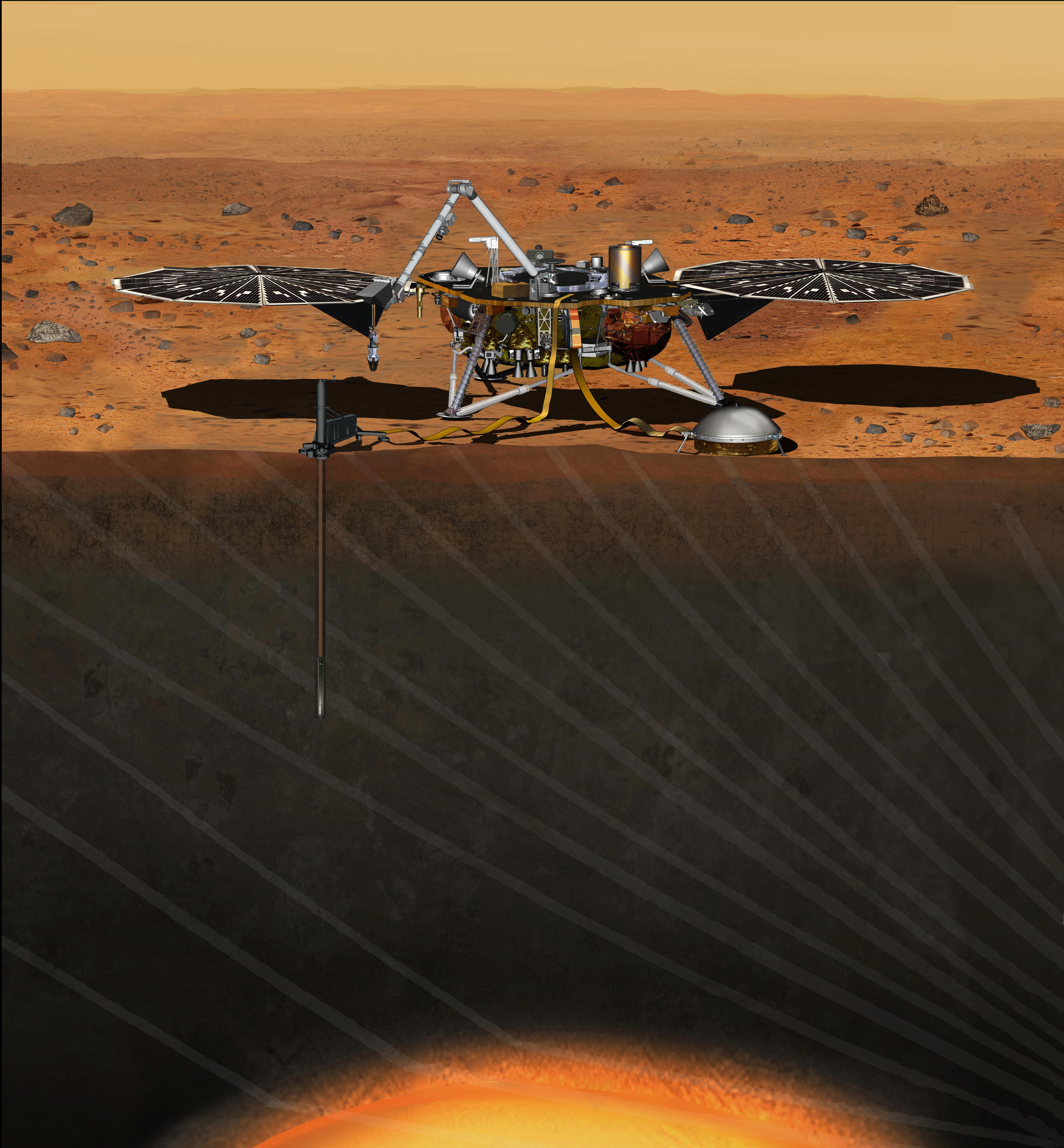
InSight is not a rover. Built using the same flight platform as the Mars Phoenix lander, InSight will touch down in one place and stay there for its entire mission – projected to last two Earth years.

Credit: NASA/JPL
The InSight science payload is comprised of two instruments: the Seismic Experiment for Interior Structure (SEIS), provided by the French Space Agency (CNES), with the participation of the Institut de Physique du Globe de Paris (IPGP), the Swiss Federal Institute of Technology (ETH), the Max Planck Institute for Solar System Research (MPS), Imperial College and the Jet Propulsion Laboratory (JPL); and the Heat Flow and Physical Properties Package (HP3), provided by the German Space Agency (DLR).
In addition, the Rotation and Interior Structure Experiment (RISE), led by JPL, will use the spacecraft communication system to provide precise measurements of planetary rotation.
Heritage hardware
Lockheed Martin is building the lander and other parts of the spacecraft. The assembly, test, and launch readiness of InSight, its aeroshell and cruise stage are well underway at Lockheed Martin Space Systems near Denver, Colorado.
The InSight mission is similar in design to the Mars lander that the NASA Phoenix mission used successfully in 2007 to study ground ice near the north pole of Mars. The reuse of this technology — developed and built by Lockheed-Martin Space Systems — provides a low-risk path to Mars without the added cost of designing and testing a new system from scratch.
JPL manages InSight for NASA’s Science Mission Directorate in Washington. InSight is part of NASA’s Discovery Program, managed by NASA’s Marshall Space Flight Center in Huntsville, Alabama.
 Posted in Space News

