 By
By  June 2nd, 2018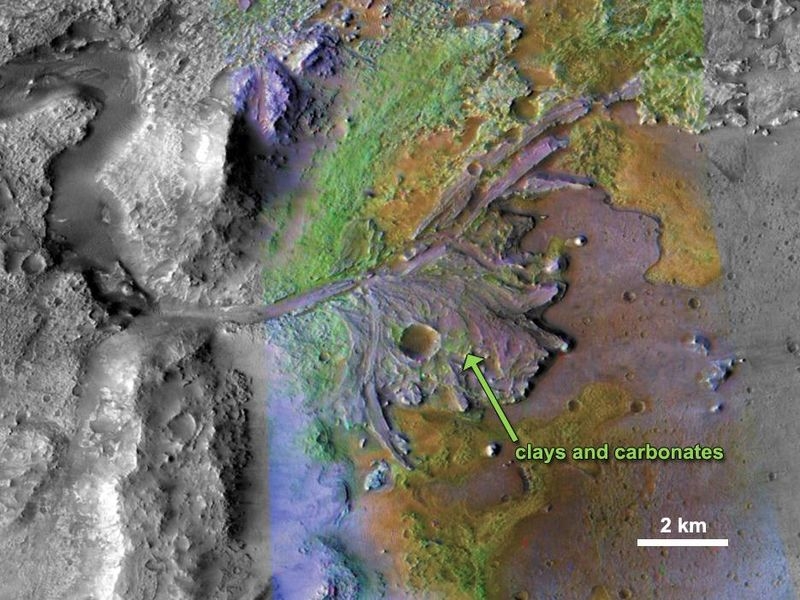
The Jezero Crater delta, a well-preserved ancient river delta on Mars. New research suggests sedimentary rocks made of compacted mud or clay, like those found in the Jezero Crater delta, are the most likely to contain microbial fossils.
Credit: NASA/JPL-Caltech/MSSS/JHU-APL
A candidate landing site for NASA’s Mars 2020 rover is being flagged as a prime spot for finding fossils on Mars. A duty of that robotic mission is to collect rock samples to be returned to Earth for analysis by a future mission.
A team led by a University of Edinburgh researcher has determined that sedimentary rocks made of compacted mud or clay are the most likely to contain fossils. These rocks are rich in iron and a mineral called silica, which helps preserve fossils.

New planetary prowler – the NASA Mars 2020 rover – scouring the Red Planet for select samples for eventual return to Earth.
Credit: NASA/JPL
Wet past
On Mars, Jezero Crater tells a story of the on-again, off-again nature of the wet past of Mars. Water filled and drained away from the crater on at least two occasions. More than 3.5 billion years ago, river channels spilled over the crater wall and created a lake. Scientists see evidence that water carried clay minerals from the surrounding area into the crater after the lake dried up. Conceivably, microbial life could have lived in Jezero during one or more of these wet times. If so, signs of their remains might be found in lakebed sediments.

NASA Mars 2020 rover is designed to collect samples, store the specimens in tubes, then deposit the tubes on the surface for later pick-up.
Credit: NASA/ESA
Fossils of microbes
A new review study – “A Field Guide to Finding Fossils on Mars” – was published in the Journal of Geophysical Research: Planets, a journal of the American Geophysical Union. It sheds light on where fossils of microbes, if they exist, might be preserved on the Red Planet.
This paper reviews the rocks and minerals on Mars that could potentially host fossils or other signs of ancient life preserved since Mars was warmer and wetter billions of years ago.
Earth’s fossil record
The research team applied recent results from the study of Earth’s fossil record and fossilization processes, and from the geological exploration of Mars by rovers and orbiters, in order to select the most favored targets for astrobiological missions to Mars.
They conclude that mudstones rich in silica and iron‐bearing clays currently offer the best hope of finding fossils on Mars and should be prioritized, but that several other options warrant further research. They also recommend further experimental work on how fossilization processes operate under conditions analogous to early Mars.
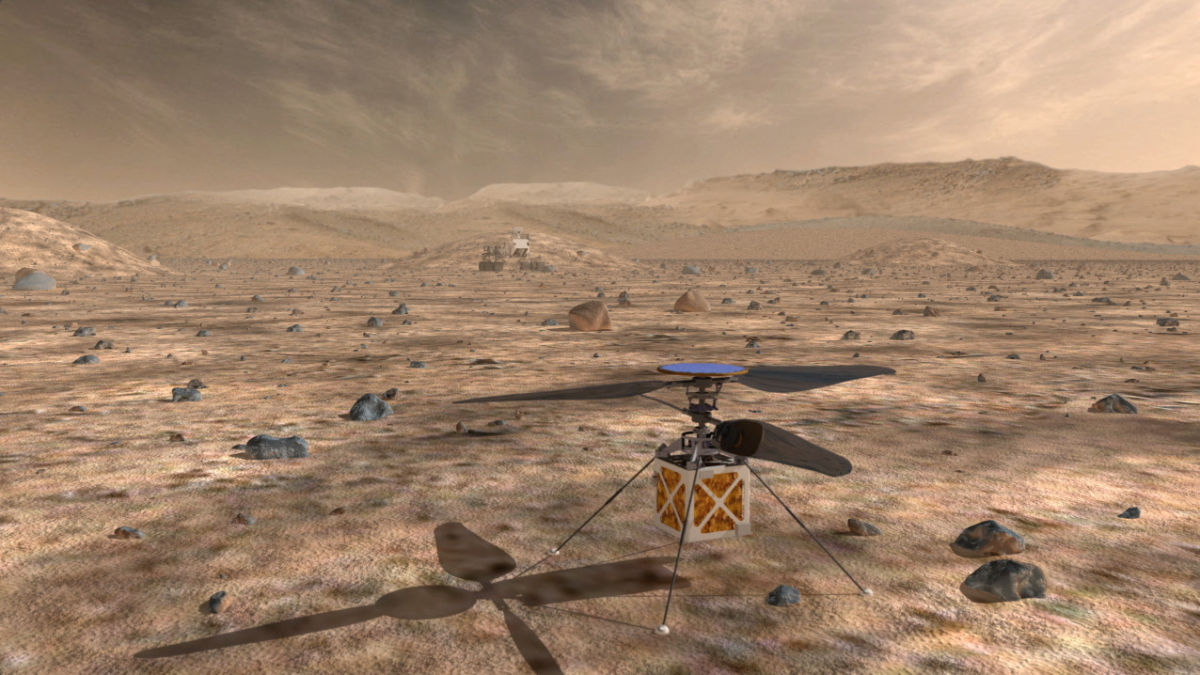
Newly selected helicopter for the Mars 2020 rover can extend the exploration zone of the rover’s landing location.
Credit: NASA/JPL-CALTECH
Prioritize promising deposits
The study, led by Sean McMahon of the UK Centre for Astrobiology, School of Physics and Astronomy at the University of Edinburgh, also involved researchers at NASA’s Jet Propulsion Laboratory, Brown University, California Institute of Technology, Massachusetts Institute of Technology and Yale University in the U.S.
“There are many interesting rock and mineral outcrops on Mars where we would like to search for fossils, but since we can’t send rovers to all of them we have tried to prioritize the most promising deposits based on the best available information,” said McMahon.
For the free access research paper, go to:
https://agupubs.onlinelibrary.wiley.com/doi/full/10.1029/2017JE005478
 Posted in Space News

