 By
By  October 8th, 2025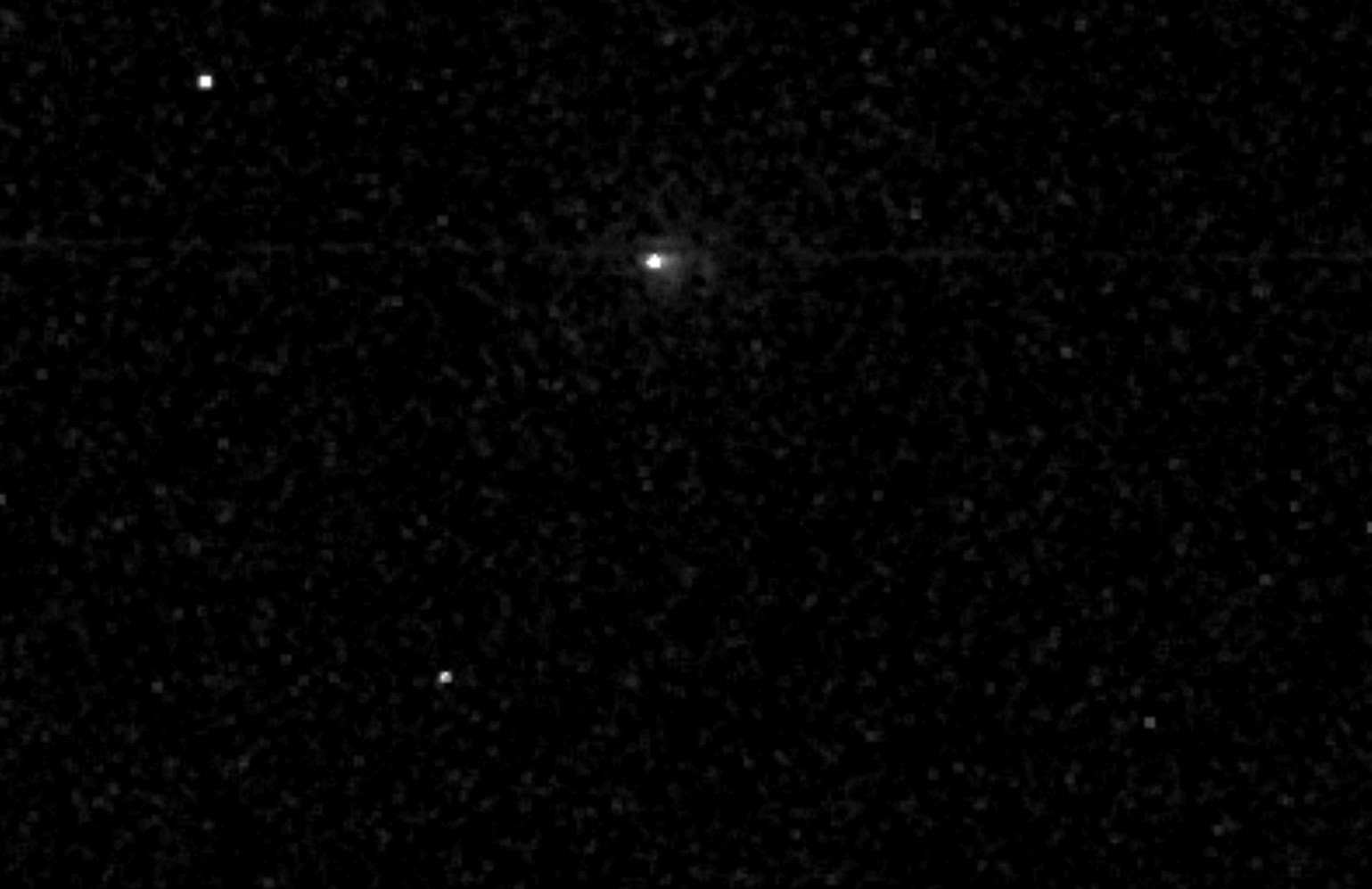
ExoMars TGO images comet 3I/ATLAS Image credit: ESA
That mysterious interloper from afar has been inspected by two Mars orbiters.
The celestial watch of 3I/ATLAS was done by the European Space Agency’s ExoMars Trace Gas Orbiter (TGO) and Mars Express with the interstellar interloper 30 million kilometers away from those spacecraft.
The object’s coma, measuring a few thousand kilometers across, is clearly visible. The Sun’s heat and radiation is bringing the comet to life, causing it to release gas and dust, which collects as this halo surrounding the nucleus.
Originating from outside our Solar System, comet 3I/ATLAS is only the third interstellar comet ever seen, following 1I/ʻOumuamua in 2017 and 2I/Borisov in 2019.
No word as yet of any observation by NASA’s Mars Reconnaissance Orbiter (MRO).

On patrol – NASA’s Mars Reconnaissance Orbiter (MRO).
Image credit: NASA/JPL
True outsiders
An ESA statement explains that “interstellar comets are true outsiders, carrying clues about the formation of worlds far beyond our own.”
Based on its trajectory, ESA says, astronomers suspect that 3I/ATLAS could be the oldest comet ever observed. “It may be three billion years older than the Solar System, which is itself already 4.6 billion years old.”
Next month, ESA’s Jupiter Icy Moons Explorer (Juice) will see the comet just after its closest approach to the Sun. While Juice will view 3I/ATLAS in a more active state, data from that spacecraft won’t be received until early 2026.
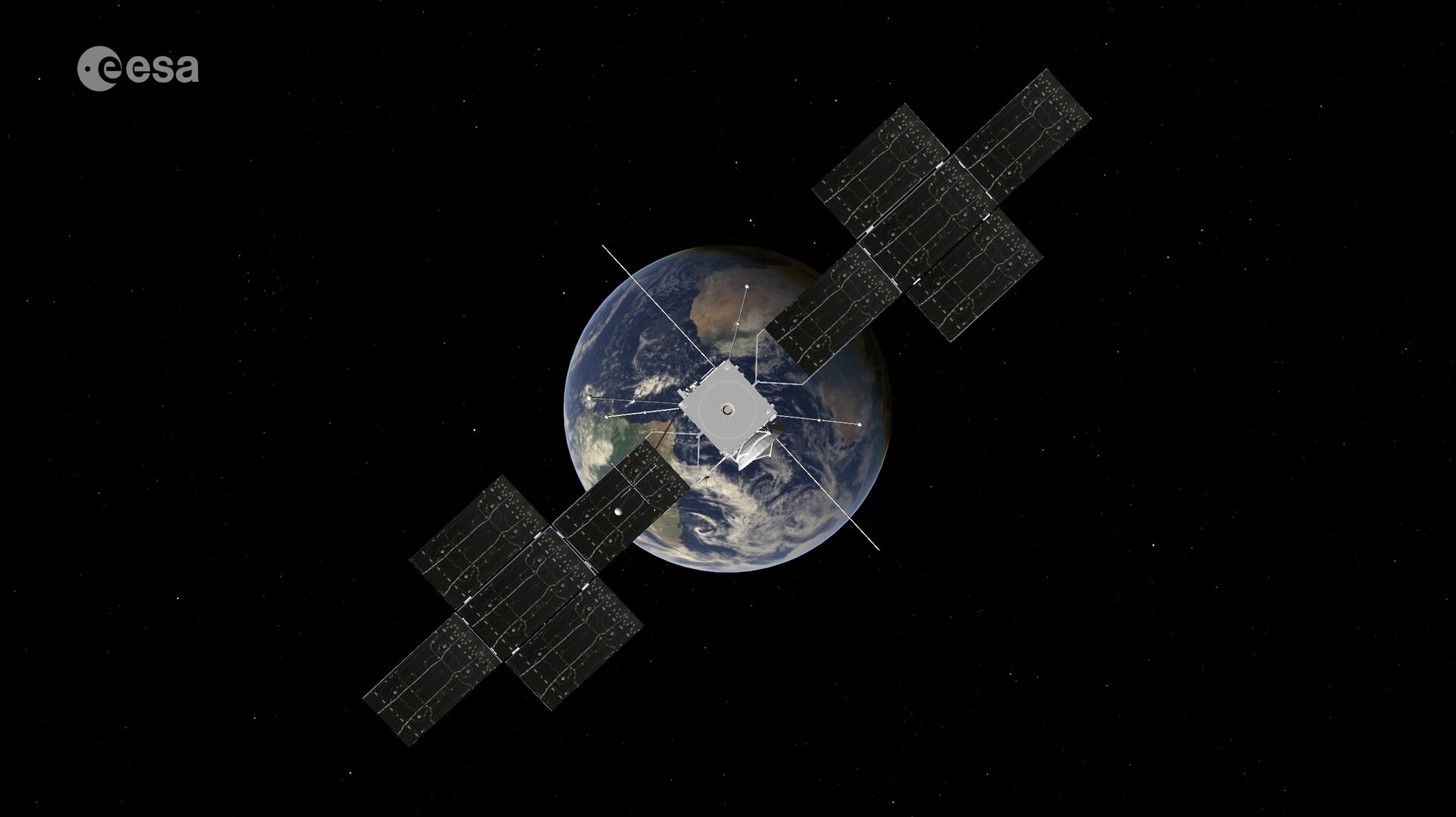
ESA’s Juice spacecraft.
Image credit: ESA
Juice observations
Juice will attempt observations in November 2025 using several instruments, including cameras, spectrometers and a particle sensor. Coordination with NASA’s en route Europa Clipper mission is being considered, in particular to observe using the twin ultraviolet spectrographs (one on each spacecraft).
As Juice is currently close to the Sun, it is using its main high-gain antenna as a heat shield. It is using its smaller medium-gain antenna to send data back to Earth at a much lower rate. It is also far from Earth, on the other side of the Sun. Therefore, ESA adds that researchers don’t expect to receive data from Juice’s observations of 3I/ATLAS until February 2026.
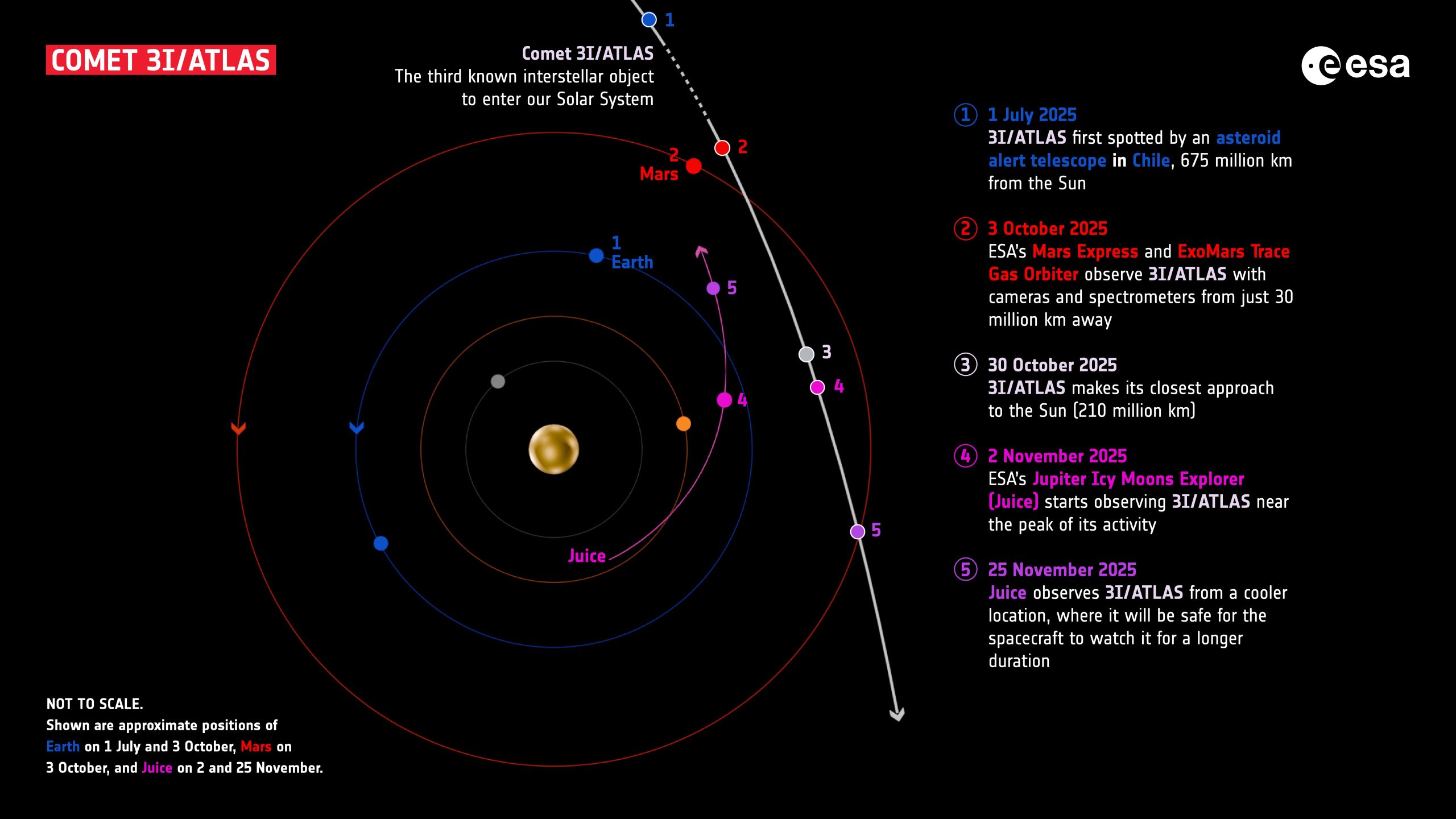
Image credit: ESA
 Posted in Space News

