 By
By  October 9th, 2025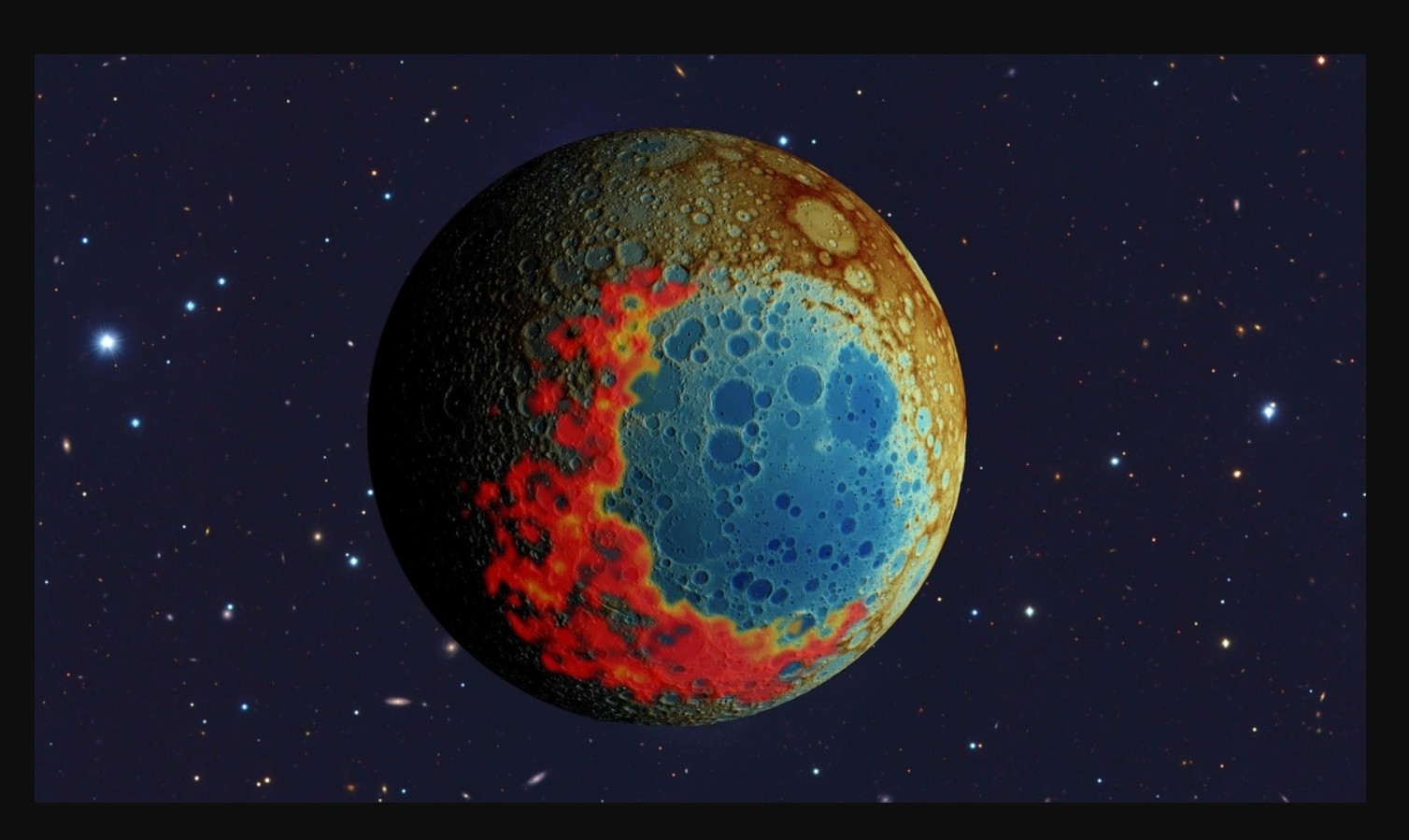
The South Pole-Aitken impact basin on the far side of the Moon formed in a southward impact (toward the bottom in the image). The basin has a radioactive “KREEP-rich” ejecta blanket on one side of the basin (bright red), containing material excavated from the lunar magma ocean. Artemis astronauts will land within this material at the south end of the basin (bottom in image).
Image credit: Jeff Andrews-Hanna/University of Arizona/NASA/NAOJ
Important new research delves into the evolution of Earth’s Moon, focused on the South Pole–Aitken (SPA) basin.
This new understanding of the basin has important implications for robotic and human exploration of the lunar south pole – a target of choice by multiple countries.
The SPA basin-forming impact occurred during a critical stage in lunar evolution, a time when the Moon was subjected to a heavy bombardment of impacts, while potentially still in the final stages of magma ocean crystallization.

Nine candidate landing regions for NASA’s Artemis III mission The background image of the lunar South Pole terrain within the nine regions is a mosaic of LRO (Lunar Reconnaissance Orbiter) WAC (Wide Angle Camera) images.
Image credit: NASA
KREEP-rich
This crystallization of the magma ocean is likely to have formed a dense, titanium-rich, ilmenite (FeTiO3)-bearing cumulates, as well as a final liquid strongly enriched in incompatible elements such as potassium, rare-earth elements and phosphorus (KREEP), including the element thorium (Th).
KREEP is an acronym stemming from the letters K (the atomic symbol for potassium), REE (rare-earth elements) and P (for phosphorus).
This prospect and a number of implications are detailed in the research paper – “Southward impact excavated magma ocean at the lunar South Pole–Aitken basin” – just published in Nature and led by Jeffrey C. Andrews-Hanna of the Lunar and Planetary Laboratory at the University of Arizona in Tucson.

Image credit: NASA
Mantle-excavating impact
“The composition of the SPA basin floor suggests a mantle-excavating impact before the overturn of the buoyantly unstable post-magma ocean cumulates, whereas increased concentrations of titanium and thorium within the basin suggest that the impact excavated into an ilmenite-rich and KREEP-rich reservoir.
“Our results indicate that the SPA basin formed from an impact on a southward trajectory at a time when the Moon still had a partial, discontinuous magma ocean,” the research paper points out.
The age of the SPA basin has been estimated at 4.25 billion years, however there is still uncertainty as to the Moon’s early bombardment history.
“Thus, important questions remain about the age of the basin, the timing and nature of magma ocean crystallization and the relation between these two pivotal events in early lunar evolution,” Andrews-Hanna and colleagues report.
Credit: NASA
Artemis landing sites
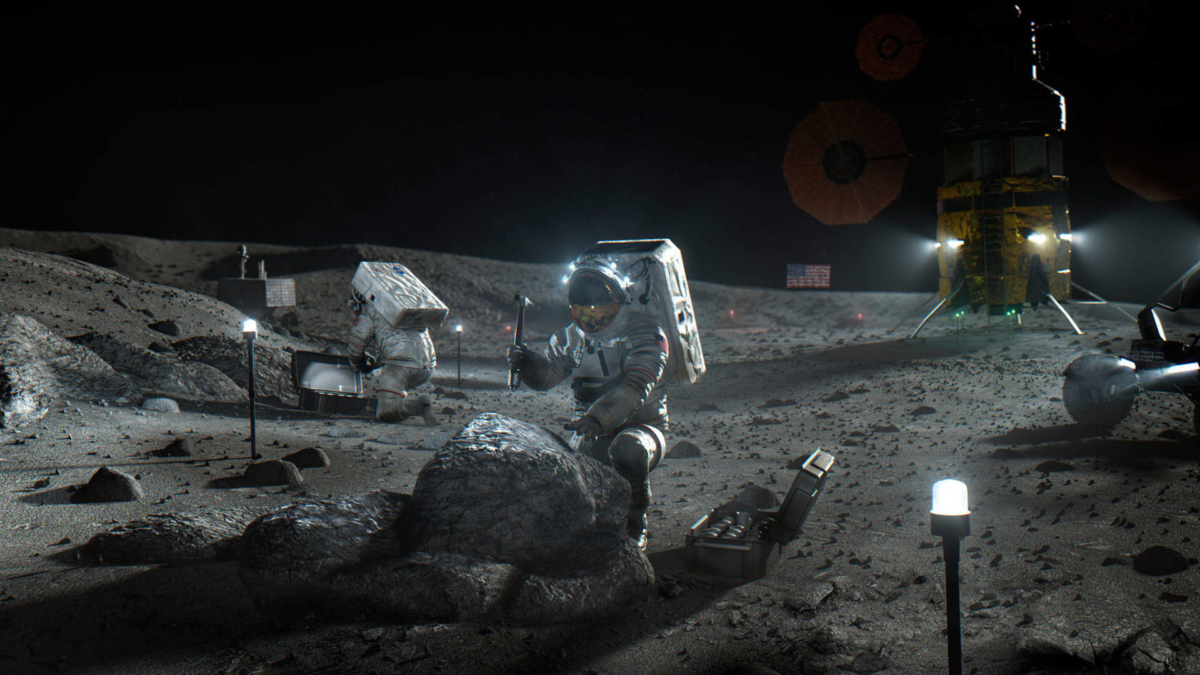
The results highlighted in the paper have “important implications for the upcoming human exploration of the lunar south pole by Artemis, as proposed landing sites are now recognized to sit on the downrange rim and thorium-rich impact ejecta of the basin.”
Proposed south polar Artemis landing sites, the research team states, are now seen to be situated within the Thorium-rich ejecta blanket at the downrange end of the basin.
“Thus, the rocks sampled by Artemis may constrain not only the age of the basin and history of lunar bombardment but also the composition of the late-stage magma ocean and timing of its solidification,” the research team notes.

Image credit: NASA
Rim shot
Observes Andrews-Hanna in a Lunar and Planetary Laboratory statement: “This means that the Artemis missions will be landing on the down-range rim of the basin – the best place to study the largest and oldest impact basin on the Moon, where most of the ejecta, material from deep within the Moon’s interior, should be piled up.”
With Artemis, Andrews-Hanna added “we’ll have samples to study here on Earth, and we will know exactly what they are. Our study shows that these samples may reveal even more about the early evolution of the Moon than had been thought.”
Endurance rover
Explains a co-author of the paper, Bill Bottke of the Southwest Research Institute & Solar System Science & Exploration Division in Boulder, Colorado, this work helps set the stage for NASA’s upcoming Endurance rover, a mission advocated in a recent National Academies of Sciences (NAS) decadal report.
The Decadal tagged the Endurance mission as the highest priority for the NASA lunar exploration program. There is a science definition team now working on the Endurance concept. However, it has yet to be funded.
“Endurance will perform a ‘Lewis and Clark’-like expedition to the Moon by collecting samples from across South Pole-Aiken basin,” Bottke tells Inside Outer Space, “and then delivering them to the Artemis astronauts. What an incredible opportunity to learn how the Moon formed and evolved!”
To read the paper – “Southward impact excavated magma ocean at the lunar South Pole–Aitken basin” – go to:
 Posted in Space News

