 By
By  December 9th, 2021
Curiosity Front Hazard Avoidance Camera Left B image taken on Sol 3320, December 8, 2021.
Credit: NASA/JPL-Caltech
NASA’s Curiosity Mars rover at Gale Crater is now performing Sol 3321 duties.
The rover is taking in the visually stunning Maria Gordon notch, reports Scott Guzewich, an atmospheric scientist at NASA’s Goddard Space Flight Center in Greenbelt, Maryland.
A plan for Sols 3321-3322 involves Chemistry and Camera (ChemCam) activities with a Laser Induced Breakdown Spectroscopy (LIBS) target on a nearby bedrock slab and then a passive observation to study atmospheric dust, ice, and gases.

Curiosity Left B Navigation Camera photo acquired on Sol 3320, December 8, 2021.
Credit: NASA/JPL-Caltech
Also, Curiosity’s arm was to be placed on “Cladh Hallan” for contact science with the Alpha Particle X-Ray Spectrometer (APXS) and Mars Hand Lens Imager (MAHLI).
Early wake-up call
On the second sol, Curiosity is slated to wake up early to catch the morning sunlight on the west face of the cliff wall lining the notch and image it with Mastcam and Navcam, Guzewich adds.
After additional science with Navcam, Mastcam, and ChemCam, the rover will drive just to the right of the corner of the cliff.

Curiosity Left B Navigation Camera photo acquired on Sol 3320, December 8, 2021.
Credit: NASA/JPL-Caltech
“From our current location, it can’t help but remind me of the Old Man in the Mountain that used to be in New Hampshire. At this parking location, we’ll conduct a focused science campaign with the [Dynamic Albedo of Neutrons] (DAN) over the weekend to study the makeup of the cliff wall itself,” Guzewich notes.

“Old Martian in the Mountain” – image taken by Right Navigation Camera on Sol 3319 December 7, 2021
Credit: NASA/JPL-Caltech
Tight canyon
In an earlier report, Mark Salvatore, a planetary geologist at the University of Michigan, explains that Curiosity is currently located within Maria Gordon notch, which is a rather tight canyon surrounded by high rock walls located at the transition onto the Greenheugh Pediment.
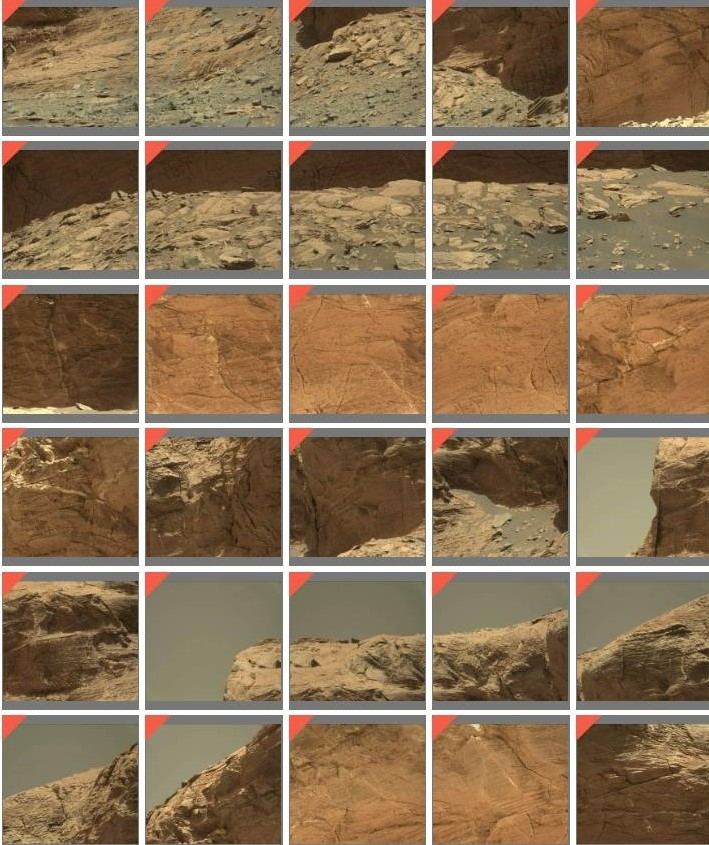
Curiosity Mast Camera Right imagery acquired on Sol 3319, December 7, 2021.
Credit: NASA/JPL-Caltech/MSSS
The rover views are currently magnificent, Salvatore adds, with steep walls surrounding Curiosity that cast some rather dramatic shadows onto the workspace.

Curiosity Mast Camera Right photo taken on Sol 3319, December 7, 2021.
Credit: NASA/JPL-Caltech/MSSS
“However, despite the beautiful views, today was a sobering lesson in the complexities of planning and executing martian surface science investigations,” Salvatore says. “On some days, planning the scientific activities for the Curiosity rover to perform on Mars seems easy – observe cool features, plan cool observations, and let Curiosity execute the plan as proposed.”

Curiosity Mars Hand Lens Imager photo produced on Sol 3320, December 8, 2021.
Credit: NASA/JPL-Caltech/MSSS
Series of events
Today, unfortunately, was not one of those days.
“A series of events (including a drive that was cut short on the previous day and a delay in getting all of our data processed, mosaicked, and ready for scientists to use) prevented our original plan from being submitted and executed,” Salvatore explains.
First, because Curiosity’s drive ended early yesterday, researchers did not have the full imaging data available for them to ensure use of the rover arm and APXS instrument safely.
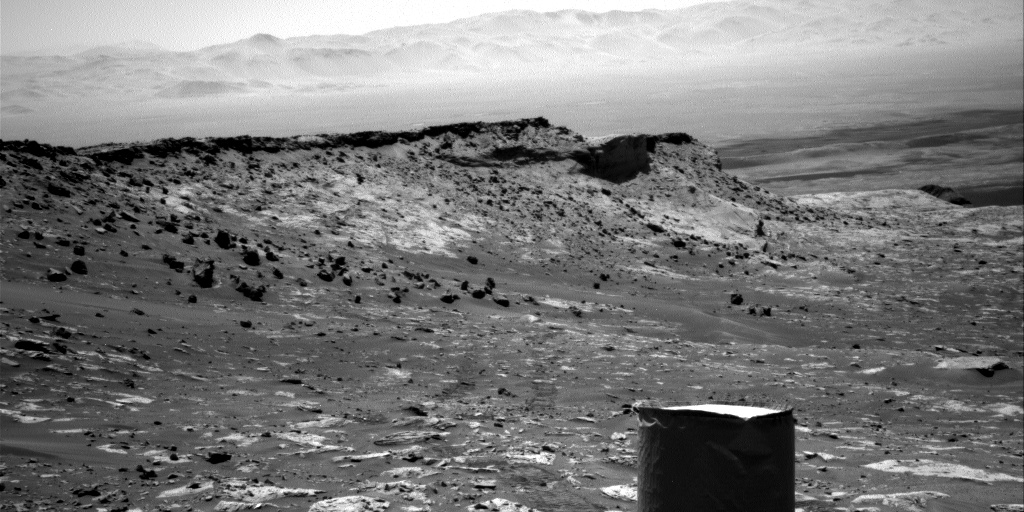
Curiosity Right B Navigation Camera image acquired on Sol 3320, December 8, 2021.
Credit: NASA/JPL-Caltech
“Therefore, we scrubbed our original plan to perform an APXS observation of ‘typical’ bedrock in front of the rover in exchange for using the MAHLI instrument to image the rover wheels and to determine whether Curiosity is in a stable position to use the arm in the next planning cycle, Salvatore notes.
Auto-targeting
Next, scientists modified their original plan to target local bedrock with a ChemCam LIBS observation in exchange for a ChemCam AEGIS activity, which is designed to automatically identify targets of interest in the landscape and autonomously target them with ChemCam’s laser instrument. Lastly, the team planned a handful of Mastcam imaging mosaics with the limited pointing and localization information available to the team.
AEGIS stands for Autonomous Exploration for Gathering Increased Science) – a software suite that permits the rover to autonomously detect and prioritize targets.
Planning cycle
“Even though today came with a lot of complexity and a lot of ‘back-and-forth’ between the science team and the rover planners, the uplink team managed to develop and uplink a really strong plan to characterize our current workspace with Mastcam and ChemCam observations,” Salvatore adds.
While great science is being done, Salvatore concludes, “here’s to hoping that the next few planning cycles are smoother and more straightforward than today’s planning cycle!”
 Posted in Space News

