 By
By  June 15th, 2024
Image credit: CCTV/Inside Outer Space screengrab
China’s projected human exploration of the Moon received a boost last week given a first-time propulsion system test for the country’s powerful Long March-10 rocket.
According to the China Aerospace Science and Technology Corporation (CASC), the propulsion system for the first stage of the Long March-10 launch vehicle underwent testing for the first time on June 14.

Image credit: CCTV/Inside Outer Space screengrab
During the static firing test, three YF-100K engines churned out a ground thrust reaching 382 tons. The YF-100K is a reusable liquid oxygen/kerosene rocket engine.
The Long March-10 is to be a three-and-a-half-stage rocket designed to carry over 27 tons of payload to the Earth-to-Moon transfer orbit.
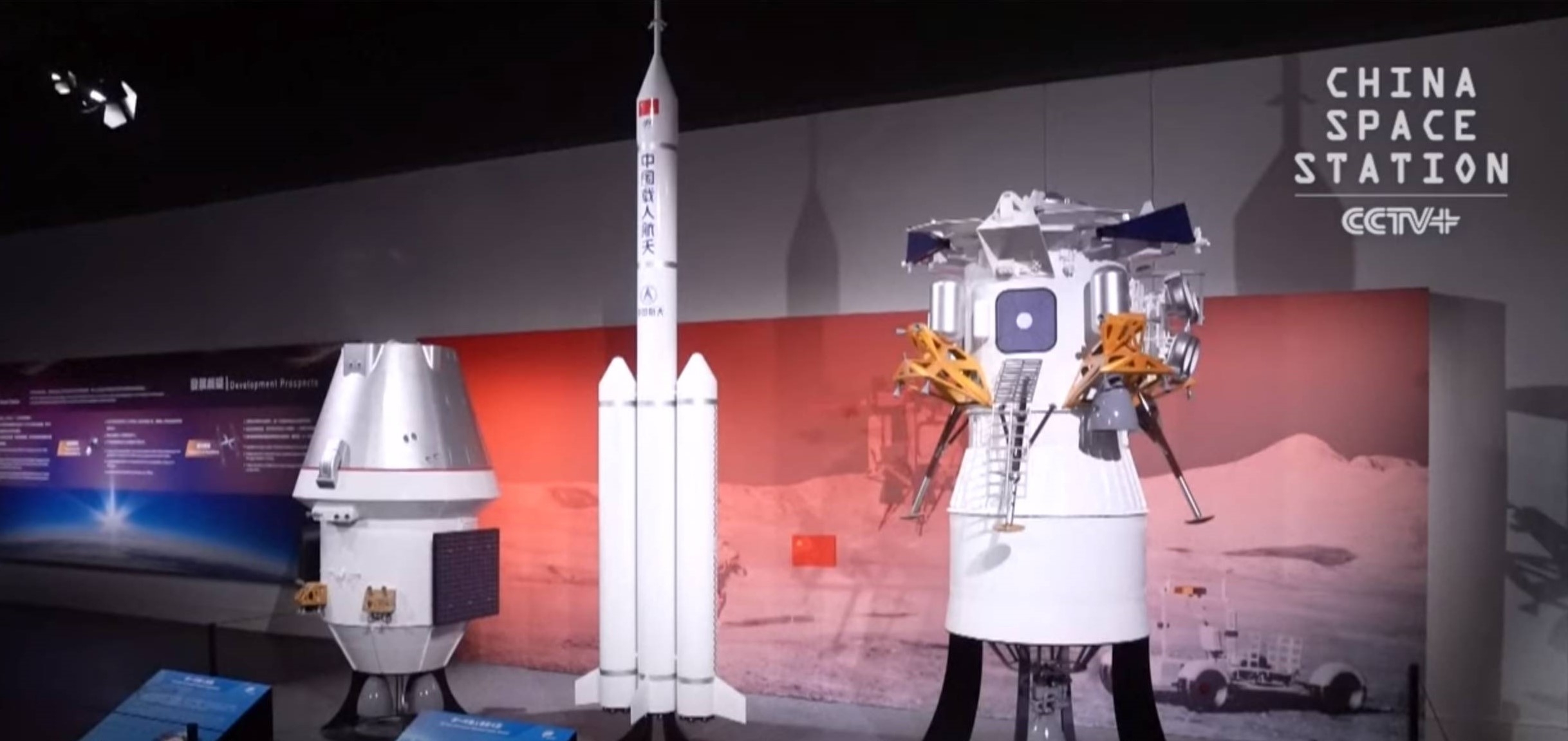
China’s plans for human crews on the Moon are being shaped.
Image credit: CCTV/Inside Outer Space screengrab
Institute 101
The rocket engine trial run for the first-stage propulsion system of the Long March-10 took place at Institute 101 of the Sixth Academy of China Aerospace Science and Technology Corporation (CASC) in Beijing.
CASC explains that a second ground test of the first-stage propulsion system is scheduled to take place soon.
The recently completed firing was the first large-scale system-level ground test of the Long March-10 series and marks a key step toward realizing China’s stated goal of landing a crew on the Moon by 2030.

Image credit: CCTV/Inside Outer Space screengrab
Crews, lunar landers
“The test is basically a comprehensive verification of our first-stage module. It was a complete success, laying a solid foundation for our subsequent research and development and the realization of our entire manned lunar exploration program,” said Xu Hongping, an engineer with CASC told CCTV.
Development of the Long March-10 is geared to send piloted spacecraft and Moon landers into a Earth-Moon transfer orbit.
The rocket specs placed it as having a total length of about 300 feet (92 meters), a takeoff weight of over 2,180 tons, a takeoff thrust of about 2,678 tons, and a carrying capacity of no less than 27 tons for an Earth-Moon transfer orbit.

Chinese astronauts may be investigating the Moon up-close before 2030.
Image credit: CMS
Advanced manufacturing sector
A non-booster configuration of the new rocket is capable of conducting missions for transporting astronauts and cargo to China’s space station.
“The development of new-generation manned rockets can greatly enhance our country’s ability to enter space and help the Chinese land on the Moon,” Xu added.
“In addition, some of its technological breakthroughs can drive the development of our entire aerospace industry,” Xu said, “and will be a considerable boost to the country’s advanced manufacturing sector.”
Go to this video spotlighting the recently completed static firing at:
https://youtu.be/a0Is9xmPUbA?si=avW3-ikDLPiQfGTp

Long March -10 Image credit: CMSE
 Posted in Space News

