 By
By  December 25th, 2024
The Hong Kong University of Science and Technology (HKUST) is spearheading an international collaboration project for China’s Chang’e-8 mission. Key research project personnel from HKUST include Prof. Yu Hongyu (3rd left), Prof. Sun Qingping (2nd left), Prof. Shi Ling (2nd right), and Prof. Duan Molong (1st right).
Technologists in China have the go-ahead to engineer a multi-task Moon robot for use in the country’s Chang’e-8 lunar landing mission, now set for launch around 2028.
The Hong Kong University of Science and Technology (HKUST) announced today its appointment by the China National Space Administration (CNSA) to spearhead an international collaboration project for the lunar lander mission.
Reportedly, the extraterrestrial android would weigh roughly 220 pounds (100 kilograms).
International partners
In October 2023, CNSA issued the Opportunity Announcement for International Cooperation on the Chang’e-8 endeavor.
HKUST assembled a team of international partners to submit a proposal to the Lunar Exploration and Aerospace Engineering Center of CNSA and was selected in November this year.

Chang’e-8 south pole Moon lander.
Image credit: CNSA/HKUST
According to China’s Xinhua news service, the Chang’e-8 will constitute, together with Chang’e-7, the basic model of a lunar research station. The Chang’e-7 probe is expected to be dispatched to the Moon around 2026 to implement resource exploration of the lunar south pole.
Dexterous operations
The HKUST-led team, according to the university, is set to produce a multi-functional lunar surface operation robot capable of dexterous operations with a mobile charging station.
“As one of the pioneering initiatives led by China to set up an international lunar research station, this project will pave the way for the establishment of a long-term unmanned facility in the lunar polar regions,” a university statement explains.
The robot is envisioned to conduct scientific exploration, deploy and install instruments in the Moon’s harsh environment. Its mobile wireless charging capability is to energize various devices on the lunar surface. Positioning, navigation and autonomous movement would not rely on satellite navigation systems.
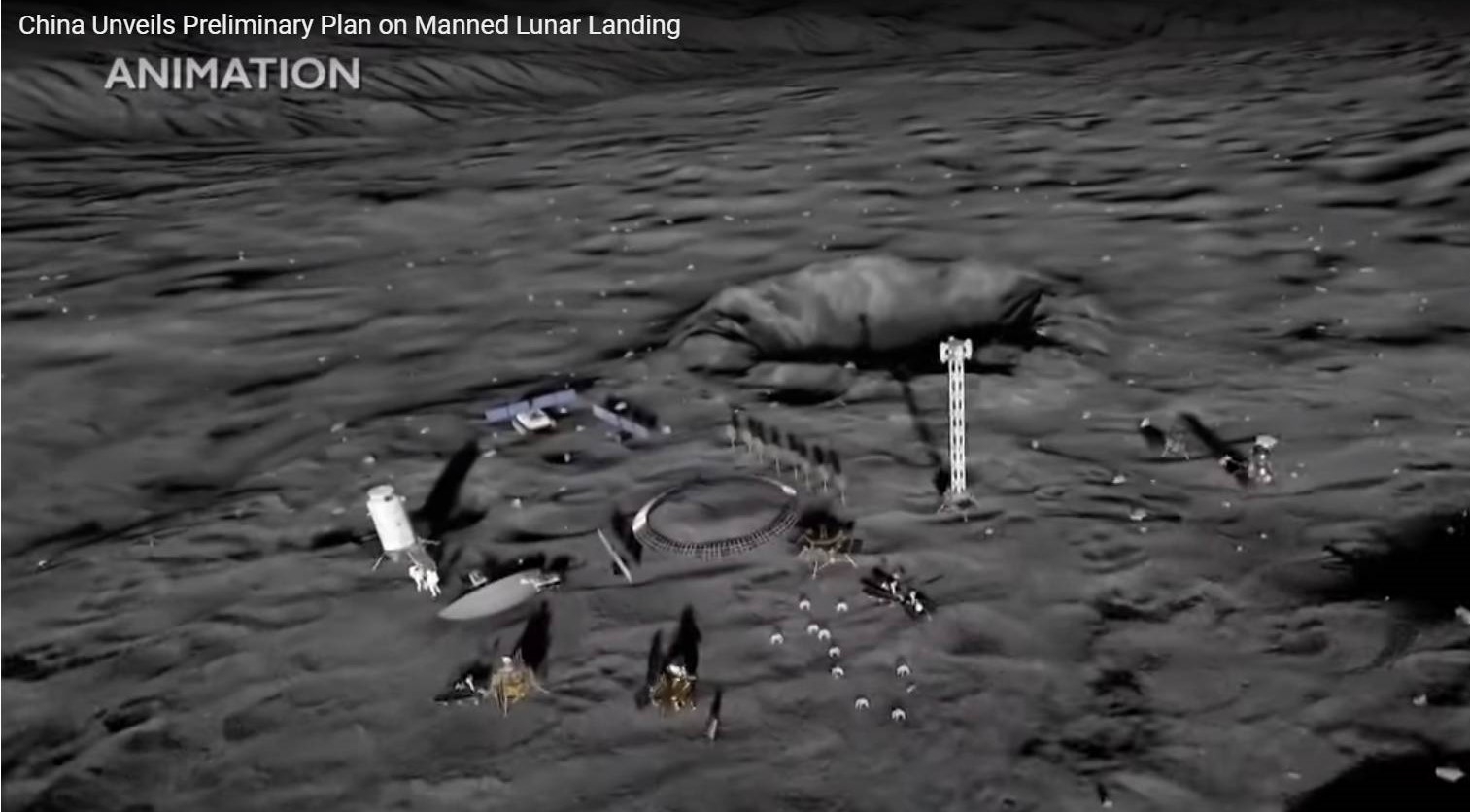
Artist’s view of International Lunar Research Station. Image credit: CNSA
The Hong Kong Space Robotics and Energy Center will be established to drive this mission forward while fostering collaboration across institutions and regions.
Other team members are from Dalian University of Technology, Shenzhen University, Hong Kong Polytechnic University (PolyU), and the South African National Space Agency (SANSA).
Low lunar temperature, highly skilled robot
Professor Yu Hongyu, director of the HKUST Space Science and Technology Institute is also principal investigator of the lunar robot.
“First, our robot venturing into the lunar south pole will encounter extremely low temperatures. To ensure its reliable performance, the use of advanced materials and temperature management systems is essential,” Yu said.
“Secondly, the absence of satellite navigation on the Moon means a smart design is required to effectively address the complexities of positioning, navigation, autonomous movement and operational control,” added Yu. “At the same time, the robot must stay lightweight while handling multiple precision tasks and serving as a charger for other lunar equipment.”
 Posted in Space News

