Archive for the ‘Wait a Minute!’ Category
 Author:
  May 11th, 2024
Wait-a-minute.
Image credit: Barbara David
In a wait-a-minute moment, pre-launch imagery of China’s Chang’e-6 shows some sort of a mini-rover with four wheels.
But so far, as far as I know, there’s been no official word from the China National Space Agency (CNSA) regarding the rover.
A glimmer of information has come from a story via China’s Science Network (news.sciencenet.cn). It does note the presence of a Chang’e-6 lunar rover.

Chang’e-6 pre-launch look with wheeled rover attached, left.
Image credit: CNSA/CCTV/Inside Outer Space screengrab
Imaging spectrometer
According to the article, the Shanghai Institute of Ceramics, Chinese Academy of Sciences (later referred to as Shanghai Institute of Ceramics) undertook the development of a number of key materials.
“The large-sized tellurium dioxide crystal developed by the Shanghai Silicate Institute has excellent acoustic and optical properties and is a key material to achieve a large field of view, high spatial and spectral resolution, and is used in the infrared imaging spectrometer of the Chang’e-6 lunar rover,” the story explains.

Artwork of Chang’e-6 landing on Moon’s far side.
Image credit: CGTN/CNSA/Inside Outer Space screengrab
Shutter speak
“The ultrasonic motor is the ‘helper’ that presses the shutter for the ‘Chang’e Family’ lunar rover’s infrared imaging spectrometer. Piezoelectric ceramics are the core material of the ultrasonic motor,” the story continues. “Following Chang’e-3, 4 and 5, the wide temperature range and highly stable piezoelectric excitation element developed by Shanghai Silicate Institute was successfully used in the Chang’e-6 ultrasonic motor.”
So there you have it, all of it so far. But surely more is to come given a successful far side touchdown of the Chang’e-6 sample return mission. If the rover is deployed and in good shape, perhaps looks at lunar sampling operations may be in the offing.

China’s first Moon lander, Chang’e-3, taken by Yutu-1 rover during 2013 nearside exploration.
Image credit: CNSA/CLEP
Then there’s the prospect of a view of the Chang’e-6’s ascender craft departing the area, loaded with its precious cargo of collected Moon goodies.
Rover comparisons
On the other hand, the Chang’e-6 rover machinery is clearly different than the earlier Yutu-1 and Yutu-2 rovers, each with six wheels, both loaded to their solar panels with lots of equipment.
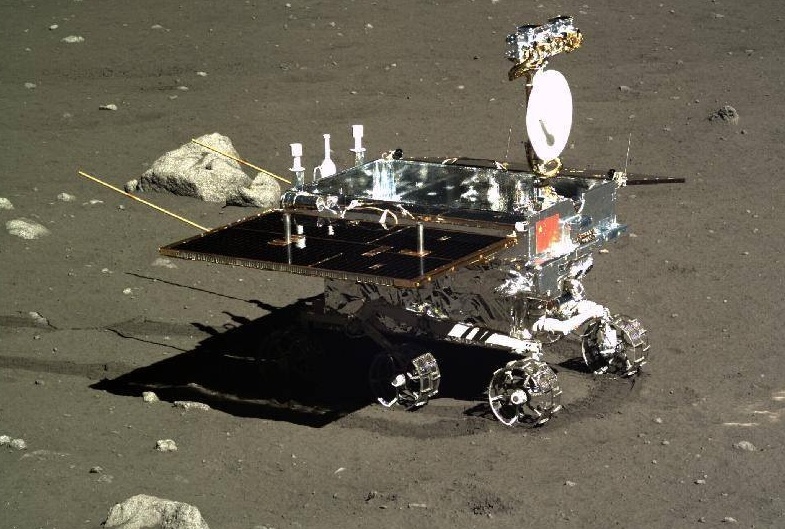
China’s Yutu-1 Moon rover.
Image credit: Chinese Academy of Sciences

Yutu-2 on the prowl.
Image credit: CNSA/CLEP
The Chang’e-3 Moon lander let loose Yutu-1 in Mare Imbrium after its December 2013 arrival on the Moon.
Yutu-2’s home turf since deployed by the Chang’e-4 lander in January 2019 is Von Kármán crater within the Moon’s south pole-Aitken basin. It is reportedly alive and well and still on the move.

Chang’e-4 lander as observed by Yutu-2 rover.
Image credit: CNSA/CLEP
Lastly, as a prelude to the launch of Chang’e-6, a communication test between China’s recently lofted Queqiao-2 relay satellite was carried out, one aspect of which was linking up with Chang’e-4 far side lander/rover hardware.
Hopefully, more details about the Chang’e-6 rover duties are forthcoming, once rolling about the landing zone.
 Posted in
Wait a minute.
Image credit: Barbara David
Over the last number of years, our planet has become encircled by Starlink, OneWeb, and other “megaconstellation” satellites.
Yes, the emergence of those megaconstellations offers great benefit for humanity. But in a wait-a-minute pause, there are also substantial costs, including the imposition on humankind’s ongoing and growing thirst for astronomical peering into the surrounding universe.
That’s the view of David Koplow, the Scott K. Ginsburg Professor of Law at Georgetown University Law Center in Washington, D.C.

Starlink constellation pass overhead near Carson National Forest, New Mexico, photographed soon after launch.
SpaceX Starlink Satellites over Carson National Forest, New Mexico, photographed soon after launch.
Credit: Mike Lewinsky/Creative Commons Attribution 2.0
“We are just beginning to appreciate how bad the disruption can be for land-based and space-based telescopes, and as more and more satellite overflights occur, the problems will only intensify,” Koplow told Inside Outer Space.
Legal rights
Koplow’s concerns have been voiced in several scholarly works, the titles of which underscore his qualms, such as: “Large Constellations of Small Satellites: The Good, the Bad, the Ugly and the Illegal,” as well as “Blinded by the Light: Resolving the Conflict Between Satellite Megaconstellations and Astronomy.”

Starlink satellites visible in a mosaic of an astronomical image.
Courtesy of NSF’s
National Optical-Infrared Astronomy Research Laboratory/NSF/AURA/CTIO/DELVE)
“The world has mostly been assuming that the relevant international law basically allows the satellite companies to do whatever they want in space, while forcing the observatories to adapt as well as they can,” Koplow advised.
But in reality, Koplow continues, the legal regime is not so one-sided. “Astronomers also have legal rights to free use of space, and they need not stand by idly while their profession is damaged.”
Hair on fire
Koplow points out that in 2019 the world of optical and radio astronomy changed abruptly and massively when the first SpaceX batch of 60 Starlink satellites was lofted.
“Jolted by the sudden brightness of those spacecraft, and alarmed by the prospect of their legions of successors, observatories scrambled to respond,” Koplow observes.
They did so by studying and documenting the true dimensions of the problem, beginning to invent or conceptualize mitigation measures, and entering into discussions with SpaceX and other companies.
“Some astronomers see this as a true ‘hair on fire’ emergency, heralding irretrievable losses to space science; others present a more sanguine face, depicting this as yet another challenge to be surmounted in surveying a decreasingly pristine sky,” Koplow remarks.

Image credit: ESO/P. Horálek
Incipient clash
That said, the astronomical community has related that the time and the financial costs of conducting effective astronomy will rise considerably, Koplow says, “and that some important data will simply be irretrievable, with concomitant losses for science and the future exploration and use of space.”
In his “Blinded by the Light” treatise, Koplow describes the incipient clash between satellite megaconstellations and astronomy, assesses the relevant international and domestic legal authorities, and proposes compromise solutions to mitigate the damage.
“Overall, the thesis is that a better balance must be struck between these competing types of space activities,” Koplow adds, “without ceding to either a comprehensive right to proceed in disregard of the key functions of the other.”

Credit: OneWeb
Voluntary measures
Koplow acknowledges that some satellite companies have voluntarily invested considerable corporate talent and money in efforts to mitigate their interference with astronomy.
“But these voluntary measures are not adequate to solve the problem, they are not durable and reliable, and they have not been adopted by all the companies,” Koplow suggests.
“A stronger response is necessary,” Koplow concludes.
To gain access to “Blinded by the Light: Resolving the Conflict Between Satellite Megaconstellations and Astronomy” go to: https://papers.ssrn.com/sol3/papers.cfm?abstract_id=4346299
To review the paper “Three Things I Hate About Large Constellations of Small Satellites” go to: https://papers.ssrn.com/sol3/papers.cfm?abstract_id=4503593
Wait a minute.
Image credit: Barbara David
In a post-flight analysis of the Artemis 1 uncrewed mission, NASA has identified more than 100 locations where ablative thermal protective material from the Artemis 1 Orion heat shield chipped away unexpectedly during reentry into Earth’s atmosphere.
In classic “wait a minute” style, a NASA Office of Inspector General (OIG) report has been issued – “NASA’s Readiness for the Artemis II Crewed Mission to Lunar Orbit” – calling attention to this issue and others before sending off a human crew to circle the Moon.

Image credit: NASA OIG
Root cause
To ensure the safety of the crewed Artemis II mission, the newly-issued OIG report recommends the Associate Administrator for Exploration Systems Development Mission Directorate:
- “Ensure the root cause of Orion heat shield char liberation is well understood prior to launch of the Artemis II mission.
- Conduct analysis of Orion separation bolts using updated models that account for char loss, design modifications, and operational changes to Orion prior to launch of the Artemis II mission.”
The report by the NASA OIG also notes that “human space flight by its very nature is inherently risky, and the Artemis campaign is no exception. We urge NASA leadership to continue balancing the achievement of its mission objectives and schedule with prioritizing the safety of its astronauts and to take the time needed to avoid any undue risk.”

Image credit: NASA OIG
Taking the heat
In earlier reporting, here’s my take on the situation, as posted on Space.com:
“NASA still investigating Orion heat shield issues from Artemis 1 moon mission” at:
https://www.space.com/nasa-investigate-orion-heat-shield-artemis-1-mission
For more information on the new IG report, take a look at Brett Tingley’s new story at Space.com – “NASA inspector general finds Orion heat shield issues ‘pose significant risks’ to Artemis 2 crew safety” at:
https://www.space.com/nasa-artemis-1-orion-heat-shield-office-inspector-general
Also read this story by Eric Berger, senior space editor at Ars Technica titled “NASA says Artemis II report by its inspector general is unhelpful and redundant” at:
For a full read of this just-issued NASA OIG report, go to:
https://oig.nasa.gov/wp-content/uploads/2024/05/ig-24-011.pdf

Orion heat shield features ablative material, called Avcoat.
Image credit: Lockheed Martin

High-speed return from lunar distance, the thermal protection system of Orion’s crew module must endure blistering temperatures to keep crew members safe. Measuring 16.5 feet in diameter, Orion’s heat shield is the largest of its kind developed for missions carrying astronauts.
Image credit: NASA

Wait a minute!
Image credit: Barbara David
In classic “wait a minute” style, for ConkSat where there’s will, there’s a way – with X postings offering some challenging marketing concepts.
“For years, spaceflight companies have discussed means for reducing the amount of space junk in low Earth orbit (LEO). As visionaries at ConkSat, we have never been satisfied with the status quo – and that means going against popular thinking. That’s why we’re announcing the first spacecraft dedicated to increasing the amount of space junk in LEO,” explains a ConkSat posting.

“FragSat is more than a satellite – it’s a cloud of over 70 billion steel ball bearings packed into a payload fairing. Say goodbye to your competitor’s megaconstellations with FragSat, guaranteed to increase the rate of collisions in orbit by orders of magnitude. Taking advantage of the increase in payload to orbit offered by new launchers, we’re planning on up to twenty launches per year of pure steel, rendering entire families of orbits unusable for centuries,” continues the posting from ConkSat.
“Just another way we’re bringing space down to Earth.”

Image credit: ConkSat
Quality Unassurance
Another X posting from ConkSat spotlight they fired their entire quality assurance team.
“How are we going to keep our rockets, satellites, and missiles at the quality expected of the ConkSat brand? Simple – we aren’t. We can’t let quality assurance hold us back from true innovation. From this point forward, we aren’t keeping lengthy or dated records. We won’t be “doing critical maintenance.” Our engineers will be motivated by the desire to push humanity forward, and by the fact that we required them to live downrange of the launch site.”

Bringing space down to Earth. At high speed.
Image credit: ConkSat
What’s the point?
“People called us crazy. People called us names. Some hurtful. People told us we were “violating federal regulations” and would be “shut down immediately.” But you don’t become a leading defense contractor without stepping on a few toes.”

Image credit: ConkSat
“Let’s be honest. Everybody’s worst nightmare is dumping $1bn in seed money into a rocket startup, only to have them churn out an ugly looking launch vehicle with weird fins at the top. If you’re embarrassed to release the promotional hype video, what’s the point? That’s why we at ConkSat recognize the importance of a smooth profile. Our launch vehicles are guaranteed to be 100% smooth with no protrusions or ugly changes in diameter that could render your investment silly.”
Artificial intelligence
“At ConkSat, we know AI is the future. Everything we do is powered by AI – every email, every spreadsheet, and every piece of code is created 100% by ChatGPT. Our launch vehicles are guided completely by onboard neural networks: even we don’t know where our rockets will land! Curious about how we’ll create the future of spaceflight? So are we! Hopefully we figure it out before our investors do.”
Thank you ConkSat for all that you do! — Leonard David
Wait-a-minute.
Image credit: Barbara David
China has reportedly embarked on a magnetic levitation (MagLev) system using an electromagnetic catapult to hurl a 50-ton space plane down a track at speeds up to Mach 1.6.
At the rail gun’s end, the space plane would use a propulsion system to reach orbit.
The South China Morning Post reports work on the idea is underway. Just how much momentum the research has behind it isn’t clear.
But if this sounds familiar…it is…and a wait-a-minute moment.

MagLifter concept. Image credit: NASA
Years ago, NASA’s Marshall Space Flight Center showcased a 50 feet (15 meters) MagLev test track.
NASA engineers working on the concept, however, couldn’t levitate, attract, and speed the necessary moolah their way to the idea – essentially derailing work.

Image credit: NASA
Mass drivers
Waaay back in 1974, work on “mass drivers” was undertaken by the late Gerard O’Neill and colleagues at Princeton University and also the Massachusetts Institute of Technology.
Mass drivers were viewed then as the logical means for transporting lunar raw material to special spots in space, namely L-5.
Those mass drivers were electromagnetic launchers that could accelerate payloads in re-circulating buckets with superconducting magnet coils at a repetition rate of about ten per second.

Artwork shows Mass driver on Moon. Courtesy: Space Studies Institute (SSI)
Raw power
One application O’Neill proposed for mass drivers: toss baseball-sized chunks of ore mined from the surface of the Moon into space. Once in space, the ore could be used as raw material for building space colonies and solar power satellites.
Now decades later, enter the world of today’s bullet trains, high-velocity artillery shells, airplane catapults, hyped-up hypersonic vehicles, new materials, and superconductor thinking – time for a MagLev re-look for space?
Space technologists in China seemingly think so.
Go to: “China building giant hypersonic railgun for space launches” by Gabriel Honrada in Asian Times at:
China building giant hypersonic railgun for space launches
Also, for more information, go to these previous Inside Outer Space stories:
https://www.leonarddavid.com/navy-rail-gun-progress-ideal-for-the-moon/
https://www.leonarddavid.com/electromagnetic-mass-driver-back-to-the-moon/

Wait-a-Minute!
Image credit: Barbara David
There’s some interesting “wait a minute” fallout from the upcoming nose dive to Earth of the European Remote Sensing satellite, ERS-2.
According to the European Space Agency (ESA), the spent ERS-2 satellite weighing 2.3 tons is predicted to slip into Earth’s atmosphere on February 19 – with a current uncertainty of +/- 2.8 days.
“No intervention can be made from the ground, so ERS-2 will return entirely naturally – now a common occurrence as on average one spacecraft reenters Earth’s atmosphere per month,” an ESA statement explains.
The bit about “return entirely naturally” is an interesting, user-friendly substitute for “uncontrolled.”

Artwork of incoming ERS-2. Image credit: ESA
End of life
Following its launch in April 1995, ERS-2 ran for nearly 16 years of observing the Earth.
In 2011, ESA took the decision to bring the mission to an end.
That was followed by ground-activated de-orbit maneuvers. Those lowered the satellite’s average altitude and mitigated the risk of collision with other satellites or space debris, ESA notes.
The spacecraft was also “passivated” to reduce the risk of fragmentation. Passivated is getting rid of internally stored energy, like unused propellant, even de-charging batteries.
Wake-up call
All that said there are those that see the fall of ERS-2 as a calling card from space that doubles as a wake-up call – and on several fronts.
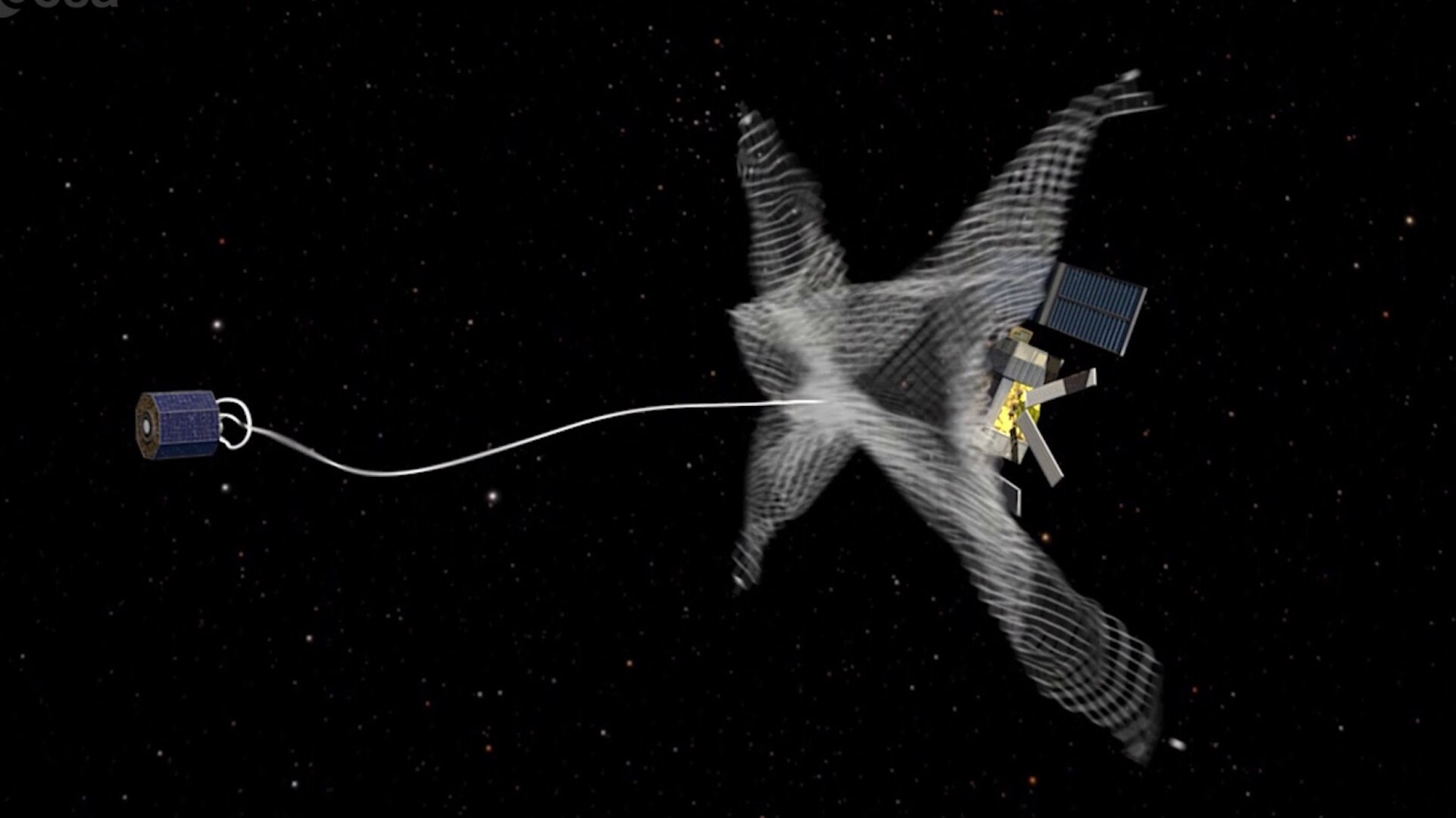
Netting of orbital debris has been studied, with ERS-2 as the catchable bait in a mix of junk-snatching ideas.
Image credit: ESA/D.Ducros
“While the ESA should be lauded for its efforts to de-orbit the ERS-2, it should be unsurprising that a 2.3-ton satellite launched into Earth orbit without any enforceable orbital debris regulation will then return to Earth’s atmosphere as orbital debris in an explosive uncontrolled reentry,” said Michael Runnels, an assistant professor of business law at California State University, Los Angeles.
“Indeed, these events highlight the continuing need for enforceable orbital debris regulation to support the sustainable exploration and scientific investigation of outer space,” Runnels told Inside Outer Space.
Someone someday
Ewan Wright is a PhD candidate at the University of British Columbia and Junior Fellow of the Outer Space Institute. He is actively focused on the sustainability of the outer space environment.
ERS-2 is a three decade old Earth Observation satellite with a mass about that of a Ford F-150, Wright said. “ERS-2 won’t burn up entirely when it reenters the atmosphere, so there is a chance that debris will hit someone on the ground, or disrupt air traffic.”

ERS-2 artwork.
Image credit: ESA
Wright told Inside Outer Space that, fortunately, the probability of someone getting hit is small. “But if we keep doing this again and again, someone someday will get hurt.”
Random reentries
Last year, 30 satellites larger than 500 kilograms uncontrollably reentered the atmosphere.
In total, in 2023, about 55 tons of satellite reentered randomly, Wright stated. ESA was responsible in lowering ERS-2’s orbit to make sure it didn’t become permanent space debris, he said.
“But in the future, all large satellites should do controlled reentries. Operators should control them to reenter over the oceans, away from people, aircraft and ships,” Wright concluded.
Minimize risk
The incoming ERS-2 is something that happens quite regularly with defunct satellites, said Leonard Schulz, a researcher at the Technische Universität Braunschweig’s Institute of Geophysics and Extraterrestrial Physics in Braunschweig, Germany.
Such falls will only increase in the future, Schulz added, due to the growing number of objects brought into low Earth orbit.

Image credit: NOAA
“I think the mass of the object stands out, probably some parts of the satellite will survive reentry,” Schulz told Inside Outer Space. “And this is the reason why people try to make satellites burn up completely in the atmosphere, to minimize the risk to people on ground.”
Atmospheric effects
Schulz said that there’s need to consider the effects on the atmosphere from spacecraft re-entry, a hot topic that ESA is evaluating.
“Today, we are lacking information on many aspects when it comes to materials released and subsequent effects on the atmosphere,” Schulz pointed out.
Satellite reentries are a good opportunity to gather observational data with measurement campaigns, Schulz advised. However, such uncontrolled reentries as with ERS-2 are extremely difficult to observe, he said, as the uncertainty of where the satellite reenters is so high.
“But controlled reentries provide great measurement opportunities,” Schulz concluded, “which should be a focus in the future!”

Taking the fall. Space hardware dives into Earth’s atmosphere with some fragments making their way to the ground.
Image credit: ESA/D.Ducros
Wait-a-Minute!
Image credit: Barbara David
The NASA Aerospace Safety Advisory Panel’s Annual Report for 2023 is just out and about for your reading critique.
ASAP was established by Congress in 1968 to provide advice and make recommendations to the NASA Administrator, as well as Congress, on safety matters.
There are some fascinating “wait-a-minute” takeaways to ponder.
“Make, manage, or buy?”
One of those eye-catchers is that NASA should try to figure out how it implements “make, manage, or buy” decisions on future programs or projects.
The ASAP reports notes that NASA is no longer the sole driver or customer for human space flight capabilities and related technology, nor is it the sole organization creating demand.

Image credit: ASAP
“NASA, however, still has a critical role and responsibility in the space sector, and the Agency’s decisions, opinions, and direction have weight and merit in the industry and across the globe,” the report adds.
Therefore, NASA must anticipate risks that otherwise might go unknown or unforeseen.

Image credit: NASA
Top down, bottoms-up
The space agency’s major human spaceflight endeavor, the aspiring Artemis “reboot the Moon” program was also eyed by the ASAP.
“NASA should manage Artemis as an integrated program with top-down alignment, and designate a Program Manager endowed with authority, responsibility, and accountability, along with a robust bottoms-up, collaborative feedback process for both Systems Engineering and Integration (SE&I) and risk management.”
Deorbiting the beast
Another flagged concern regards the deorbit plans for dumping the big beast of a Earth orbiting megatonnage, the International Space Station (ISS).

Image credit: Roscosmos
While discussions about ISS are ongoing between NASA and the Russian Space Agency to make the controlled deorbit plan more robust, “the ASAP reiterates its concern first stated in 2012, about the lack of a well-defined, fully funded controlled reentry and deorbit plan for the ISS that is available on a timeline that supports the planned ISS retirement. Furthermore, the Panel recognizes that the ISS partners are operating at risk, today, without the capability to deal with a contingency situation that would lead to a deorbit.
Risk to public safety
“The risk to public safety and space sustainability,” the report points out, “is increasing every year as the orbital altitudes in and around the ISS continue to become more densely populated by satellites, increasing the likelihood that an unplanned emergency ISS deorbit would also impact other resident space objects.”
NASA should define an executable and appropriately budgeted deorbit plan, the report adds, “that includes implementation on a timeline to deliver a controlled reentry capability to the ISS as soon as practicable — to be in place for the need of a controlled deorbit in event of an emergency as well as in place before the retirement of the ISS — to ensure that the station is able to be deorbited safely.”

Image credit: Roscosmos
NASA response
In a response to the ASAP by NASA leadership, the space agency has made progress toward solicitation of a U.S. Deorbit Vehicle to serve as the nominal ISS deorbit capability to be used in conjunction with Russian thrusters.
NASA is still coordinating with Russia’s Roscosmos on sustaining ISS operations until nominal deorbit and providing contingency deorbit capability with existing Progress and Service Module thrusters.
For a full look at the report — NASA Aerospace Safety Advisory Panel’s Annual Report for 2023 – go to:
https://www.nasa.gov/wp-content/uploads/2024/01/asap-2023-annual-report-tagged.pdf

Wait a minute!
Image credit: Barbara David
Update: No reports of interference of Santa Claus by China’s space plane.
About that robotic China space plane now circling Earth!
I woke up this morning worried about possible consequences of this winged warrior of an experimental vehicle fouling up the North American Aerospace Defense Command (NORAD’s) ability to track Santa Claus.
One satellite tracker reportedly has the Chinese craft belching out communiqués to a ground station or boat near British Columbia, Canada.
Indeed, for the last several days, media outlets have cast dire warnings, just as Santa is prepared to make his Christmas droppings around the planet.

Image credit: NORAD
For example, here are a couple of headline-catching eye-grabbers:
“Top secret Chinese spaceplane is releasing strong signals over North America – months after US shot down China’s spy balloon that collected intelligence from military sites.”
“China’s space plane deployed 6 mysterious ‘wingmen,’ and no one knows what they are”

Possible design of China’s space plane.
Source: Homem do Espaco/Twitter
Spirit dragon
So China’s top-secret spaceship is spewing out signals over North America. All in all, shades of that spy balloon from China that was eventually downed via a jet-launched Sidewinder missile.
Making matters more worrisome, according to media outlets, the clandestine craft – dubbed Shenlong after a spirit dragon from Chinese mythology – tossed out six mysterious objects after its launch on December 15.
The objects are being tracked by the US Space Force, but they are scant of publicly releasing specific details as to what they are or what purpose they serve. Maybe the craft is testing U.S. surveillance skills?
But all this gives rise to the fact that tonight Santa Claus is making his annual trip from the North Pole to deliver presents to children all over the world.
No wonder I’m not sleeping well.

China’s tracking facility at the Santiago Satellite Station in Chili.
Image credit: Marco Langbroek
Mystery ship
But wait a minute!
According to satellite watcher, Robert Christy at his Orbital Focus website, these kinds of stories and bait-click titles are nonsense.
The four (not six) objects are parts cast off by China’s CZ 2F launch vehicle that put the space plane into Earth orbit, Christy notes.
“There is no ‘mystery ship’ moored off Canada,” Christy reports. “The radio transmissions described emanate from the spaceplane making its first daily orbital pass over China.”
Technical connection
Similarly, satellite tracker Marco Langbroek of the Netherlands, calls into question anything nefarious going on.
In his assessment, he told Inside Outer Space that China’s space plane passes do go more or less directly over China’s tracking facility at the Santiago Satellite Station in Chili, where China is leasing tracking capacity.

Uncrewed military space plane featuring the United States Space Force logo for the first time.
Image credit: U.S. Space Force/Courtesy Photo
“So rather than there being some unacknowledged tracking station on a ship on the ocean near North America,” he suspects that the space plane might only broadcast within say half an orbit from passing over their ground station in Chili.
All that said, master satellite watcher, Scott Tilley is doing deep dives into sorting out signals associated with the Chinese space plane and its “wingman” objects. There may be a technical connection with the space plane operations and China’s secretive Yaogan satellite constellation, a set of military reconnaissance spacecraft, he speculates.
Counter-punch
Meanwhile, all this tracking talk of the Chinese vehicle leads to a U.S. Space Force “counter-punch” – the projected launch of America’s own classified robotic space plane – the X-37B. It’s due for liftoff no earlier than December 28, riding atop a SpaceX Falcon Heavy booster, headed for the heights on its classified undertaking.
U.S. Space Force-52 will be the seventh flight of the X-37B Orbital Test Vehicle (OTV-7) built by Boeing and this flight is a program first making use of a Falcon Heavy booster.
Here’s the bad news.
That X-37B has been delayed in its send-off…now too late to counter China’s space plane outing and any provocative anti-jamming of the true whereabouts of Santa Claus, his sleigh, reindeer entourage, and all those packages!
Meanwhile, happy holidays to all and keep an eye on the sky.
To double-check on Santa’s route, tap into this NORAD site at:

Wait a minute!
Image credit: Barbara David
I have just finished digesting a post-Thanksgiving helping of Kennedy Assassination investigation output – including film director Rob Reiner’s new podcast, “Who Killed JFK,” a new deep dive into the history of what they call “America’s greatest murder mystery.”

Image credit: iHeartPodcasts
For myself, I went through that experience on November 22, 1963 in high school. I later visited and strolled up the grassy knoll of Dealey Plaza, a suspected spot tied to the slaying of President Kennedy. I was sure I’d stumble across the proverbial “smoking gun” but left the site empty handed, but with a mind filled with more questions.
Here we are 60 years later and I still await some undisclosed closure of some kind. There has been a long and protracted struggle to get documents released.
And six decades later I’m struck by some common threads to where we are in the current UFO/UAP melee.

Image credit: SCU
Cultural enigma
The term Unidentified Flying Objects (UFOs) has morphed into Unidentified Anomalous Phenomena (UAP). But whatever nomenclature you use, “unidentified” remains an up-front declaration of this weird and perplexing cultural enigma.
There’s the prospect of government cover-up, public belief that there are conspiratorial factors afoot, but also a sense we’ll never get the “truth” out and about. Once again, there has been a lengthy struggle to get documents publicly released.
For good measure, mix in a worrisome factor: Maybe we aren’t ready for reality and the attached sociological repercussions from revealing the truth?

Image credit: RAND
But perhaps there a purposeful, drip-by-drip doling out of evidence in preparation of “full disclosure,” be it what the JFK assassination facts are or what’s the bottom line on UFO/UAP?
Conspiracy theories
“The government’s persistent hiding and actions related to the UFO/UAP topic does nothing but fuel conspiracy theories,” says Robert Powell, an executive board member of the Scientific Coalition for UAP Studies.
“Whatever the truth may be, we can be certain that it will be a long time before the public is made aware of the truth,” Powell adds. “Unfortunately, we cannot depend upon our government to tell us the truth,” he told Inside Outer Space.

Image credit: Yannick Peings, Marik von Rennenkampff/AIAA
Amen amendment
So what is the legitimacy of rumors that our government has extraterrestrial craft in its possession?
For Powell, the biggest persuader is Senate Majority Leader Chuck Schumer and Senator Mike Rounds-led amendment to the National Defense Authorization Act (NDAA) of 2024. That amendment, the Unidentified Anomalous Phenomena Disclosure Act of 2023, talks specifically about the government and the concealment of non-human intelligence.
“Why would Schumer have associated his name with such an amendment? One thing that I’ve learned over the years is that government politicians don’t risk their careers on some lark of a story. And a powerful senator is going to be extra careful with what they endorse,” Powell senses. “Senator Schumer knows something that makes him confident that he is not risking his career with that amendment.”

Image credit: Congressional Record/Inside Outer Space screengrab
Bombshells and whistleblowers
“The American public, and humanity as a whole, deserve to know what the U.S. government has secretly learned about the UFO/UAP phenomenon, if indeed there have been such clandestine studies,” says Mark Rodeghier, president and scientific director of the Center for UFO Studies.
“I have faith in our collective ability to handle such information, even if initially disconcerting,” Rodeghier told Inside Outer Space.
So it’s a world of smoking guns, grassy knolls, newly-released old documents, X-files mysteriously misfiled, here-say “evidence” and “I’ve been told” tattle-telling, along with alien corpses, “bombshell allegations” from whistleblowers that can’t carry a tune but will sing like a bird after they are in an Orwellian-sounding “sensitive compartmented information facility” – a SCIF.
No telling where all this is headed.
What’s your view?
For your own deep-diving into this topic, go to:
- Center for UFO Studies at https://cufos.org/
- Scientific Coalition for UAP Studies at https://www.explorescu.org/
Also, here is Schumer’s amendment, the Unidentified Anomalous Phenomena Disclosure Act of 2023 at:
https://www.democrats.senate.gov/imo/media/doc/uap_amendment.pdf

Wait a Minute!
Image credit: Barbara David
Last month, I wrote a story for Space.com that focused on the issue of finding evidence of life on Mars…but would we recognize it?
Go to: https://www.space.com/perseverance-rover-search-for-life-on-mars-is-difficult
Indeed, NASA’s Perseverance rover is on-duty, scurrying around on the Red Planet, wheeling and dealing with Jezero Crater.
Jezero Crater definitely has a story to tell. And that’s why the rover landed there in the first place.

Ancient Jezero Crater is depicted in this artistic view, replete with shoreline of a lake that dried up billions of years ago.
Credit: NASA/JPL-Caltech/MSSS/JHU-APL
Microbial life could have lived in that area during a wetter period of time in its past. If so, signs of their remains might be found in the ancient lakebed or shoreline sediments that formed billions of years ago.
Eye-catching features
That said, the robot recently came across some eye-catching circular rock structures. They are attention-grabbers because they resemble ones formed by microbial communities in some lakes on Earth.
Those rover observations became the focus of an informative “Mars Guy” episode that called attention to Perseverance finding features resembling reef-like structures.

Image credit: Mars Guy
“In the very place it might be reasonable to expect, Perseverance discovered circular rock structures resembling ones formed by microbial communities in some lakes on Earth. This exciting possibility called for a closer look,” Mars Guy explained at:
https://youtu.be/7lwarWtXABA?si=wdNKRd8ESLPIke2e
Mother Nature on Mars
The finding also underscores, perhaps, how Mother Nature on the Red Planet can make it difficult to conclude what might or might not constitute evidence for life on that world.
What’s up with that rover finding? I asked Ken Farley, a professor of geochemistry in the Division of Geological and Planetary Sciences at the California Institute of Technology. He is the project scientist for Mars 2020, the Perseverance sleuthing of Jezero Crater.

On the prowl at Jezero Crater, NASA’s Mars Perseverance rover is loaded with scientific equipment.
Image credit: NASA/JPL-Caltech/MSSS
“We investigated that rock with our remote sensing instruments, and we acquired two abrasion patches and two sample cores from similar rocks in close proximity,” Farley told Inside Outer Space. “We also recognized the very peculiar and suggestive concentric-domelike morphology.”
Currently favored hypothesis
Farley said as an alternative to a biological origin – for example, a stromatolite – Mars scientists on the rover mission also considered the hypothesis that these features are simply spheroidal weathering.
That’s a very common phenomenon on Earth, Farley pointed out, and one seen elsewhere in Jezero, in both igneous and sedimentary rocks.
“Although we are still interpreting the data, the latter hypothesis is far less extraordinary, and at least partly for this reason, currently favored,” Farley said.

NASA Mars 2020 rover is collecting samples, storing the specimens in tubes, then depositing the tubes on the surface for later pick-up.
Credit: NASA/ESA
Plausible manifestations
As to the general question, Farley added, if ancient life were present, would Perseverance recognize it?
“My answer is ‘maybe.’ Based on ancient terrestrial analogs there are plausible manifestations we could detect with our instrument suite, but many plausible manifestations too subtle for us to confidently identify,” Farley explained.
“This is of course a key motivation for sample return,” Farley added. “As an example, compared to the organic molecule detection capabilities on Perseverance, those in terrestrial laboratories are at least a factor of 10,000 more sensitive.”

