Archive for the ‘Space News’ Category
 Author:
  May 27th, 2024
Artwork depicts Chang’e-6 now in Moon orbit.
Image credit: CNSA/CGTN/Inside Outer Space screengrab
China’s Chang’e-6 Moon-orbiting mission is studying far side landing sites for accessibility and to perform a safe touchdown in early June.
Launched on May 3, some 5 days later the craft entered a 12-hour lunar orbit and began circularizing its orbit.
James Head of the Department of Earth, Environmental and Planetary Science at Brown University has been working with China’s cadre of lunar exploration planners.
At a May 24th NASA Lunar Reconnaissance Orbiter project science working group meeting, Head detailed the progression of China’s Moon effort.

Image courtesy James Head.
Projected landing date
The Chang’e-6 mission profile is essentially identical to China’s Chang’e-5 robotic Moon mission in late 2020, Head advised Inside Outer Space. That earlier effort returned 1,731 grams of lunar materials from Northern Oceanus Procellarum near a huge volcanic complex, Mons Rümker, located in the northwest lunar near side.

Chang’e-6 mission profile is essentially identical to China’s Chang’e-5 robotic Moon mission in late 2020.
Image courtesy James Head
A key upcoming event for Chang’e-6 is a projected June 2 (Beijing Time) descent and landing, followed by three days of lunar surface sampling and instrument observations at the far side landing site. This sequence is followed by the sample-loaded ascent module rocketing off the Moon into lunar orbit, for rendezvous and docking with a lunar orbiter.
After the lunar collectibles are transferred into a return-to-Earth module that then carries out a trans-Earth coast, the return capsule on June 25 (Beijing Time) is to enter the Earth’s atmosphere and make a parachute-assisted landing.
Sample catalog
With samples retrieved, they will be transferred to a lunar receiving lab in Beijing for examination. The far side specimens are to be described and documented, prior to publication of a Chang’e-6 sample catalog.

Chinese President Xi Jinping inspects Chang’e-5 lunar sample return capsule.
Credit: CCTV/Inside Outer Space screengrab
Samples then become open for application to the China National Space Agency for analysis by the scientific community, Head said.
In the case of Chang’e-5 returned lunar materials, China later delivered about 17 grams of these samples to 13 institutions which had submitted applications to the Lunar Exploration and Space Program Center of the Chin National Space Agency (CNSA) to utilize them for research purposes.

Image courtesy James Head
Far side specimens
The Chang’e-6 landing site is within the South Pole-Aitken Basin (SPA), the largest and most ancient lunar impact basin. SPA basin is in the southern part of the Apollo basin. It is possible that this return sample mission will haul back to Earth lunar basalts that have major implications for the magmatic processes and the far side mantle properties.

Wang Chi, chief scientist of the fourth phase of the lunar exploration project.
Image credit: CCTV/Inside Outer Space
“We can conduct exploration and research on the oldest soil and lunar soil on the Moon, which will reveal the history of the formation of the Moon,” academician Wang Chi, chief scientist of the fourth phase of China’s lunar exploration project, recently explained to China Central Television (CCTV).
“The main task of Chang’e-6 is to collect samples from the Aitken Basin on the far side of the Moon and return them. In order to facilitate sampling, we also have a series of payloads. For example, our panoramic camera will be used to detect the terrain and landforms, and an important payload is the lunar radar, which will be used to investigate the geological structure,” said Wang.
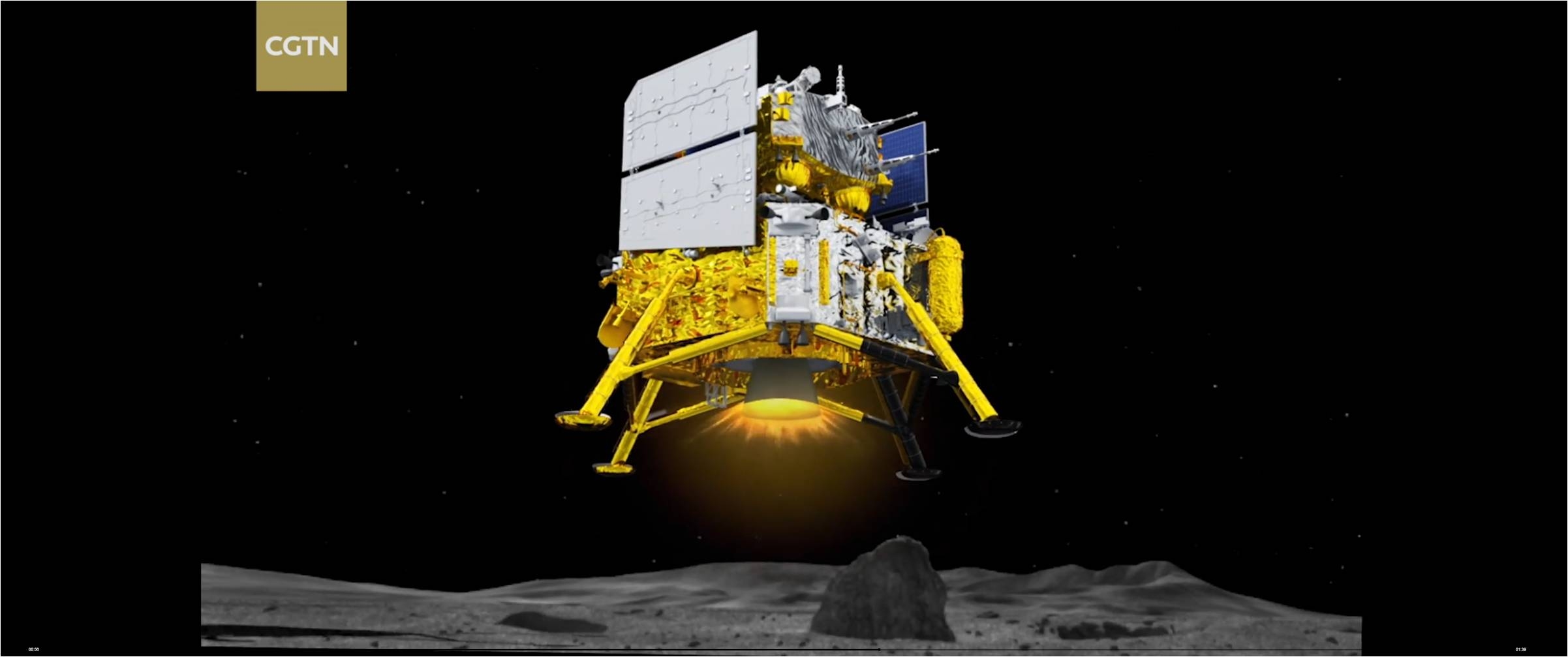
Image credit: CGTN/CNSA/Inside Outer Space screengrab
Solar illumination
The Chang’e-6 lander relies on solar panels for power generation.
“Our spacecraft depends on solar illumination for power generation, and this illumination varies with latitude. For this mission, we have selected a landing site in a region with moderate latitude. We chose the South Pole-Aitken Basin due to its adequate solar illumination and reliable communication signals, meeting the engineering standards,” Lu Yuntong, an engineer at the China Aerospace Science and Technology Corporation, told CCTV.
The Wang Chi interview is available at:
 Posted in

Possible design of China’s space plane.
Image source: Homem do Espaco/Twitter
Back in mid-December from the Jiuquan Space Center, China launched its reusable spacecraft test vehicle on a flight 3 cruise.
UK satellite tracker, Bob Christy via his Orbital Focus posting, explains that the Chinese space plane released a small satellite May 24, “or maybe earlier if it ran close alongside its parent for a while. Both vehicles made thruster firings, probably during the evening of May 24 UTC.”
Interesting observations
The previous flight of this type of vehicle also released a companion object for multiple rendezvous and capture operations, Christy explains, “so this pair may offer some interesting observations.”

Credit: China Central Television (CCTV)/Xinhua News Agency/China National Space Administration (CNSA)/screengrab Inside Outer Space
Launched December 14, 2023, the Chinese spacecraft has now been circling Earth for roughly 165 days.
For a look at the latest update on China’s space mission and meaning, go to the newly-posted story by China space watcher, Andrew Jones/SpaceNews– “China’s secretive spaceplane releases object into orbit” – at:
https://spacenews.com/chinas-secretive-spaceplane-releases-object-into-orbit/

Artwork depicts X-37B space plane. Image credit: Boeing/Inside Outer Space screengrab
U.S. Space Force flyer
Meanwhile, also underway is the hush-hush mission of the U.S. Space Force Orbital Test Vehicle 7 (OTV-7).
This Boeing-built, X-37B reusable space plane was launched to a highly elliptical orbit aboard a Falcon Heavy rocket on its classified mission on December 28, 2023.

OTV-6 was the first mission to introduce a service module that expanded the capabilities of the spacecraft.
Image credit: U.S. Space Force/Staff Sgt. Adam Shanks
For more details on this U.S. Air Force mission also now on-going, go to:
https://www.leonarddavid.com/u-s-military-space-plane-next-mission-what-will-it-do/

Mystery object found in North Carolina.
Image credit: WLOS TV Staff
Perhaps yet another bit of space debris leftover has hot-footed its way onto terra firma.
This latest incident is within The Glamping Collective in Canton, a secluded mountaintop 160-acre site that features travel/leisure outdoor structures near Clyde, North Carolina.
WLOS, a local ABC-affiliated TV station in Asheville, North Carolina, reported the find last week by a grounds worker at the site. The large object is thought to be a chunk of “trunk” associated with the SpaceX Crew-7 mission – appearing to be similar to earlier clutter found in Australia and Canada.

North Carolina debris. Image credit: WLOS TV Staff

Canada debris.
Image credit: Barry Sawchuk

Canada debris.
Image credit: Barry Sawchuk

Chunks of space junk rained down in Australia, later identified as SpaceX leftovers from its Crew-1 Mission that flew in 2020-2021.
Photo courtesy: Brad Tucker

Confirmed SpaceX debris found in Australia.
Photo courtesy: Brad Tucker
Space tracker Jonathan McDowell had noted several days ago that the SpaceX Dragon “Trunk” from the Crew-7 mission re-entered the atmosphere over Birmingham, Alabama.
Given its northeast track, potential debris could have fallen in Tennessee, western Virginia and West Virginia, McDowell noted.

Re-entry path going just west of Asheville, North Carolina. Direction of flight path was to the northeast reports space tracker Jonathan McDowell.
Image credit: J. McDowell
According to WLOS TV reporting, the object in question was found along a very remote trail on the Canton property.
Viewer comments
WLOS TV reporting points out that the surface of the recovered object features burnt carbon fiber with heavy-duty pieces and plates of metal, held together by what seems to be thick bolts.
When broadcast on WLOS TV, the video report stirred up viewer comments, such as: “Fear not…Scully & Mulder are on their way,” “WeAreAllDoomed,” to “Probably fell off of a balloon” and “Marjorie Taylor Green’s Jewish Space Laser.”
Advised another comment: “100% belongs to the SpaceX Dragon Space Capsule that reentered about 4:30 in the afternoon on 5/21 over NC. Lots of Debris on radar between GA and Asheville.”

Image credit: Google Maps/Inside Outer Space screengrab
Kessler syndrome
In a twist of space debris fate, the possible SpaceX detritus fell not too far away from former NASA orbital debris expert, Donald Kessler.
Among his scientific credits, Kessler is noted for the “Kessler Syndrome” that suggests when so much human-made garbage is adrift in Earth orbit, collisions between objects may well spark a cascade of fragments that increases the likelihood of further collisions.
The purported space junk was found not too far away from Kessler’s home, “about a 30 minute drive from us,” he told Inside Outer Space.
Kessler added: “If it were from space, I’d bet there are more similar objects scattered across several miles.”
To view the WLOS TV report, go to:
Note: Special thanks to Ewan Wright, University of British Columbia, Vancouver, Canada for calling this video to my attention.
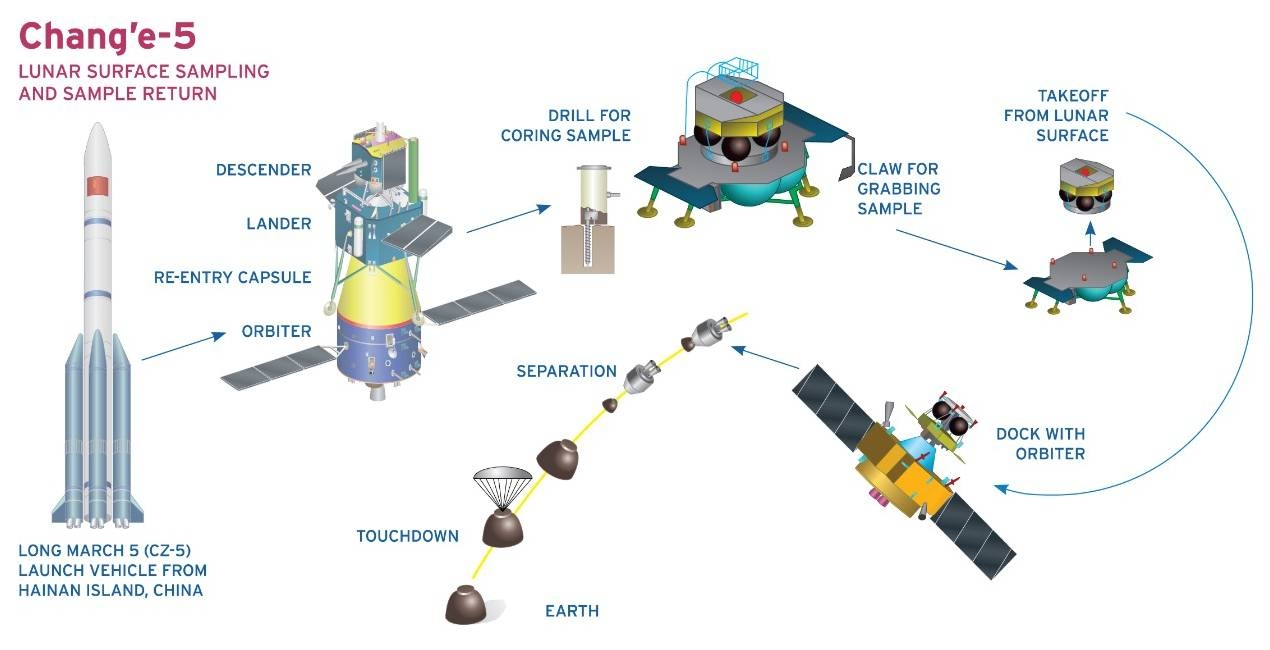
Image credit: CNSA via James Head

Image credit: CCTV/Inside Outer Space screengrab
At a NASA Lunar Reconnaissance Orbiter (LRO) Project Science Working Group meeting today, James Head of Brown University offered this projected milestone update on China’s now lunar orbiting Chang’e-6 mission – a sample return to Earth from the Moon’s far side — now targeted to land June 2 (Beijing Time).
The mission underway mirrors the earlier Chang’e-5 lunar sample mission and its step-by-step steps (see upper opening artwork).
Artwork depicts Chang’e-6 now in Moon orbit.
Image credit: CNSA/CGTN/Inside Outer Space screengrab
Image credit: CGTN/CNSA/Inside Outer Space screengrabto land on June 2.
Chang’e 6 Current Mission Timeline (5-24-24)
• 5-3-24: Launched
• 5-8-24: Entered a 12-hour lunar orbit (~200 X 380,000 km
altitude) begins circularizing orbit.
• 5-24-24: Currently; studying landing site areas for
accessibility and landing.
Following are in Beijing Times:
• 6-2-24: Descent and Landing: Surface sampling and
instrument observations for three days:
• 6-4-24: Ascent to lunar orbit:
• 6-6-24: Ascent module docks with orbiter, transfers
samples then leaves lunar orbit for trans-Earth coast:
• 6-25-24: Earth atmosphere reentry, descent and landing. Samples recovered where a preliminary examination team undertakes description and documentation prior to publication of the Chang’e-6 sample catalog.
Samples then become open for application to the China National Space Administration (CNSA) for analysis to the scientific community.

SpaceX/Inside Outer Space screengrab
SpaceX is posting that the fourth flight test of its Starship could launch as soon as June 5, pending regulatory approval.
The fourth flight test is focused from achieving orbit to demonstrating the ability to return and reuse Starship and Super Heavy.
“The primary objectives will be executing a landing burn and soft splashdown in the Gulf of Mexico with the Super Heavy booster, and achieving a controlled entry of Starship,” according to SpaceX.
Software/hardware upgrades
For the upcoming flight, several software and hardware upgrades have been made to increase overall reliability and address lessons learned from the last Starship test – flight 3 last March.

Image credit: SpaceX
In addition, the SpaceX team will execute operational changes, including the jettison of the Super Heavy’s hot-stage following boostback to reduce booster mass for the final phase of flight.
According to SpaceX, the flight 4 mission will fly a similar trajectory as the previous flight test. Starship is targeted to splashdown in the Indian Ocean.

Image credit: SpaceX
“This flight path does not require a deorbit burn for reentry,” SpaceX adds, “maximizing public safety while still providing the opportunity to meet our primary objective of a controlled Starship reentry.”
Schedule is dynamic
“We’re continuing to rapidly develop Starship, putting flight hardware in a flight environment to learn as quickly as possible as we build a fully reusable transportation system designed to carry crew and cargo to Earth orbit, the Moon, Mars and beyond,” SpaceX explains.
A live webcast of the flight test will begin about 30 minutes before liftoff. Viewing will be available via the SpaceX website and on X @SpaceX.
The projected June 5 launch window opens as early as 7 a.m. Central Time.
“As is the case with all developmental testing, the schedule is dynamic and likely to change, so be sure to stay tuned to our X account for updates,” SpaceX explains.

Image credit: Olivier Bonin/SLAC National Accelerator Laboratory
The largest camera ever built for astrophysics has arrived at the summit of Cerro Pachón in Chile.
Transported from the SLAC National Accelerator Laboratory in California, the Legacy Survey of Space and Time (LSST) 3200-megapixel camera is the largest digital camera in the world. The device will soon be installed on the Simonyi Survey Telescope at Vera C. Rubin Observatory in Chile.
The LSST camera will produce detailed images with a field of view seven times wider than the full Moon.

Image credit: NOIRLab/Inside Outer Space screengrab
Targets on tap
Once up and operating, the LSST camera is assigned multiple tasks, for instance: take detailed images of the southern hemisphere sky for 10 years, build the most comprehensive time-lapse view of our Universe ever seen.
Using the LSST Camera, exploring the nature of dark matter and dark energy, is on tap, along with mapping the Milky Way, surveying our Solar System, and studying celestial objects that change in brightness or position.
Two decades of work
Rubin Observatory is a program of the National Science Foundation’s (NSF) NOIRLab, which, along with the U.S. Department of Energy’s SLAC National Accelerator Laboratory, will jointly operate Rubin.

Image credit: SLAC National Accelerator Laboratory
The NSF-funded Rubin Observatory Project Office for construction was established as an operating center under the management of the Association of Universities for Research in Astronomy (AURA).
The DOE-funded effort to build the Rubin Observatory LSST Camera (LSSTCam) is managed by SLAC National Accelerator Laboratory (SLAC), completed after two decades of work.
Go to this impressive video at:
https://noirlab.edu/public/media/archives/videos/hd_1080_screen/noirlab2413a.mp4

Who Owns the Moon? – In Defence of Humanity’s Common Interests in Space by A.C. Grayling; Oneworld Publications/distributed by Simon & Schuster (2024); Hardcover, 224 pages; $26.95.
Multiple countries have the Moon within its cross-hairs, for scientific purposes, for industrial gain, as well as to salute its military usefulness. Of late, China has put into action a lunar agenda that includes outreach to the Moon, planting taikonaut footprints there in the time-aged, dusty topside.
Meanwhile, NASA’s Artemis project also aims to “reboot” the Moon in a few years time.
So not only is this book timely reading – it’s a must-read. As the world’s superpowers and corporations jostle for control in space, it asks: who really can claim ownership of that world?
“To answer this question we have to look at some highly relevant precedents,” the author writes, as this is the aim of the volume.
Grayling is the founder and principal of the New College of the Humanities at Northeastern University, London, and its Professor of Philosophy.
Within its pages, the key chapters discuss the global commons, Antarctic protection, the high seas and deep oceans, as well as tackling a major issue of the day: Is the United Nations Outer Space Treaty “good enough” or ripe for an overhaul?
A space spinoff for discussion is addressed in this volume. That is, is there something available to humankind that is more powerful than partisan self-interest, be it profit motive, diplomatic power and national prestige?
The book concludes with a section, “what will happen…what can be done?” Grayling writes that the answer will take maturity, wisdom – “neither of which has evolved to a sufficient degree so far,” but there are some encouraging signs.
The book has a handy bibliography and very healthy section of notes for the reader to pursue.
Grayling makes the case for a new global consensus, one that recognizes the rights of everyone who lives on this planet, but also longingly looks at the Moon and ponders how it fits into our 21st century landscape of posturing politics, resource requirements, and whether the Moon is an extension of human conflict.
For more information on this timely book, go to:
https://www.simonandschuster.com/books/Who-Owns-the-Moon/A-C-Grayling/9780861547258

Earth’s Sun can toss out powerful solar storms that can impact infrastructure on Earth’s surface, in near-Earth orbit, including Artemis-era astronaut travel to and from the Moon.
BOULDER, Colorado — The sending of Artemis astronauts beyond the protective cocoon of Earth’s magnetic field to the Moon is spurring a look at flight rules and sharpening space weather forecasting skills.
The National Oceanic and Atmospheric Administration’s Space Weather Prediction Center (SWPC) here is working with NASA space radiation specialists to bolster space weather support for human expeditions to the Moon.
If schedule holds, in late 2025, NASA’s Artemis II mission is to be the first crewed sojourn to the vicinity of the Moon, a 10-day outing, and the first human voyage to that distance since Apollo-era moonwalker flights ended in December 1972.
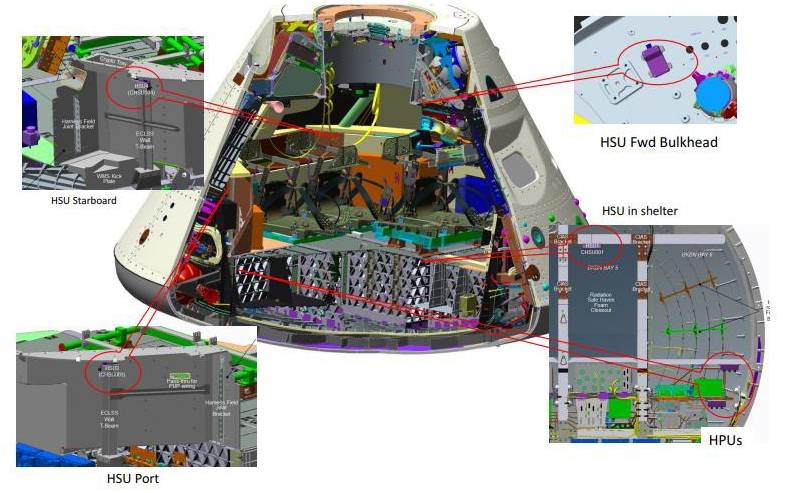
Inside look at Orion capsule.
Image credit: NASA/Steve Johnson
Given the recent powerful solar eruptions, what impact on Artemis operations would have happened if a crewed mission was now underway?
Take a look at my new SpaceNews story – “How Artemis astronauts will be protected from solar storms” – at:
https://spacenews.com/how-artemis-astronauts-protected-solar-storms/

Image credit: Washington Post
The Washington Post has an informative series focused on the “New Space Age” – one that includes an exclusive conversation with the NASA Artemis II crew.
“Space travel is booming,” explains the Washington Post, “creating an energy around the exploration of our solar system that hasn’t been seen since the days of Apollo — and leading to no shortage of questions. “
For example:
Why does NASA want to go back to the Moon?
What toll does space travel take on the human body?
And what are the consequences of the increasing amount of space debris littering the atmosphere?

Image credit: Washington Post
The series of articles on The New Space Age seeks to answer those questions, and others, offering a look at this significant moment in the history of human spaceflight.
Exclusive conversation
As part of their coverage, the Washington Post is staging an exclusive conversation featuring NASA astronauts Christina Koch, Victor Glover and Reid Wiseman and Canadian astronaut Jeremy Hansen, about their upcoming Artemis II mission.
This event is Tuesday, June 4 at 4 p.m. Eastern Time.
For more information, go to:
https://www.washingtonpost.com/technology/interactive/2023/new-space-age/
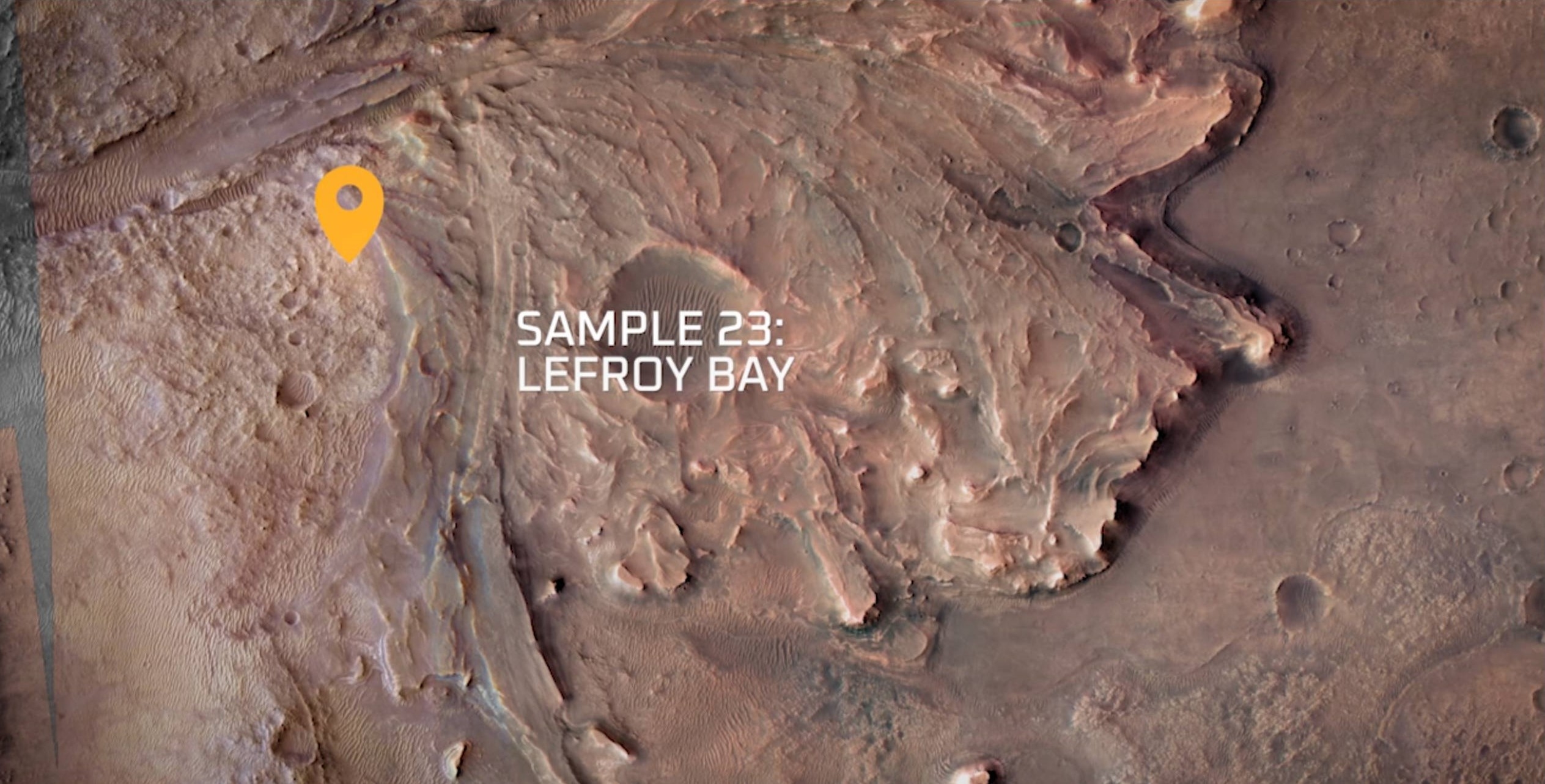
Image credit: NASA/JPL-Caltech
The lead scientist for the NASA Perseverance rover is upbeat regarding how much material has been stuffed in tubes, both dropped on the surface of Mars, as well as contained within the rover itself while wheeling about within Jezero Crater.
Tagged “Lefroy Bay,” Caltech’s Ken Farley called attention to this sample collected by the Perseverance rover, found to have hydrated silica. Here on Earth, that mineral has the highest potential to preserve signs of ancient life.
Given the samples of Mars that Perseverance has collected so far, could one of those specimens be what the rover was sent to look for in the first place: evidence of past microbial life on the Red Planet?
Lively question
So a lively question wanting of an answer arises: Perhaps Lefroy Bay carries preserved signs of ancient life on Mars?
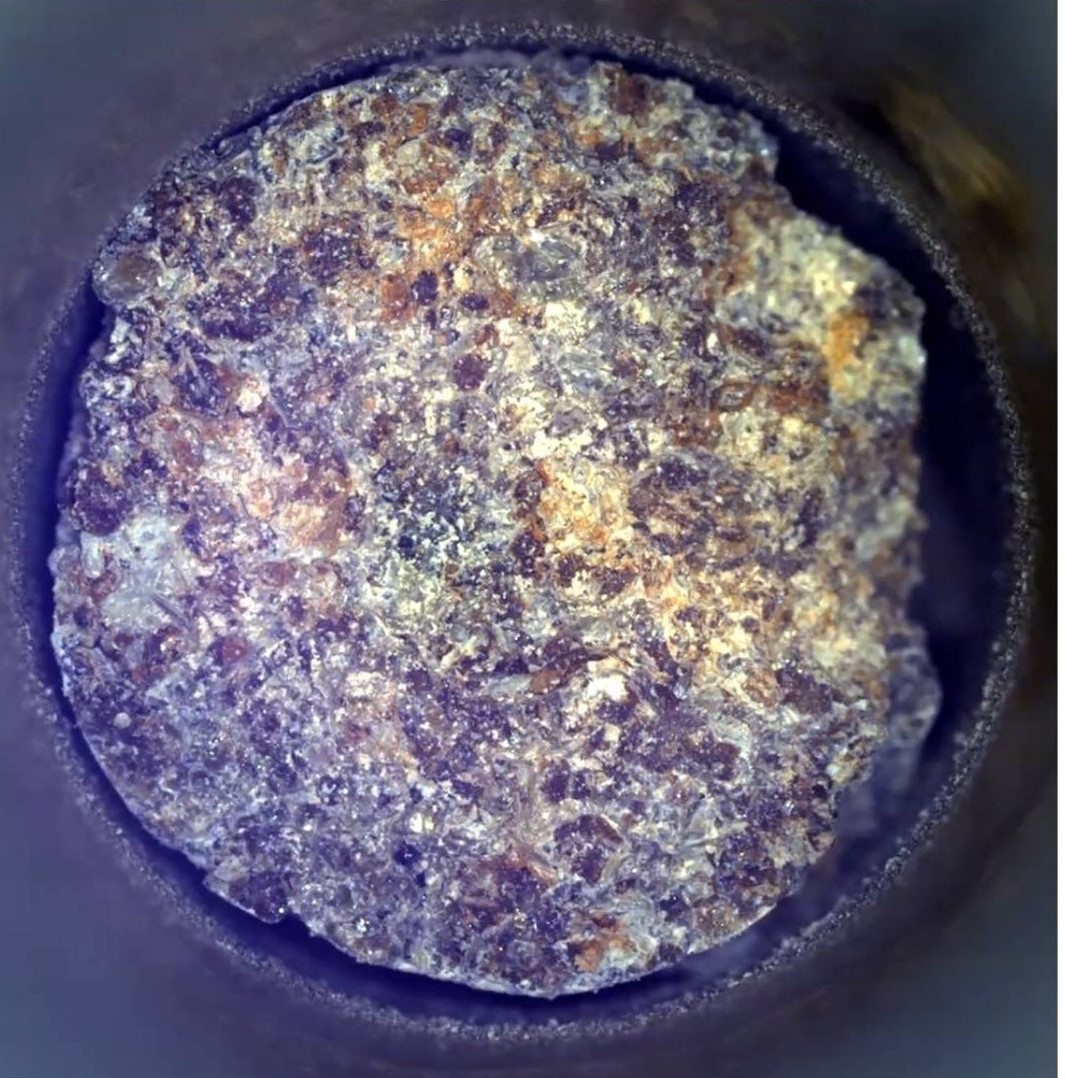
Sample collected tagged as Lefroy Bay at the Margin Unit may have been deposited either in a lake or in a groundwater system. Both are very important settings for understanding Mars habitability and habitation at Jezero Crater.
Image credit: NASA/JPL-Caltech/Ken Farley
Go to my new Space.com story – “Perseverance rover’s Mars rock sample may contain best evidence of possible ancient life” – at:

