Archive for the ‘Space News’ Category
 Author:
  June 11th, 2024
China’s humans-to-the-Moon program eyes by 2030 time period.
Image credit: CMS/CCTV/Inside Outer Space screengrab
China has announced selection of new astronaut candidates to ready the country for its future human treks to the Moon.
The China Manned Space Agency (CMSA) announced Tuesday that 10 candidates, including eight space pilots and two payload specialists, have been selected as the country’s fourth batch of astronauts.
Geology field work
Huang Weifen, chief designer of the manned space program’s astronaut system, told China Central Television (CCTV): “When the development of training simulators for manned lunar missions is completed, we will be able to unfold more substantive training tasks.”
Huang added that preliminary preparations are underway involving both existing astronauts and the newly-selected astronauts to engage in engineering development work and scientific research for future missions.

Image credit: CCTV/Inside Outer Space screengrab
In preparation for Moon exploration expeditions, China’s astronauts are taking fundamental courses related to geology, including participation in field studies and geological surveys, Huang noted.
The CMSA announced in late May that China plans to realize a crewed lunar landing by 2030.
Pilots, flight engineers, payload specialists
The ten candidates include eight pilots and two payload specialists from the Hong Kong Special Administrative Region and the other is from the Macao Special Administrative Region, the CMSA explained.

China’s astronaut training activities for space station and Moon exploration duties.
This selection of the fourth batch of Chinese astronaut candidates began in the second half of 2022.
Back in 1998, China picked 14 astronauts from air force pilots and an additional seven in 2010. Selection of the third batch of 18 astronauts in 2020 included space pilots, flight engineers and payload specialists.
Huang said the building of an astronaut team, from the selection of astronauts to the training programs, has been organized to support both China’s space station missions and future human excursions to the Moon.
For an informative video on the selection of new astronauts and China’s human reach for the Moon, go to:
 Posted in

Flag deployed from China’s Chang’e-6 lander/ascender in far side sampling scenery.
Image credit: CNSA/CLEP
About that five-star red flag now in position on the far side of the Moon – it’s made of basalt, a type of volcanic rock that’s plentiful on the lunar surface.
On June 2, China’s Chang’e-6 far side robotic lander touched down in the South Pole-Aitken (SPA) Basin on the Moon.
Post-landing, the national flag was sprung out from the firmly-footed Chang’e-6 lander/ascender.
That flag measures 300 millimeters by 200 millimeters, about the size of an A4 sheet of paper.

Image credit: CNSA/CLEP/CCTV/Inside Outer Space screengrab
Weighing only 11.3 grams, the far side flag is similar in size to the flag carried by the earlier Chang’e-5 lunar lander that spot-landed on the Moon’s near side in 2020.
Inorganic fiber
The decision to use basalt, China Central Television (CCTV) reports, was guided by the “in-situ utilization” principle, to leverage resources available on the lunar surface rather than transporting materials from Earth, an approach that aligns with China’s goal of sustainable lunar exploration, the state-run television group notes.
A member of the Chang’e-6 “national flag development team” is Cao Genyang, a professor at Wuhan Textile University.

Cao Genyang, professor, Wuhan Textile University; member, Chang’e-6 national flag development team.
Image credit: CCTV/Inside Outer Space screengrab
“Building on this idea and the lunar ‘local specialty’ brought back by Chang’e-5, we have found in the literature that the main content of lunar soil is basalt, Cao told CCTV. “So we thought that since this material actually exists in large quantities on the Moon, how can we use it as a high-performance inorganic fiber?”
Early research was performed on basalt fiber for China’s future lunar exploration project, Cao said.
Cutting-edge textile technology
Wang Yunli, professor of Wuhan Textile University, and a member of the Chang’e-6 national flag development team, added that the flag’s printing and dyeing process involved specialized approaches.
“Our pigments and formulas are specially developed to adapt the flag to the extreme conditions on the Moon and the conditions during orbiting and landing,” Wang said, and makes use of “cutting-edge” textile technology.

Wang Yunli, professor, Wuhan Textile University; member, Chang’e-6 national flag development team.
Image credit: CCTV/Inside Outer Space screengrab
Basalt as an inorganic fiber is smooth and brittle, making it difficult to spin and maintain in high-durability colors.
Weathering lunar conditions
Cao explained that the flag development team found it challenging to create the ideal and desired ultra-fine fibers after encountering many failures.
Ordinary materials were unsuitable for the lunar flag. But the basalt fiber is endowed with outstanding insulation and radiation resistance, CCTV reports, making it ideal for weathering the harsh conditions on the lunar surface.
The result: a national flag with superior corrosion resistance, high-temperature tolerance, and low-temperature endurance.
The final version of the national flag was produced with composite material primarily composed of basalt, accounting for 62 percent of all the materials.

Image credit: CCTV/Inside Outer Space screengrab
“The entire production of the flag started with the rocks,” said Wang. “We first mixed together all the basalt rocks collected from different locations before breaking them into very small pieces.”
Multi-step process
The first step was to draw the processed basalt rocks into ultra-fine fibers.
A second step was to spin those fibers into thread, leading to the third and fourth steps of weaving the threads into fabrics and printing.
The fifth step was to enhance the performance of the fabrics using specific physical and chemical methods and techniques, Wang added.
“After that, we proceeded with laser cutting, trimming, and sewing until a national flag was made,” Wang said, later becoming the first flag of any country to fly on the far side of the Moon.

Far side scenery taken by Chang’e-6 lander/ascender.
Image credit: CNSA/CLEP
Excitement is mounting for the return of lunar samples from the far side of the Moon.
China’s on-going Chang’e-6 mission is nearing departure from lunar orbit, making a bee-line for the Earth and delivering a motherlode of Moon materials.
Late last week, more than 200 Chinese scientists from 31 domestic universities and research institutes gathered in Beijing at the Institute of Geology and Geophysics, participating in a “Chang’e-6 Landing Area Geological Background Seminar.”

Deployed mini-rover from Chang’e-6 lander/ascender captured the robotic explorer at work.
Image credit: CNSA/CLEP
In a posting from James Head, a leading lunar expert at Brown University: “This seminar/workshop was designed to highlight the geological setting of the sample return landing site in the Apollo basin, and the types of scientific problems that can potentially be addressed by analysis of the Chang’e-6 return samples, both themes designed to assist scientists across China in preparing proposals for analysis of the Chang’e-6 samples.

Image credit: James Head
Step by step
Launched from south China’s Hainan Province on May 3, the Chang’e-6 multi-component craft made the first-ever gathering of lunar samples from the far side of the Moon.
The probe’s lander-ascender combination safely touched down in the South Pole-Aitken (SPA) Basin on the Moon last Sunday. After completing its collection of lunar samples on Sunday and Monday, the probe’s ascender segment departed from the lunar surface with the precious cargo on Tuesday.
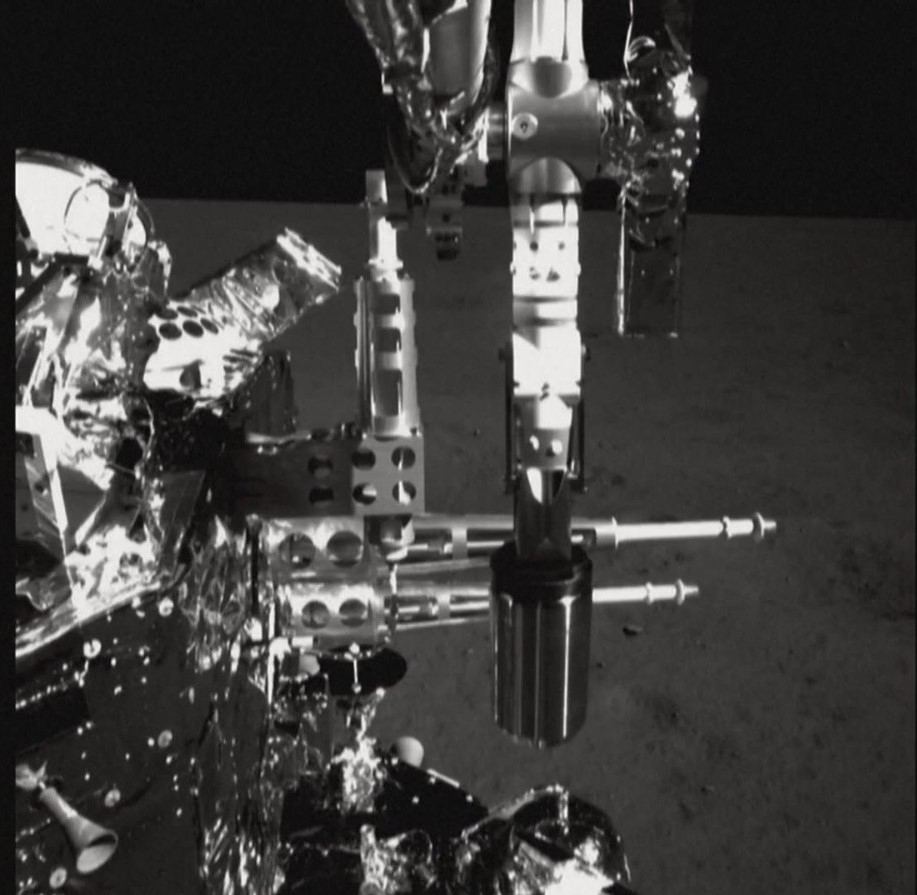
Locked and loaded…with lunar samples.
Image credit: CNSA/CLEP
After re-uniting with the orbiter and completing the lunar sample transfer on Thursday, the returner segment will continue to orbit the Moon, awaiting the time to initiate its return journey back to the Earth.
Re-entry day
The returner’s capsule, toting its cache of lunar collectibles, will parachute into a pre-picked landing zone at Siziwang Banner in north China’s Inner Mongolia Autonomous Region.
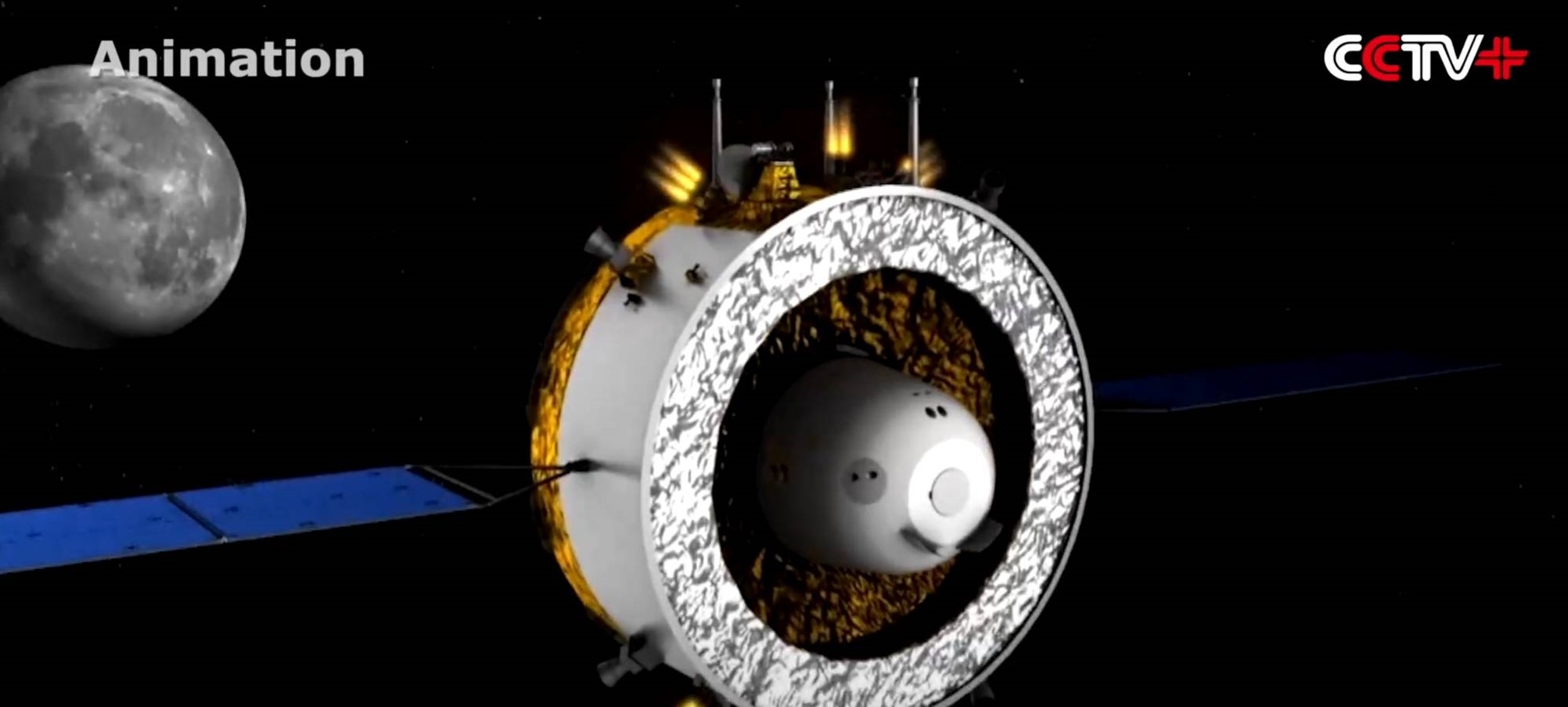
Chang’e-6 returner component delivers the lunar goods to Earth.
Imaage credit: CNSA/CCTV/Inside Outer Space screengrab

Release of returner capsule loaded with far side samples.
Image credit: CNSA/CCTV/Inside Outer Space screengrab

Parachuting to Earth, the Chang’e-6 capsule toting its lunar collection.
Image credit: CNSA/CCTV/Inside Outer Space screengrab
That re-entry is projected to take place on June 25 (Beijing Time), according to informed sources. At capsule touchdown, the Chang’e-6 mission wraps up its 53-day journey of going to the Moon and back.
European ground stations are providing support to the Chang’e-6 mission, according to the European Space Agency (ESA). Shortly after the launch from China on May 3, ESA’s Kourou station in French Guiana tracked the spacecraft for several hours to confirm its orbit.
Around June 25, ESA will catch signals from the Chang’e-6 returner as it brings to Earth its grab and go Moon samples via ESA’s Maspalomas station, operated by the Instituto Nacional de Técnica Aerospacial (INTA) in Gran Canaria, Spain.
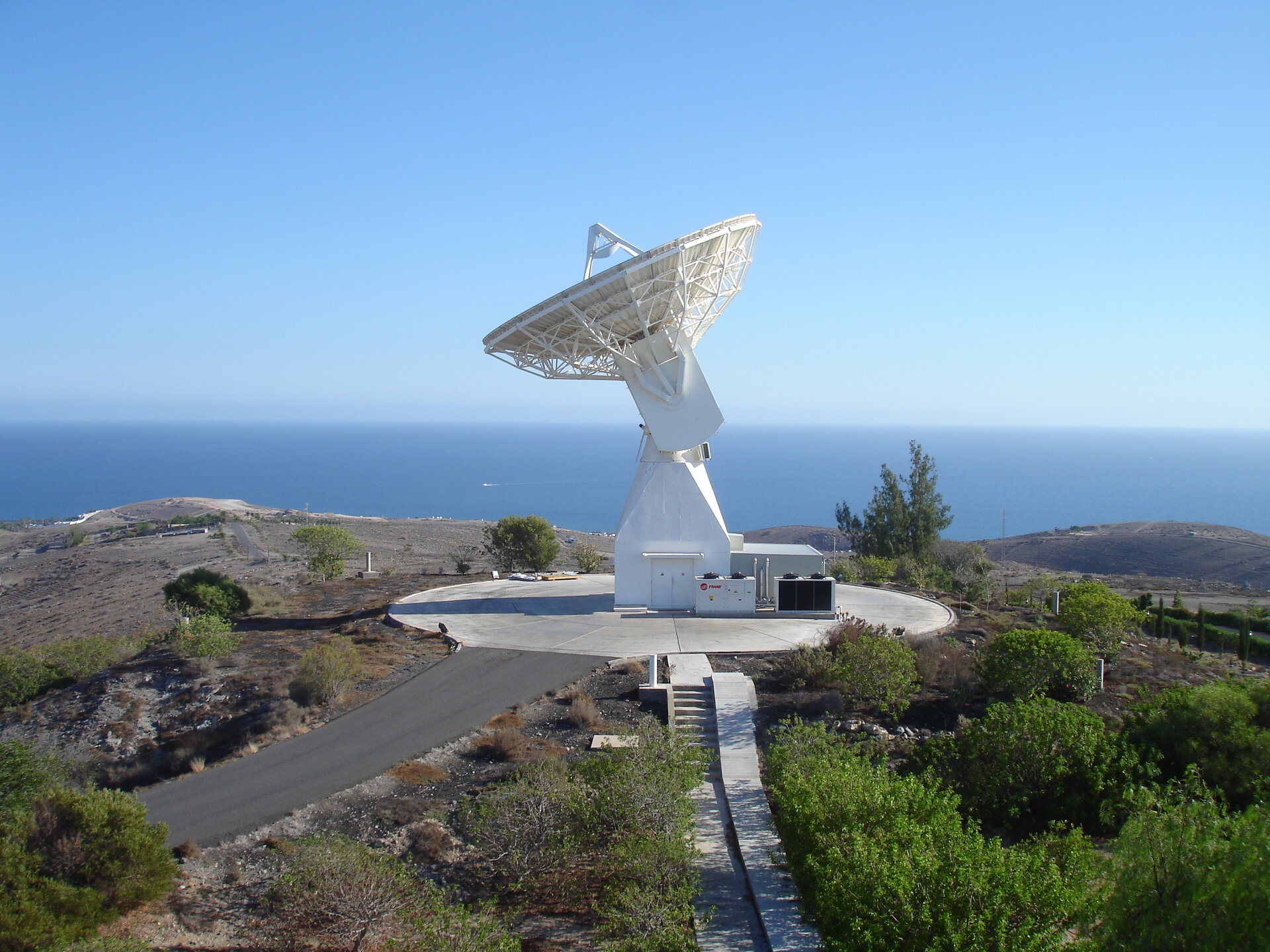
The European Space Agency’s Maspalomas station is located on the campus of the Instituto Nacional de Tecnica Aerospacial (INTA), in the southern part of the Canary Islands’ Gran Canaria, at Montaña Blanca.
Image credit: ESA
International partnership
James Carpenter, lead for Moon and Mars Science for ESA’s Directorate of Human and Robotic Exploration, stressed that the Chang’e-6 samples could help broaden humanity’s understanding of the Moon’s formation.
“China has presented a very exciting plan for lunar exploration, after Chang’e-6, we have the Chang’e-7 mission and Chang’e-8. They’re talking about having humans on the surface of the Moon and an international lunar research station,” Carpenter said, speaking to China Media Group (CMG) from Noordwijk, the Netherlands.
“These are things that China has set out as elements of their plan. I think it’s a very exciting plan, I think the scientific outcomes that could come from this would be fantastic. And I think internationally we’re all interested to see how this progresses and where are the opportunities for international partnership,” Carpenter said.

Image credit: WLOS/Inside Outer Space screengrab
Yet another chunk of SpaceX junk from space has apparently been found in a resident’s yard in North Carolina.
As reported by the WLOS television station, this latest incident adds to objects of various sizes and weights being tied to surviving fragments of the jettisoned “trunk” associated with the SpaceX Dragon Crew-7 mission.
Katrinka Barnett found the space junk-related object in her yard in Jackson County about a week before Memorial Day.
Space clutter similarity

SpaceX Dragon trunk debris falls into North Carolina.
mage credit: WLOS TV staff
Barnett’s finding looks similar to two other larger pieces found around the same time in Canton and Franklin within North Carolina. Furthermore, this type of SpaceX space clutter from separate incidents has been found in Australia and Canada.
For a view of my new SpaceNews story – “Uncontrolled reentry of space debris poses a real and growing threat” – go to:
https://spacenews.com/uncontrolled-reentry-of-space-debris-poses-a-real-and-growing-threat/

“Wait-a-minute”
Image credit: Barbara David
In classic “wait-a-minute” style, back in mid-April, NASA requested proposals from industry to do a double-take on the costly Mars Sample Return (MSR) initiative to return samples of the Red Planet in the 2030s.
NASA is now moving forward with 10 studies to examine more affordable and faster methods of bringing samples from Mars’ surface back to Earth.

Image credit: NASA
The MSR seven
As part of this re-look, NASA will award a firm-fixed-price contract for up to $1.5 million to conduct 90-day studies to seven industry proposers.
Additionally, the go-ahead has been given to NASA centers, NASA’s Jet Propulsion Laboratory (JPL) and Johns Hopkins’ Applied Physics Laboratory (APL) to also crank out MSR re-evaluation studies in the hopes of improving MSR’s price tag and schedule.

Mars sample return to Earth – a major and multi-billion dollar undertaking by NASA, the European Space Agency.
Image credit: NASA/JPL-Caltech
Alterations or enhancements
Once all the studies are in hand, NASA will assess them to consider alterations or enhancements to the Mars Sample Return architecture, tagged by independent assessment groups as perhaps costing upwards of $11 billion to carry out.
NASA has announced that the following companies and their proposals were selected from among those that responded to the April 15 request for help in re-shaping the MSR undertaking. They are:
Lockheed Martin, Littleton, Colorado: “Lockheed Martin Rapid Mission Design Studies for Mars Sample Return”
SpaceX, Hawthorne, California: “Enabling Mars Sample Return With Starship”
Aerojet Rocketdyne, Huntsville, Alabama: “A High-Performance Liquid Mars Ascent Vehicle, Using Highly Reliable and Mature Propulsion Technologies, to Improve Program Affordability and Schedule”
Blue Origin, Monrovia, California: “Leveraging Artemis for Mars Sample Return”
Quantum Space, Rockville, Maryland: “Quantum Anchor Leg Mars Sample Return Study”
Northrop Grumman, Elkton, Maryland: “High TRL [Technology Readiness Level] MAV [Mars Ascent Vehicle] Propulsion Trades and Concept Design for MSR Rapid Mission Design”
Whittinghill Aerospace, Camarillo, California: “A Rapid Design Study for the MSR Single Stage Mars Ascent Vehicle”

The Mars Ascent Vehicle (MAV) is a major and costly component of NASA’s robotic Holy Grail mission, a sample return effort to haul to Earth Martian collectibles.
Image credit: NASA/JPL-Caltech
Dumpster fire
All of this activity was sparked last September when an independent review board (IRB) released its findings after taking a diligent and detailed look at the flagship MSR project.
The IRB was established by NASA to judge the technical requirements, cost and calendar plans of the task. It was a thorough sanity check on how things were going for MSR…and things were found not to be going well.
For more information, go to my Scientific American story – “NASA’s Troubled Mars Sample Mission Has Scientists Seeing Red – NASA’s Mars Sample Return program is the agency’s highest priority in planetary science, but projected multibillion-dollar overruns have some calling the plan a “dumpster fire”” – at:

Image credit: SpaceX/Inside Outer Space screengrab
SpaceX has issued details of the company’s Starship Flight #4.
Lifting off on June 6 from Starbase in Texas, Starship “went on to deliver maximum excitement,” explains the posting, “attempting to go farther than any previous test before and begin demonstrating capabilities central to return and reuse of Starship and Super Heavy.”
“The payload for this test was the data,” explains SpaceX.

One engine out. Image credit: SpaceX/Inside Outer Space screengrab
What was accomplished?
Here are the performance stats:
- The Super Heavy booster lifted off successfully and completed a full-duration ascent burn.
- Starship executed another successful hot-stage separation, powering down all but three of Super Heavy’s Raptor engines and successfully igniting the six second stage Raptor engines before separating the vehicles.
- Following separation, the Super Heavy booster successfully completed its flip maneuver, boostback burn to send it towards the splashdown zone, and jettison of the hot-stage adapter.
- The booster’s flight ended with a landing burn and soft splashdown in the Gulf of Mexico seven minutes and 24 seconds into the flight.

Image credit: SpaceX/Inside Outer Space screengrab
Controlled reentry
— Starship’s six second stage Raptor engines successfully powered the vehicle to space and placed it on the planned trajectory for coast.
— Starship made a controlled reentry, successfully making it through the phases of peak heating and max aerodynamic pressure and demonstrating the ability to control the vehicle using its flaps while descending through the atmosphere at hypersonic speeds.
— Starlink on Starship once again enabled real-time telemetry and live high-definition video throughout every phase of entry, with external cameras providing views all the way to the flight’s conclusion.
— Flight 4 ended with Starship igniting its three center Raptor engines and executing the first flip maneuver and landing burn since our suborbital campaign, followed by a soft splashdown of the ship in the Indian Ocean one hour and six minutes after launch.
Major strides
In summary form, SpaceX explains that the fourth flight of Starship “made major strides to bring us closer to a rapidly reusable future.”
Data accumulated by the flight will drive improvements to develop Starship into a fully reusable transportation system “designed to carry crew and cargo to Earth orbit, the Moon, Mars and beyond,” SpaceX concludes.
Go to SpaceX Starship Flight Test #4 video at:
https://www.spacex.com/launches/mission/?missionId=starship-flight-4
China’s Chang’e-6 lander/ascender in far side sampling scenery. Image taken by deployed Wi-Fi-toting mini-rover.
Image credit: CNSA/CLEP
China’s Chang’e-6 Moon sampling mission is set to return to Earth, loaded with its cache of far side specimens.
According to the China National Space Administration (CNSA), the mission’s orbiter/returner will circle the Moon for a projected 14 days before departure to Earth.
The combination will make one to three orbital adjustments over a five day period.
Cruising into position around 3,000 miles (5,000 kilometers) above the Earth, the returner segment will separate from the orbiter and start the phase of re-entering the atmosphere and returning to Earth.

Chang’e-6 scooping operation on Moon’s far side.
Image credit: CNSA/CLEP

Chang’e-6 drilling into lunar far side landscape.
Image credit: CNSA/CLEP
Parachute landing
The returner, carrying lunar samples collected in the South Pole-Aitken (SPA) Basin, will touch down at a planned landing area at Siziwang Banner in north China’s Inner Mongolia Autonomous Region.
That re-entry is projected to take place on June 25 (Beijing Time), according to informed sources.
Parachuting into the area will mark the end of Chang’e-6’s 53-day, to the Moon and back sampling mission.
Far side scenery taken by Chang’e-6 lander/ascender.
Image credit: CNSA/CLEP

Taking the heat as it maneuvers ever-deeper into Earth’s atmosphere before parachute touchdown.
Image credit: CNSA/CCTV
Stable status
“At present, the overall status of the Chang’e-6 is very stable,” Hao Dagong, an engineer at the Beijing Aerospace Control Center told China Central Television (CCTV).
The orbiter-returner combination will separate from the ascender, undergo trans-Earth injection, enter Moon-Earth transfer orbit, Hao said, then re-enter the atmosphere with recovery teams retrieving the sample-loaded capsule.
As the orbiter-returner circuits the Moon, it signals the second time China has achieved a probe rendezvous and docking in lunar orbit. China’s Chang’e-5 mission performed this scenario back in December 2020.

Fresh samples from the Moon delivered by China’s Chang’e-5 return capsule.
Image credit: Xinhua News Video/Inside Outer Space screengrab
Chang’e-6 departed from China’s sprawling spaceport situated in south Hainan Province on May 3, assigned the task of snagging and bagging the first-ever lunar samples from the far side of the Moon.
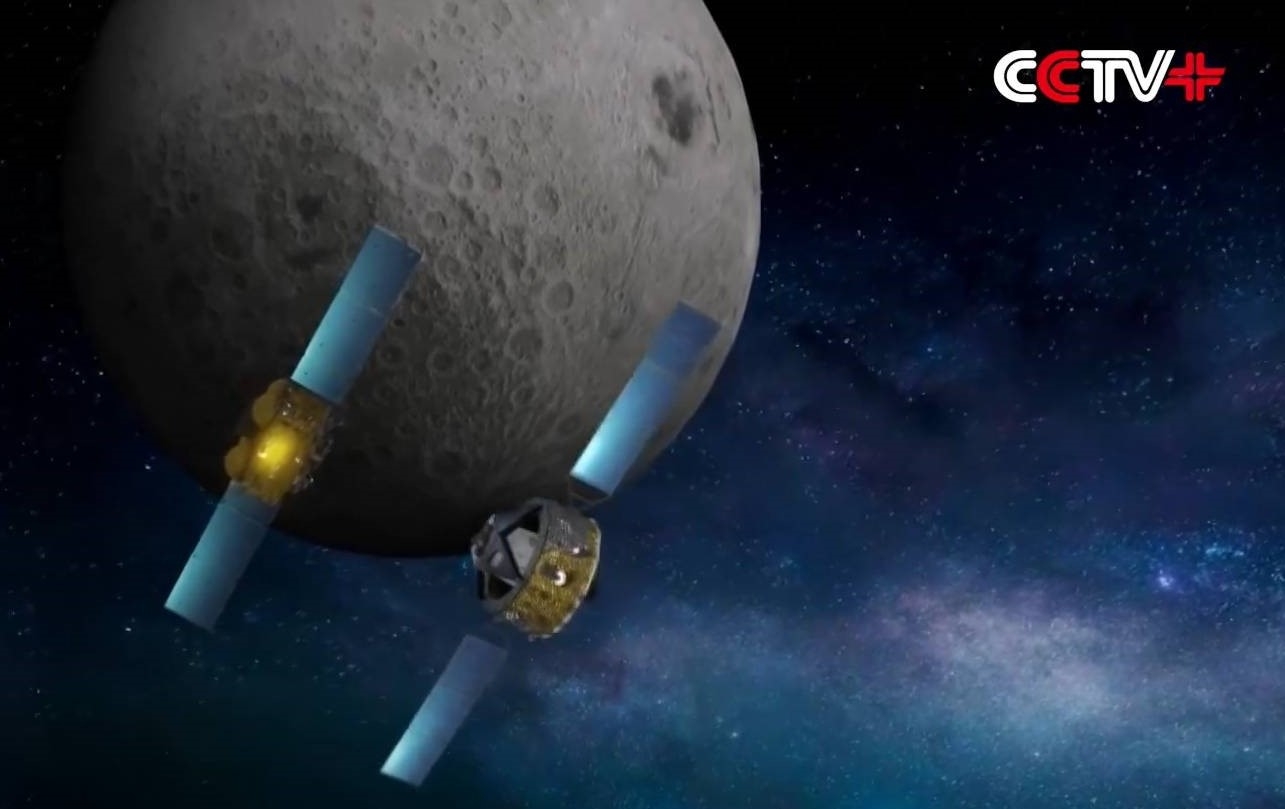
Ascender rendezvous and docking with returner craft for transfer of lunar samples.
Image credit: CNAS/CCTV
China’s Chang’e-6 robotic mission to pluck samples from the Moon’s far side achieved another step in bringing the goods home to planet Earth, targeted for a June 25 parachute landing.
At 2:48 PM (Beijing Time) the mission’s ascender vehicle rendezvoused and docked with the Chang’e 6 orbit-return vehicle combination in lunar orbit.
The container carrying the first lunar far side samples were transferred from the ascent vehicle to the orbit-return vehicle by 3:24 PM.
The successful transfer process followed surface sampling, stowage, and ascent stage liftoff from the floor of the Apollo basin on Tuesday morning, and entering lunar orbit, during which time it made four orbital adjustments to enable rendezvous.
Holding claws
“There were two steps in the rendezvous and docking process. After the ascender took off from the far side of the moon, it made four orbital adjustments in the lunar orbit to enter the preset orbit. Then, the orbiter-returner combination caught up with and got closer to the ascender. Finally, the docking was completed. The biggest challenge therein was stability,” Lu Yuntong from the China Aerospace Science and Technology Corporation told China Central Television (CCTV).
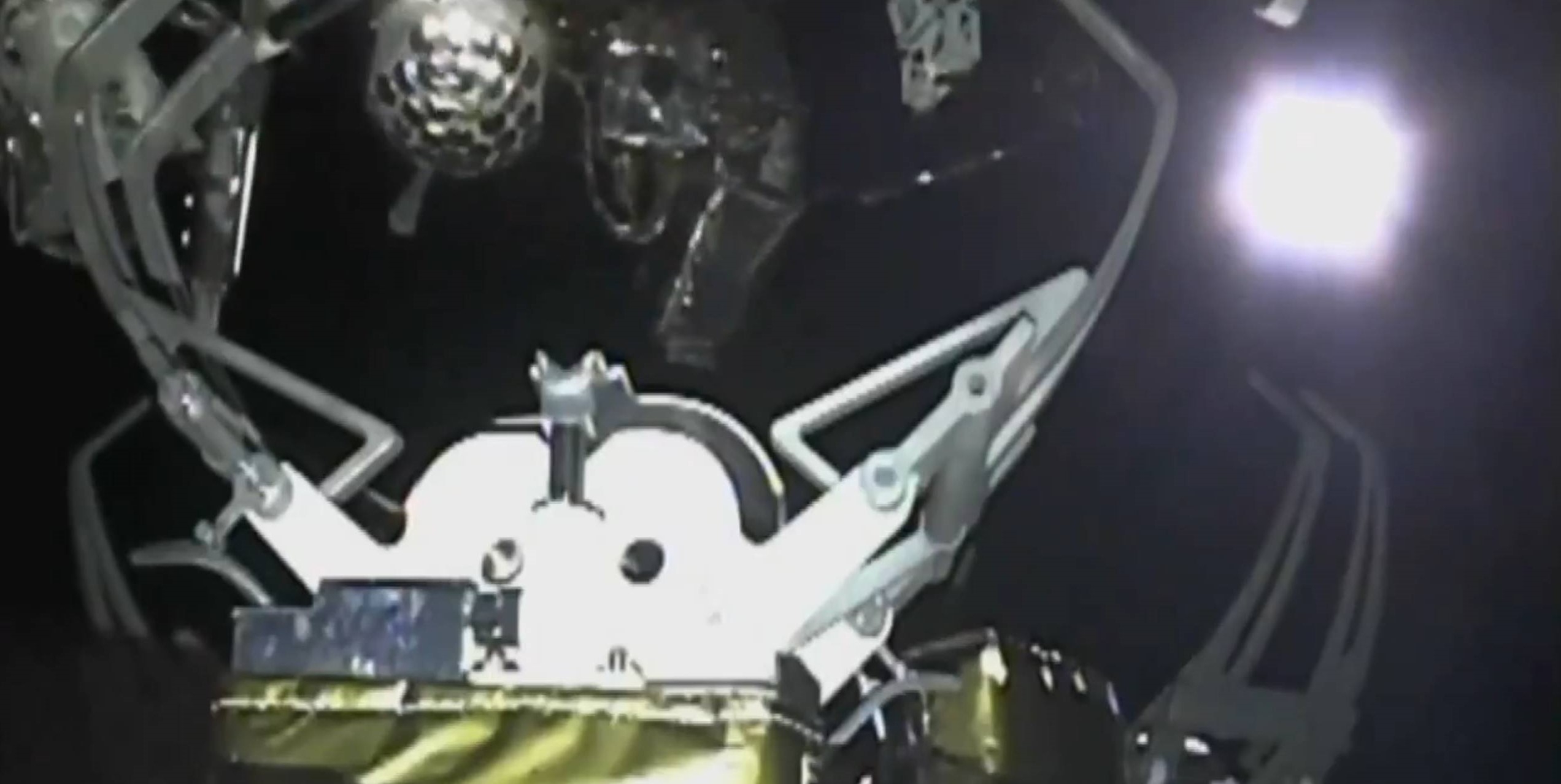
Image credit: CNSA/CCTV/Inside Outer Space screengrab
Wang Qiong, deputy chief designer of the Chang’e-6 mission, said that the docking apparatus of the Chang’e-6 mission is capable of precisely capturing the sample container and transferring it to the orbiter-returner combination, with the three pairs of holding claws playing an important role in the process.
“A pair of holding claws equipped onto the orbiter firmly clasped a bar of the ascender, after which the two spacecrafts closely got together. During the process, the container carrying samples were transferred from the ascender into the returner capsule,” Wang told CCTV.
“The docking process went very well today with high precision because it docked at the right time. If we missed this opportunity, there would be a collision. We got one chance only,” Qiao Dezhi, a space scientist at the China Aerospace Science and Technology Corporation, told CCTV.
Mini-rover images Chang’e-6 lander/ascender.
Image credit: CNSA/CLEP
Next step: Moon-Earth departure
When the ascender was about 30 miles (50 kilometers) in front of, and 6 miles (10 kilometers) above the orbiter-return vehicle combination, the combination gradually approached the ascent vehicle through short-range autonomous control, and captured it with clasping claws, similar to the successful docking and transfer procedures of the Chang’e 5 nearside surface samples in 2020.
The orbiter-return combination will later separate from the ascent vehicle and prepare to return to Earth at an appropriate and optimal trans-Earth injection time.
Following the Moon-Earth transfer burn and the trip home, the orbiter and ascent vehicle carrying the sample container is scheduled to separate.
Taking the heat as it maneuvers ever-deeper into Earth’s atmosphere before parachute touchdown.
Image credit: CNSA/CCTV
If all continues to go as planned, the sample return capsule is expected to parachute into Siziwang Banner (county) in north China’s Inner Mongolia Autonomous Region around June 25.
Note: Special thanks to James Head of Brown University for this update.
Go to this video posted on “X”:
Mini-rover images Chang’e-6 lander/ascender.
Image credit: CNSA/CLEP
Early in the morning of June 2 (6:23 AM, Beijing Time), Chang’e-6 successfully landed on the southern mare plain of the Apollo basin interior, in the northeast interior of the far side South Pole-Aitken (SPA) Basin.
During the following two days, the lander undertook surface operations, including sampling (drilling and scooping), depositing and sealing the samples in the ascent vehicle, and scientific investigations using the experiment complement onboard the lander.

Chang’e-6 lander/ascender image from the Moon’s far side.
Image credit: CNSA/CLEP
In the early morning of June 4 (7:38 AM, Beijing Time), the Chang’e 6 lunar ascent vehicle lifted off from the floor of the Apollo basin with the samples sealed in the ascent stage, beginning the complex journey back to Earth.

Image credit: CCTV/Inside Outer Space screengrab
Tomorrow (Beijing Time) as planned, the ascent craft will dock with the orbiter and transfer the samples to the orbiter, in preparation for the trans-Earth injection burn, and the journey home.
Information courtesy James Head, Brown University
Go to these informative videos that detail what China’s Chang’e-6 mission has accomplished to date:

Taking the fall. Space hardware dives into Earth’s atmosphere with some fragments making their way to the ground.
Image credit: ESA/D.Ducros
Last March a high-speed cylindrical object weighing nearly two pounds shot through the roof of a Naples, Florida homeowner, smashing through a ceiling and punching through a floor.
NASA later confirmed that the object was an item from the International Space Station – a small leftover from a discarded, multi-ton pallet let loose some three years earlier.

Image credit: WINK News/Inside Outer Space screengrab
That occurrence and the follow-on confirmation that the errant object was, indeed, an old ISS battery-related part, has spun up worrisome views regarding the escalation of human-made refuse plummeting to Earth in an uncontrolled manner.
SpaceX: more trunk trash
Even more recent, more human-made space debris leftovers have been found to hot-foot their way onto terra firma.
SpaceX Dragon trunk debris falls into North Carolina.
Image credit: WLOS TV staff
This latest incident in late May is within North Carolina in which objects of various sizes and weights are being tied to surviving fragments of the jettisoned “trunk” associated with the SpaceX Dragon Crew-7 mission.
For a view of my new SpaceNews story – “Uncontrolled reentry of space debris poses a real and growing threat” – go to:
https://spacenews.com/uncontrolled-reentry-of-space-debris-poses-a-real-and-growing-threat/

