Archive for the ‘Space News’ Category
 Author:
  June 20th, 2024
Phobos, the larger of Mars’ two moons as seen by the High-Resolution Imaging Sciences Experiment (HiRISE) on NASA’s Mars Reconnaissance Orbiter. Image credit: NASA/JPL/University of Arizona.
Planting a telescope on Phobos – one of the two moons circling Mars – is seen as providing significant support for eventual human exploration of the Red Planet.
A powerful space telescope situated on Phobos offer unique advantages for observing Mars and other solar system objects.
Such a spot-landed facility – roughly a 10-meter-class telescope — along with an attendant rover, would support human exploration of Mars by facilitating high-capacity optical communication links, offering a backup for data transmission during raging martian dust storms, and churn out high-resolution surface imaging in support of humans living, working, and exploring the surface of that distant world.
Rolling out the idea
In an upcoming American Institute of Aeronautics and Astronautics’s ASCEND meeting the idea is being introduced, explains Jim Green, a NASA science leader for over 40 years before retiring from the agency in late 2022.

Image credit: Boeing/Benjamin Donahue, et al.
The Phobos telescope concept stems from work exploring the capability of the NASA Space Launch System (SLS) to deliver a lander with a space telescope to the north pole of Phobos.
Along with Green, Boeing’s Benjamin Donahue, principal investigator of SLS internal research and development, and other advocates, will roll out the idea.
Family of launch vehicles
Underscored in the paper is that the SLS is a “family of launch vehicles that evolve in capability.” The Block 1 SLS configuration that was launched in November of 2022 used the Interim Cryogenic Propulsion Stage (ICPS) as its upper stage.
“The SLS will evolve to a higher performing configuration in 2026 with the new Exploration Upper Stage (EUS),” the paper explains.

Image credit: Boeing
The Phobos lander and its telescope payload would together mass more than 20 metric tons, making a heavy lift SLS “the preferred candidate for launch.” A feasible time period for this mission is 2030-2035, the study participants are suggesting.
High-rez imaging
While high-resolution imagery from super-powerful camera gear onboard NASA’s Mars Reconnaissance Orbiter has been a key capability, due to the exhaustion of that spacecraft’s fuel supply it is near the end of its life.
Furthermore, Mars is such a large planet that even after 18 years of operations by MRO’s High Resolution Imaging Science Experiment, long-hand for HiRISE, less than 6 percent of the Red Planet’s surface has been given the once-over at the highest resolution.

Image credit: Boeing/Benjamin Donahue, et al.
Enter the Phobos-mounted camera.
Action agenda
A Phobos telescope, which sits on the north pole of the Mars moon, must be able to replace HiRISE and perform the following functions, according to the study paper:
— Detailed Surface Reconnaissance: Allow for the continued study of the planet’s geology and the identification of landforms that are indicative of past and present geological processes. In addition, the Phobos telescope can monitor those eye-catching, still perplexing recurring slope lineae (RSLs) that suggest the presence of liquid water on Mars during the summer seasons.

Artist’s concept depicts astronauts and human habitats on Mars. NASA’s Mars Perseverance robot carries an oxygen-generating unit, viewed as a precursor for technologies that could make Mars safer and easier to explore for humans.
Image credit: NASA
— Identification of Landing Sites: High-resolution images can be obtained for the selection of landing sites for future Mars missions, including robotic and human landers. The camera can reveal potential hazards, such as boulders, steep slopes, and deep dust deposits, which could jeopardize a safe landing.
— Monitoring of Martian Weather: The Phobos telescope monitors seasonal changes and weather phenomena such as dust storms, avalanches, and the sublimation of carbon dioxide from the polar ice caps. This helps scientists understand the Martian climate and how it changes over time.
— Other Mission Support Work: The Phobos telescope provides contextual information for findings from other instruments orbiting, as well as data to support missions on the ground, such as the various Mars rovers, by monitoring their landing, progress, and context within the larger landscape.
— Geological Record of Mars: The Phobos telescope helps build a detailed geophysical record of Mars by revealing surface features such as layering in ice deposits and ancient river channels. These observations can reveal the history of water on Mars, which is essential for understanding its past habitability and for finding important current on-the-spot resources for supporting a human presence.
— Monitoring Mars Space Weather: The Martian aurora is a global indicator of solar wind conditions around Mars, auroral events that likely occur nightly and last for hours under certain solar wind conditions.

Mars beckons. Human explorers can maximize the science output for unraveling the complex nature of the Red Planet.
Image credit: NASA/Pat Rawlings
Phobos: a staging node
As explained in the study paper — “Deep Space Telescope: An SLS Launched Space Telescope
Landed on The North Pole of Phobos” –the Mars-circling installation would be one busy beast. It would also routinely observe, within the framework of long-term monitoring, solar system objects such as volcanically active bodies, the giant planets, and their satellites.
“Moreover, the emplacement and operation of this asset will begin the process of establishing Phobos as a staging node, and logistic base for, other future Mars missions,” the paper concludes.
 Posted in

Image credit: United Nations Office for Outer Space Affairs
The Moon is coming into sharp focus given this week’s first United Nations Conference on Sustainable Lunar Activities in Vienna, Austria.
Taking part are astronauts, heads of space agencies, the scientific and legal communities, and industry to address common approaches, priorities, and expectations for the peaceful, sustainable, and cooperative exploration of the Moon.
The conference underscored the significant number of lunar missions that are planned in the coming decade, ranging from potential permanent settlements to expanding commercial interests.
According to the United Nations Office for Outer Space Affairs (UNOOSA), since the start of the space age in the 1950s, there have been more than 77 successful lunar missions. “This number is expected to increase tremendously over the next few years with more crewed landings, soft landings, and sample return missions, amongst others, planned for the future by both public and private entities.”

Image credit: United Nations Office for Outer Space Affairs
Key takeaways
Invited State signatories to the U.S. Artemis Accords, as well as China’s International Lunar Research Station (ILRS), are on tap to exchange views on the origins, goals, and ambitions of future Moon exploration projects.
An interactive workshop has been staged to spur possible common priorities and expectations for peaceful, safe, and sustainable lunar activities.
Key takeaways from the conference include:
- the importance of transparency
- the role of interoperability
- the usefulness of dedicated international platforms for consultations among stakeholders
- the significance of predictability and “proactiveness”
- the driving and unifying value of science
- and the benefits that exploring and using the Moon can deliver to all humanity.
International consensus
The conference was held ahead of the 67th Session of the Committee on the Peaceful Uses of Outer Space (COPUOS).

Earth’s Moon as viewed from the International Space Station.
Image credit: NASA
One outcome is the potential establishment of an Action Team on Lunar Activities Consultations (ATLAC).
“This first UN Conference on Sustainable Lunar Activities has shown that there is a growing international consensus of the need for consultation and coordination on lunar exploration rather than a ‘space race’ or division of space policy,” said Aarti Holla-Maini, Director of UNOOSA in a statement.
“As was the case when countries came together to negotiate the 2019 Guidelines on the long-term sustainability of outer space,” Holla-Maini added, “I am confident the Committee on the Peaceful Uses of Outer Space will also advance on these much-needed activities and on topics such as space resources, leveraging expert-driven consultations as a mechanism to do so. Watch this space.”

Taking the heat as it maneuvers ever-deeper into Earth’s atmosphere before parachute touchdown.
Image credit: CNSA/CCTV
China’s Chang’e-6 far side sampling mission is near departure time as it circles the Moon awaiting the proper Moon-to-Earth alignment.
Launched on May 3, the mission’s sample toting returner/capsule hardware is projected to parachute to Earth on June 25, wrapping up a 53-day undertaking. Touchdown of the lunar collectibles is scheduled for a landing area within Siziwang Banner in north China’s Inner Mongolia Autonomous Region.
Chang’e-6 is a multi-tasking spacecraft: an orbiter, a lander, an ascender and a returner, similar in scope as its near-side sampling predecessor Chang’e-5.

Image courtesy U.S. Defense Intelligence Agency (DIA) in its “2022 Challenges to Security in Space” report.
Lunar research station
Meanwhile, Russian President Vladimir Putin approved a plan last week to jointly build with China the International Lunar Research Station, or ILRS.
While specifics are sparse, a two-phase ILRS blueprint appears to consist of sections on the lunar surface, sections in lunar orbit and sections on Earth.
The initial phase involves a basic station built by 2035 in the lunar south pole region. A second phase expands the ILRS, with its completion reportedly to be done by 2045.
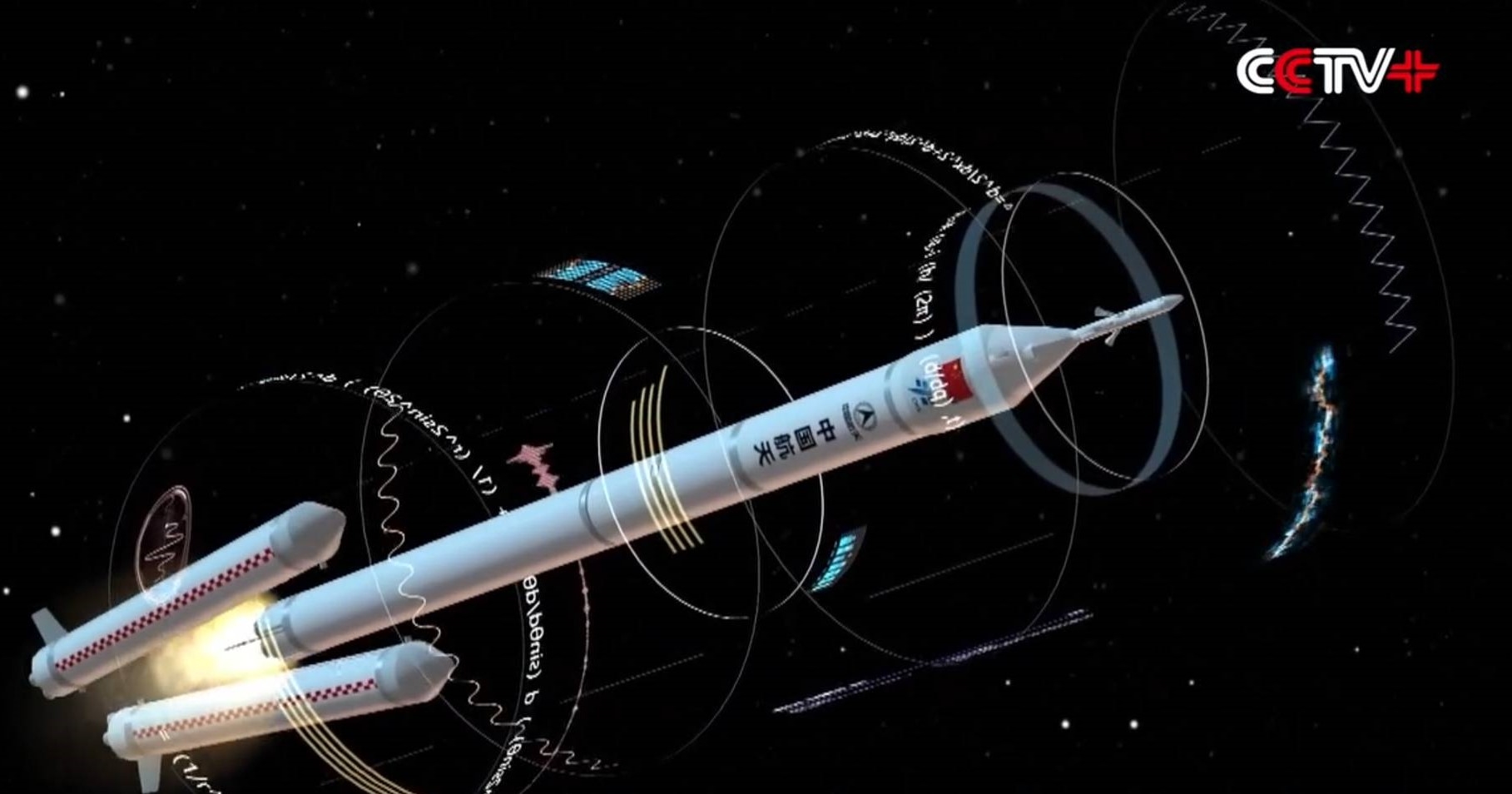
Image credit: CCTV/Inside Outer Space screengrab
Powerhouse rocket
China’s intention to plant boots on the Moon is picking up speed.
Work is underway to shape various elements of China’s human program for lunar exploration, including its Long March-10 powerhouse rocket.
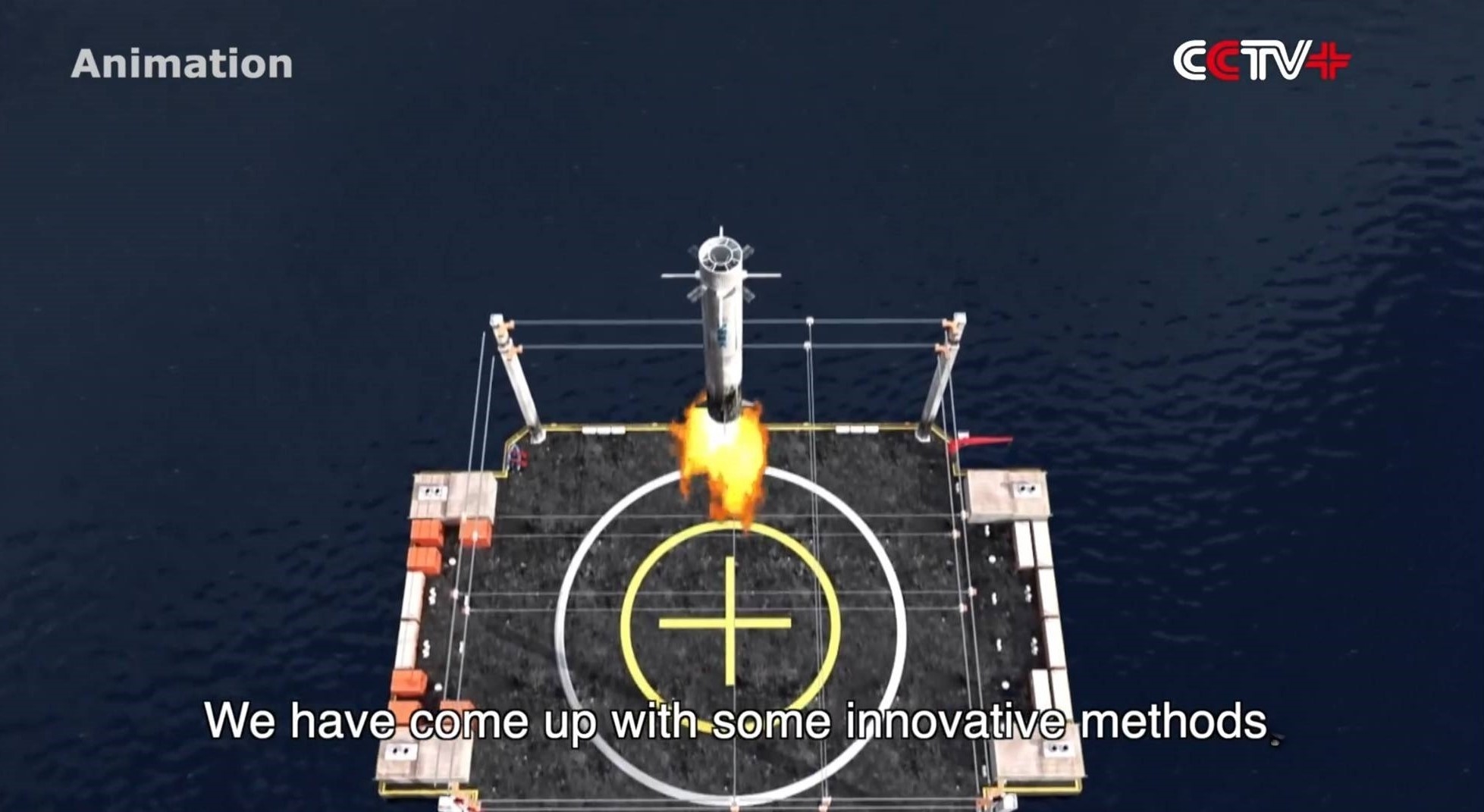
Shades of SpaceX. China Long March-10 stage heads for ocean landing in this artwork.
Image credit: CCTV/Inside Outer Space screengrab
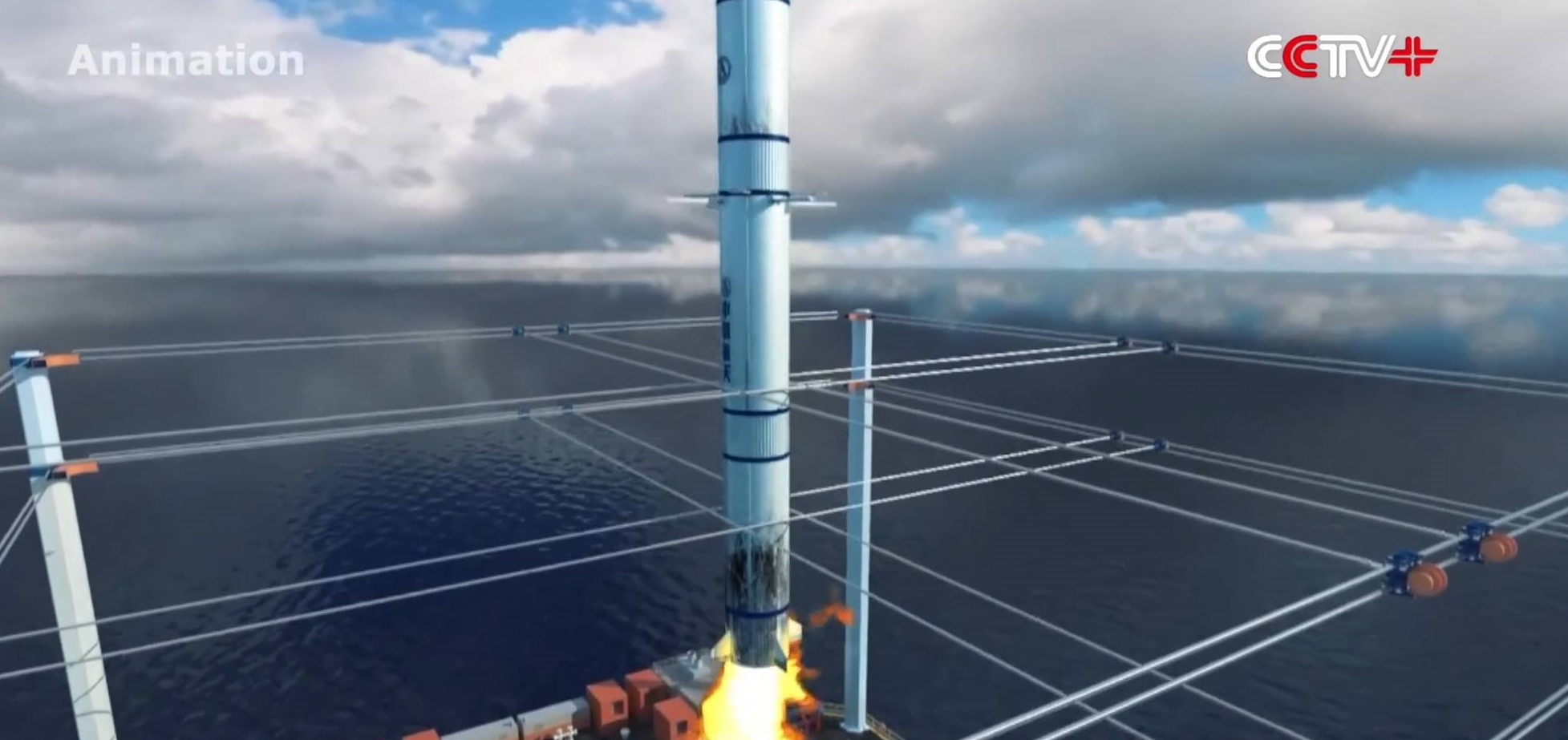
Image credit: CCTV/Inside Outer Space screengrab
“The development of new-generation manned rockets can greatly enhance our country’s ability to enter space and help the Chinese land on the Moon,” Xu Hongping, an engineer with the China Aerospace Science and Technology Corporation (CASC) in Beijing recently told China Central Television (CCTV).
China’s piloted lunar mission rocket is touted as featuring reusable engines and think-for-itself intelligent flight attributes.
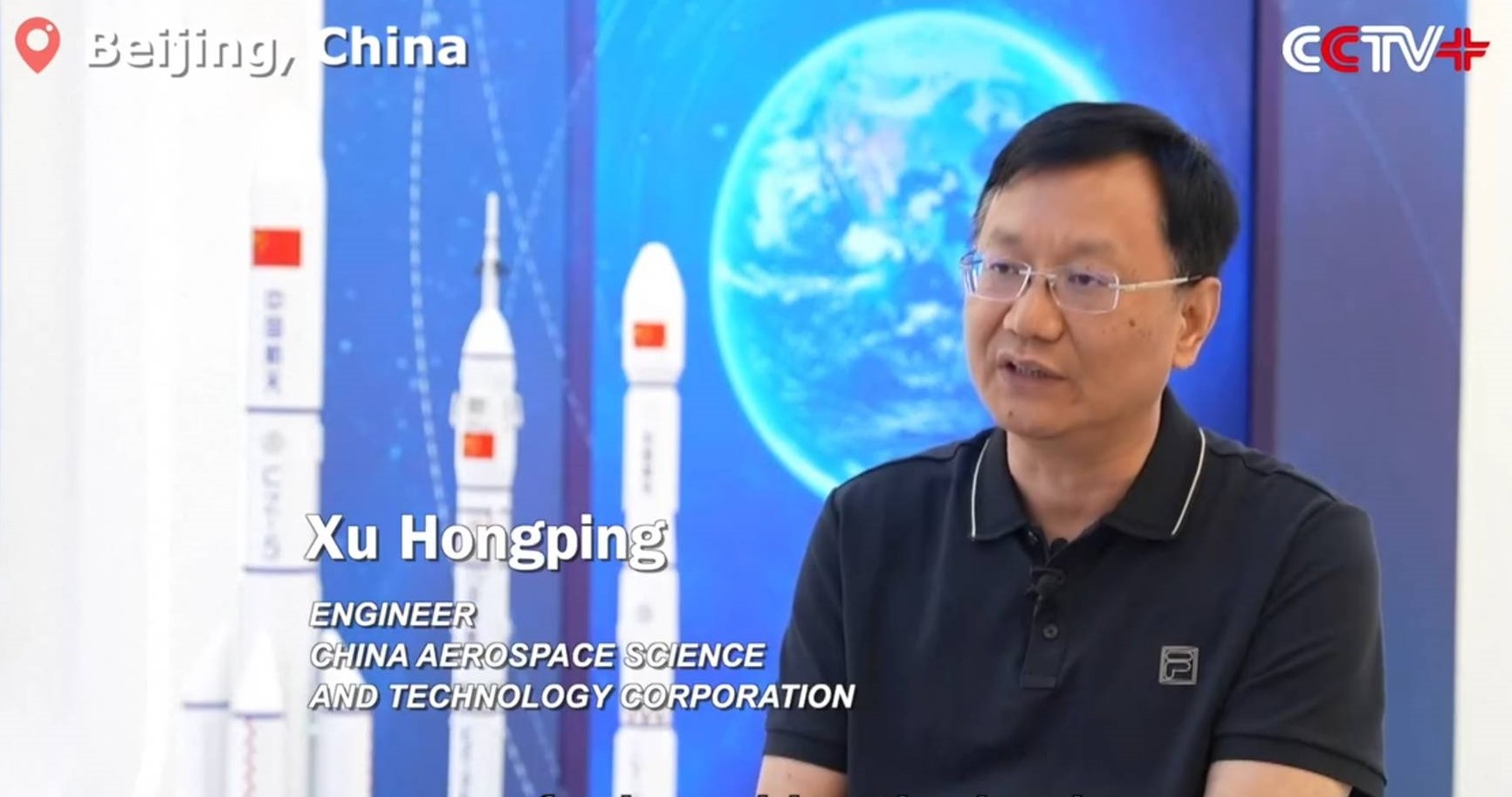
Image credit: CCTV/Inside Outer Space screengrab
Xu added that some of the Moon rocket’s technological breakthroughs can drive the development of the country’s aerospace industry, “and will be a considerable boost to the country’s advanced manufacturing sector.”
For informative videos on China’s Long March-10 development, go to:

Image taken by mini-rover of Change’-6 lander/ascender spacecraft on the far side of the Moon.
Image credit: CNSA
China’s new set of lunar collectibles, scooped up by the country’s Chang’e-6 Moon sample mission, owes a tip of the space helmet visor to a research team at the Hong Kong Polytechnic University (PolyU).
In collaboration with the China Academy of Space Technology (CAST), a “Surface Sampling and Packing System” for the task was set in stone – or set in lunar regolith that is!

Chang’e-6 scooping operation on Moon’s far side.
Image credit: CNSA/CLEP
On June 3, following the soft landing of the Chang’e-6 probe on the Moon’s far side, the PolyU-developed system accomplished the tasks of automatic sample collection and packaging on the lunar surface.
If all goes according to plan, samples from the first-ever lunar far side mission are returning to Earth on June 25.

Artwork depicts the parachuting to Earth of the Chang’e-6 capsule toting its lunar collection.
Image credit: CNSA/CCTV/Inside Outer Space screengrab
Sealing and packaging
PolyU was involved in the design and manufacturing of Samplers A and B, together with two accompanying high temperature near-field cameras for multiple-point surface sample collections, and automatic vision guidance of the lunar topside sampling.
The sampling process started with the near-field cameras mounted on the lander/ascender’s robotic arm next to Samplers A and B.

Yung Kai-leung introduces PolyU-developed “Surface Sampling and Packing System” for the Chang’e-6 mission. Image credit: PolyU
These cameras guided the sampling and sample deposition into the sample container, part of the primary sealing and packaging system.
Upon the completion of the sampling process, the tightly-sealed container was then vision-guided by the near-field cameras for automatic and precise insertion into the Chang’e-6’s ascender. That spacecraft segment subsequently rocketed off the Moon with its cache of lunar collectibles.

Group photo of Yung Kai-leung (center) and his research team at PolyU’s Industrial Center.
Image credit: PolyU
Lunar soil storage
PolyU researchers have also used advanced topographic mapping technologies to evaluate and identify the best landing sites for spacecraft.
That work has supported China’s lunar exploration missions, including Chang’e-3, Chang’e-4 and Chang’e-5, as well as the Mars exploration mission, Tianwen-1.

PolyU-developed a “Surface Sampling and Packing System.”
Image credit: PolyU
In 2021, PolyU established the Research Center for Deep Space Explorations and in the following year established the Joint Research Center of Advanced Aerospace Propulsion Technology in collaboration with the Academy of Aerospace Propulsion Technology.
The Space Resources Laboratory of the PolyU Deep Space Exploration Research Center has set up a lunar soil storage and sample analyzer capability to properly store and study lunar soil in depth.
“The far side of the Moon lacks any protection like magnetic fields or atmosphere at all, and features lots more impacts from meteors. The basin that was visited this time is a huge crash crater on the far side of the Moon, which is very old, possibly capable of ejecting substances from the deep lunar crust, or even from the lunar mantle,” Yung told CCTV.

Image credit: PolyU
“For this reason, I hope that with the retrieval of lunar mantle material, we will have some clues as to what exactly is inside the moon,” Yung commented.
Express mail cargo
Launched from south China’s Hainan Province on May 3, the Chang’e-6 mission’s lander-ascender combination later touched down in the South Pole-Aitken (SPA) Basin on the Moon.
After completing its collection of lunar specimens, the ascender blasted off from the lunar surface with its express mail cargo.

Artwork depicts ascender reaching orbiter to enable return of lunar samples.
Image credit: CGTN/Inside Outer Space screengrab
The ascender then re-united with the Chang’e-6 orbiter for the sample transfer. The mission’s returner segment is awaiting the optimal time to start its journey back to the Earth.
Drilling process
The far side grab-bag of Moon bits and pieces was completed within two days, done by two methods of sampling: use of a drill to collect subsurface specimens and the grab of samples on the surface with a robotic arm.
According to China Central Television (CCTV), the drilling process used a set of sampling equipment consisting of three layers, with a designed length of 8 feet (2.5 meters). The outer layer is the drilling rod, closely followed by the core tube, and the core tube is wrapped with a core bag.
As the drill bit was drilling downward, the core bag was also moving downward along with the core tube, and the sample was pushed into the bag. Once the sampling was completed, the core bag was wrapped and positioned onto the primary sealing device.

Chang’e-6 drilling gear.
Image credit: CCTV/Inside Outer Space screengrab
Plasticity and toughness
“During the drilling process, the drilling rod must be wear-resistant and difficult to deform. Excessive deformation would hinder the retrieval of lunar soil. The drilling rod must possess sufficient plasticity and toughness to prevent any cracking throughout the entire drilling operation,” said Ma Zongyi, a researcher with the Institute of Metal Research of the Chinese Academy of Sciences.
In order to ensure capability and stability of the drilling rod while further reducing its weight, the researchers developed tough aluminum-based composite materials. The wear resistance and strength of the drilling rod made from these materials can rival that of steel, while reducing the weight by 65 percent, reported CCTV.

Image credit: CCTV/Inside Outer Space screengrab
53-day journey
Researcher, Jiang Haichang, also with the Institute of Metal Research of the Chinese Academy of Sciences, told CCTV:
“The tube is integrally molded. And it is very long. In order to reduce weight during the lunar landing process, the wall of the tube needs to be very thin, which poses significant challenges in the manufacturing process. We have to update the molds and fixtures accordingly,” said Jiang.
The Chang’e-6 returner capsule, toting lunar samples collected in the South Pole-Aitken Basin on the Moon, is slated for touch down at a landing area within Siziwang Banner in north China’s Inner Mongolia Autonomous Region.
That parachute landing will signify the end of Chang’e-6’s 53-day journey of flying to the Moon and back.

Space debris plunges to Earth, burning its way through the atmosphere.
Image credit: The Aerospace Corporation
End-of-life, human-made space scraps that fall into Earth’s atmosphere are leaving behind a train of tiny particles that are eating away at our fragile biosphere.
The new work has been published in the AGU journal Geophysical Research Letters pointing to the increasing number of satellite constellations, the byproducts of which on re-entry catalyze chemical reactions that destroy stratospheric ozone.
The work was led by José Ferreira in the Department of Astronautical Engineering at the University of Southern California (USC), Los Angeles.

Launch and reentry particle emissions in the Earth’s stratosphere.
Image credit: The Aerospace Corporation
Rapid ramp up
“Only in recent years have people started to think this might become a problem,” said Joseph Wang, a researcher in astronautics at USC and a corresponding author of the new work.
“We were one of the first teams to look at what the implication of these facts might be,” Wang said in an AGU media release.
According to Wang and research colleagues, demand for global internet coverage is driving a rapid ramp up of launches of small communication satellite swarms.

Falcon 9 booster topped with sixty Starlink satellites.
Credit: SpaceX
SpaceX and its Starlink satellites is the front runner in this enterprise. Amazon and other companies around the globe are also planning constellations ranging from 3,000 to 13,000 satellites, the authors of the study explain.
Unplanned pollution
Internet satellites in low Earth orbit are short-lived, say about five years. What follows is that companies must then launch replacement satellites to maintain internet service.
What this adds up to is a cycle of planned obsolescence, coupled with unplanned pollution of Earth’s atmosphere.
“Satellites burn up at the end of service life during reentry, generating aluminum oxides as the main byproduct. These are known catalysts for chlorine activation that depletes ozone in the stratosphere,” explains the research paper: “Potential Ozone Depletion From Satellite Demise During Atmospheric Reentry in the Era of Mega-Constellations.”
Molecular dynamics simulations
Wang and research team colleagues note that the environmental impacts from the reentry of satellites are currently poorly understood.
The team’s investigation focuses on the oxidation process of the satellite’s aluminum content during atmospheric reentry utilizing atomic-scale molecular dynamics simulations, cited as the first simulation work to do so.
The simulations were performed at the USC Center for Advanced Research Computing (CARC).
Above natural levels
By applying reentry forecasts considering the deployment of mega-constellations, the aluminum excess ratio at the top of the mesosphere can reach a yearly excess of more than 640 percent above natural levels, they report, or over 360 metric tons of aluminum oxide clusters per year from satellites.
“We find that the population of reentering satellites in 2022 caused a 29.5% increase of aluminum in the atmosphere above the natural level, resulting in around 17 metric tons of aluminum oxides injected into the mesosphere,” the researchers report.

Credit: CORDS/The Aerospace Corporation
Aluminum is one of the most prevailing materials in satellites and launch vehicles by mass.
Future scenario
Moreover, the byproducts generated by the reentry of satellites in a future scenario – where projected mega-constellations come to fruition — can reach over 360 metric tons per year. “As aluminum oxide nanoparticles may remain in the atmosphere for decades, they can cause significant ozone depletion,” the new research adds.
The team calculates that, based on particle size, it would take up to 30 years for the aluminum oxides to drift down to stratospheric altitudes, where 90% of Earth’s ozone is located.
To view this research – “Potential Ozone Depletion From Satellite Demise During Atmospheric Reentry in the Era of Mega-Constellations” – go to:
https://agupubs.onlinelibrary.wiley.com/doi/10.1029/2024GL109280

Image credit: CCTV/Inside Outer Space screengrab
China’s projected human exploration of the Moon received a boost last week given a first-time propulsion system test for the country’s powerful Long March-10 rocket.
According to the China Aerospace Science and Technology Corporation (CASC), the propulsion system for the first stage of the Long March-10 launch vehicle underwent testing for the first time on June 14.

Image credit: CCTV/Inside Outer Space screengrab
During the static firing test, three YF-100K engines churned out a ground thrust reaching 382 tons. The YF-100K is a reusable liquid oxygen/kerosene rocket engine.
The Long March-10 is to be a three-and-a-half-stage rocket designed to carry over 27 tons of payload to the Earth-to-Moon transfer orbit.
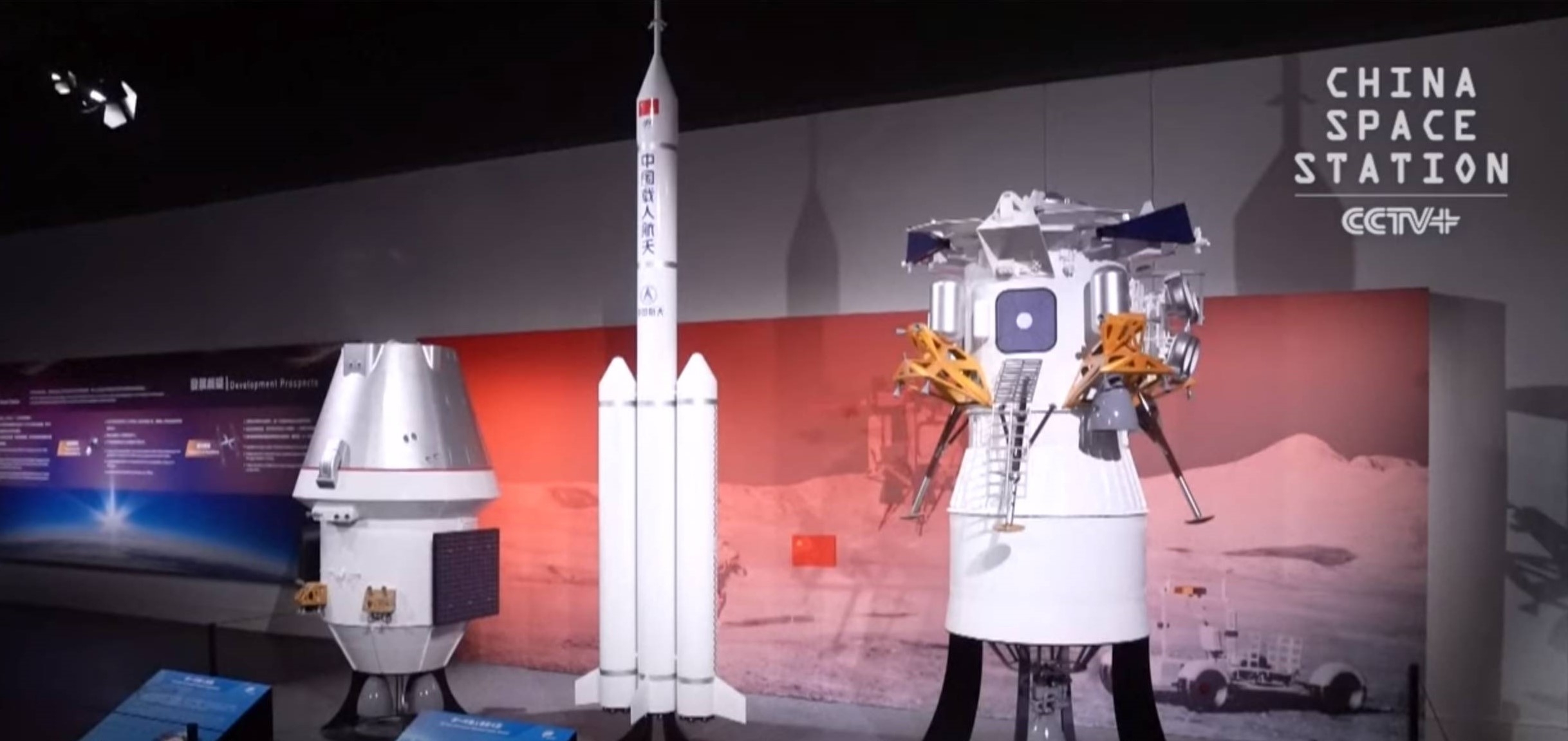
China’s plans for human crews on the Moon are being shaped.
Image credit: CCTV/Inside Outer Space screengrab
Institute 101
The rocket engine trial run for the first-stage propulsion system of the Long March-10 took place at Institute 101 of the Sixth Academy of China Aerospace Science and Technology Corporation (CASC) in Beijing.
CASC explains that a second ground test of the first-stage propulsion system is scheduled to take place soon.
The recently completed firing was the first large-scale system-level ground test of the Long March-10 series and marks a key step toward realizing China’s stated goal of landing a crew on the Moon by 2030.

Image credit: CCTV/Inside Outer Space screengrab
Crews, lunar landers
“The test is basically a comprehensive verification of our first-stage module. It was a complete success, laying a solid foundation for our subsequent research and development and the realization of our entire manned lunar exploration program,” said Xu Hongping, an engineer with CASC told CCTV.
Development of the Long March-10 is geared to send piloted spacecraft and Moon landers into a Earth-Moon transfer orbit.
The rocket specs placed it as having a total length of about 300 feet (92 meters), a takeoff weight of over 2,180 tons, a takeoff thrust of about 2,678 tons, and a carrying capacity of no less than 27 tons for an Earth-Moon transfer orbit.

Chinese astronauts may be investigating the Moon up-close before 2030.
Image credit: CMS
Advanced manufacturing sector
A non-booster configuration of the new rocket is capable of conducting missions for transporting astronauts and cargo to China’s space station.
“The development of new-generation manned rockets can greatly enhance our country’s ability to enter space and help the Chinese land on the Moon,” Xu added.
“In addition, some of its technological breakthroughs can drive the development of our entire aerospace industry,” Xu said, “and will be a considerable boost to the country’s advanced manufacturing sector.”
Go to this video spotlighting the recently completed static firing at:
https://youtu.be/a0Is9xmPUbA?si=avW3-ikDLPiQfGTp

Long March -10 Image credit: CMSE
Earth’s moon – a watering hole to enable long-term human exploration?
Image credit: NASA
A hot topic for moon researchers is whether or not water ice is an available, ripe for the picking resource at the lunar south pole.
The search for exploitable water ice is high on NASA’s Artemis agenda to blueprint a “sustainable” human presence pathway on the Moon, with water ice being the elixir for longevity of future expeditions there.
Lunar water ice is believed to reside within permanently-shadowed regions, or PSRs, contained within super-chilly “cold traps.”
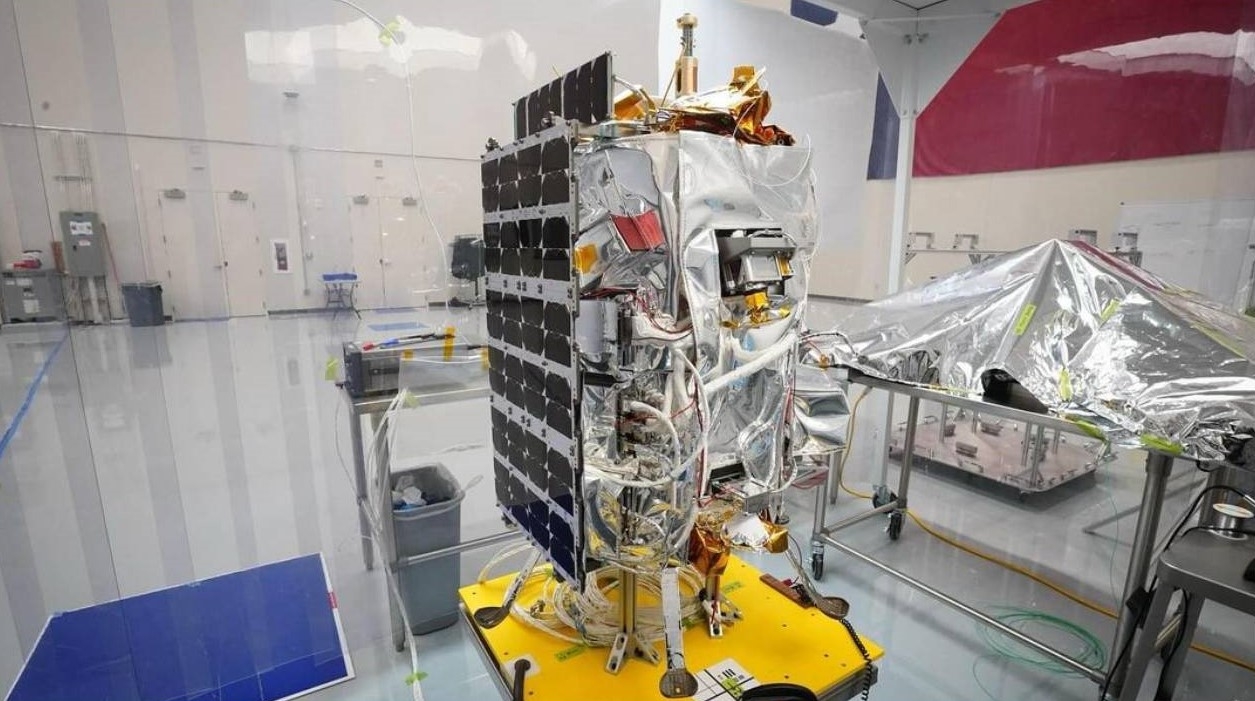
Intuitive Machines mini-hopper is scheduled to dive into the permanently shadowed floor of Marston crater at the moon’s south pole.
Image credit: Intuitive Machines
A Space Resources Roundtable was held June 4-7 on the campus of the Colorado School of Mines. Experts brought attention to the scant data now in hand to shore up the prospect of utilizing water ice on the moon.
For more details on the prognosis for finding water ice on the Moon, go to my new SpaceNews story – “Moon ice in the Artemis era: what we still don’t know” – at:
https://spacenews.com/moon-ice-in-the-artemis-era-what-we-still-dont-know/
Image taken by mini-rover of Change’-6 lander/ascender spacecraft on the far side of the Moon.
Image credit: CNSA
NASA’s Lunar Reconnaissance Orbiter (LRO) now circling the Moon has taken its first look at China’s far side Chang’e-6 landing spot.
The lander is flanked by two craters similar in size to it, and is on the edge of a much more subtle crater about 50 meters wide, reports Mark Robinson, the principal investigator of the sharp-shooting camera system onboard LRO.
Chang’e-6 has been sighted within the Apollo basin on the lunar far side on June 7, 2024. The lander is seen as the small cluster of bright pixels in the center of the image.
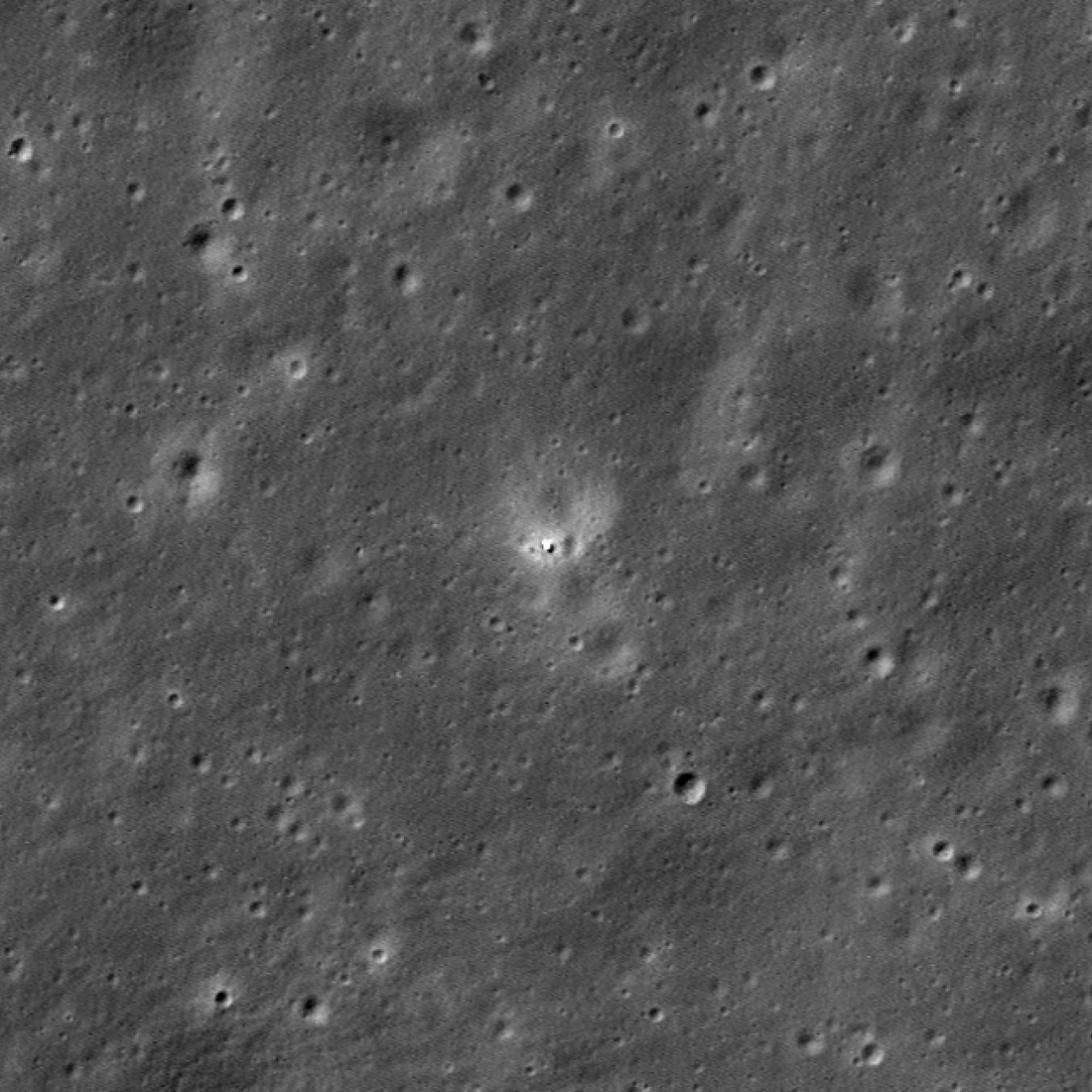
Landing locale of China’s Change’-6 far side lander.
Image credit: NASA/GSFC/Arizona State University
Rim shot
NASA’s LRO imaged China’s Chang’e 6 sample return spacecraft on the lunar farside five days after its June 1st landing and when LRO passed over, acquiring an image showing the Chang’e-6 lander on the rim of an eroded ~50 meter diameter crater.
The Lunar Reconnaissance Orbiter Camera (LROC) team computed the landing site coordinates as -41.6385°N, 206.0148°E, at -5256 meters elevation relative to the average lunar surface, with an estimated horizontal accuracy of plus-or-minus 30 meters.
“The increased brightness of the terrain surrounding the lander is due to disturbance from the lander engine and is similar to the blast zone seen around other lunar landers.
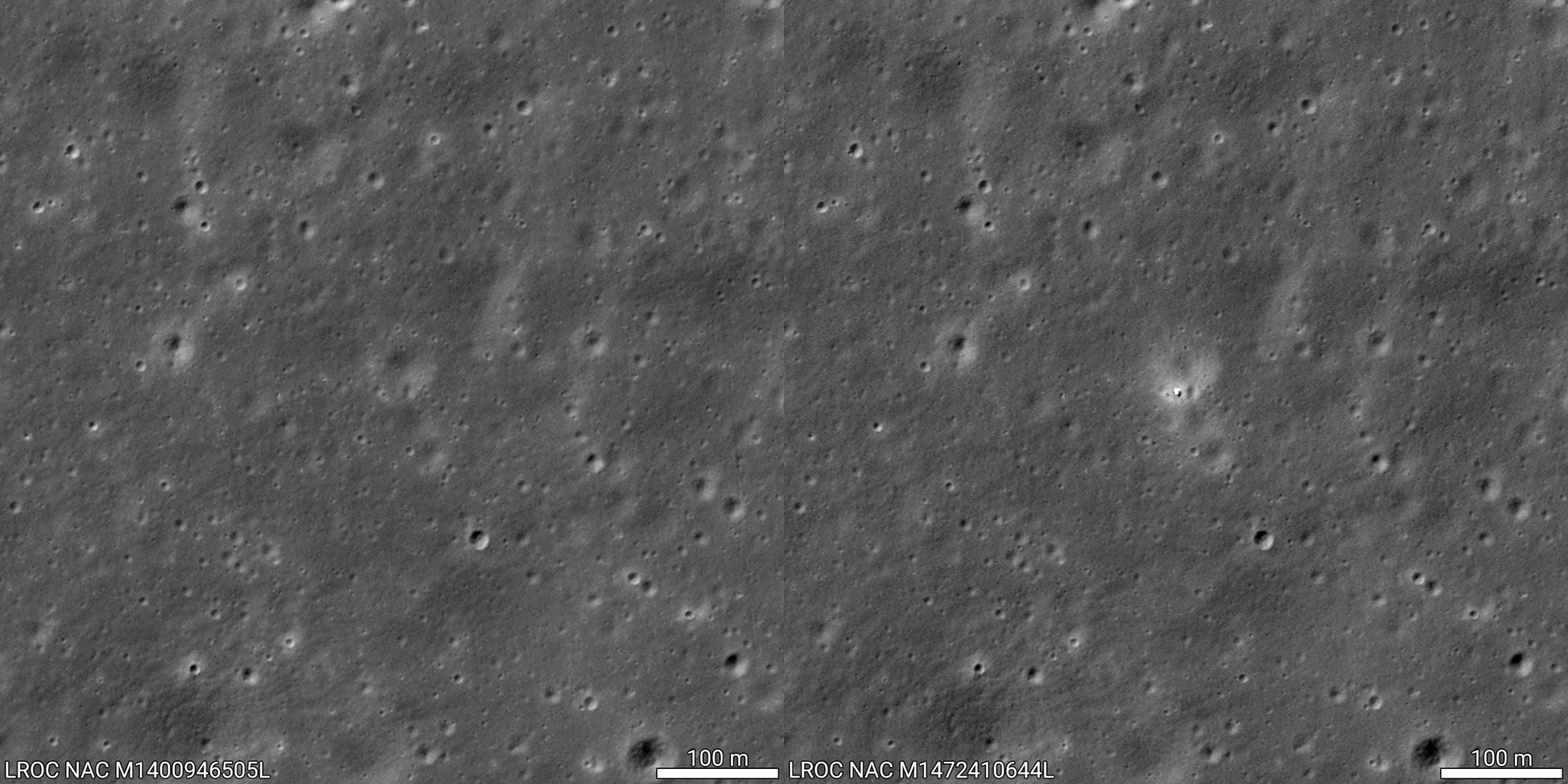
Click on image for before and after photography. Image credit: NASA/GSFC/Arizona State University
Before and after imagery
In comparative imagery, a before image is from March 3, 2022, and the after image is the June 7, 2024 image.
The Chang’e 6 landing site is situated on a mare unit at the southern edge of the Apollo basin.
Robinson and colleagues at Arizona State University note that Basaltic lava erupted south of Chaffee S crater approximately 3.1 billion years ago and flowed downhill to the east until it encountered a local topographic high, likely related to a fault.
“Several wrinkle ridges in this region have deformed and raised the mare surface,” according to an LRO posting. “The landing site sits approximately halfway between two of these ridges. The lava flow also overlaps a slightly older flow, visible further east, but the younger flow is distinctive because it has higher iron oxide and titanium oxide abundances, the posting reports.
Homeward bound
Chang’e-6 was launched from south China’s Hainan Province on May 3, with the Chang’e-6 multi-component craft making the first-ever gathering of lunar samples from the far side of the Moon.
After completing its collection of lunar samples, the probe’s ascender segment departed from the lunar surface with the precious cargo.
Parachuting to Earth, the Chang’e-6 capsule toting its lunar collection.
Image credit: CNSA/CCTV/Inside Outer Space screengrab
After re-uniting with the Chang’e-6 mission orbiter and completing the lunar sample transfer last week, the returner segment is continuing to orbit the Moon, awaiting the time to initiate its return journey back to the Earth.
A projected date of June 25 is the likely return to Earth of the returner’s capsule, toting its cache of lunar collectibles, parachuting into a pre-picked landing zone at Siziwang Banner in north China’s Inner Mongolia Autonomous Region.
At parachute touchdown, the Chang’e-6 will wrap up its 53-day journey of going to the Moon and back.

NASA’s Lunar Reconnaissance Orbiter (LRO).
Credit: NASA’s Goddard Space Flight Center Conceptual Image Lab

Book Review: After the Flying Saucers Came: A Global History of the UFO Phenomenon by Greg Eghigian; Oxford University Press, 2024; Hardcover, 400 pages; $29.99.
In this highly embraced volume the author explores how individuals, scientists, governments and the media responded to reports of UFO sightings and alien abductions, and what those responses say about the human experience.
Eghigian expertly tells this compelling tale via eight chapters, such as “Spaceships, Conspiracies, and the Birth of the UFO Detective, 1948-1953,” “Science and UFOs in the 1960s,” with a concluding segment “Where To, Where From, Wherefore?”

Image credit: Penn State/Inside Outer Space screengrab
“The UFO phenomenon essentially has been asking us to think of ourselves historically: what has been our past, what is going on right now, and what does the future hold?,” Eghigian writes. “The last question is one that has haunted the flying saucer mystery from the very beginning, and it was one that was acutely pressing during the Cold War.”
This book is a valuable contribution to unraveling (maybe snarl your mind more) the countless questions that swirl around UFOs, aliens from afar, and the significance of taking the time, pondering the plausible and implausible, and coming up with your own conclusions.
For an informative overview of the book, go to this article by Francisco Tutella at:
Also, go to this video featuring the author, Greg Eghigian, as he details why he wrote this book and his feelings about the intriguing, perplexing world of UFOs in the past, the present, and what the future portends at:

China’s Chang’e-6 lander/ascender in far side sampling scenery. Image taken by a mini-rover.
Image credit: CNSA/CLEP
That mysterious tiny rover let loose by China’s Chang’e-6 Moon lander has finally been spotlighted.
The state-run Xinhua news agency said the roughly 5 kilograms device is an autonomous, intelligent mini-robot, developed by the China Aerospace Science and Technology Corporation (CASC).
Weighing roughly 11 pounds (5 kilograms), the sporty mini-snooper is far lighter than China’s first lunar rover, Yutu, that drove across the lunar landscape in 2013.

Chang’e-6 pre-launch look with wheeled rover attached (left side of photo).
Image credit: CNSA/CCTV/Inside Outer Space screengrab
Ideal angle
“After Chang’e-6 collected the samples on the far side of the Moon,” Xinhua reports, “the mini rover autonomously detached from the lander, moved to a suitable position, selected an ideal angle for the photograph, and then captured the image.”
No word on the ultra-tiny Moon rover’s health given the Chang’e-6’s ascender blastoff that lofted lunar collectibles into Moon orbit.

