Archive for the ‘Space News’ Category
 Author:
  September 17th, 2024
Moon as viewed from the International Space Station:
Image credit: Matthew Dominick/NASA
The size of the cislunar market industrial base is in growth mode.
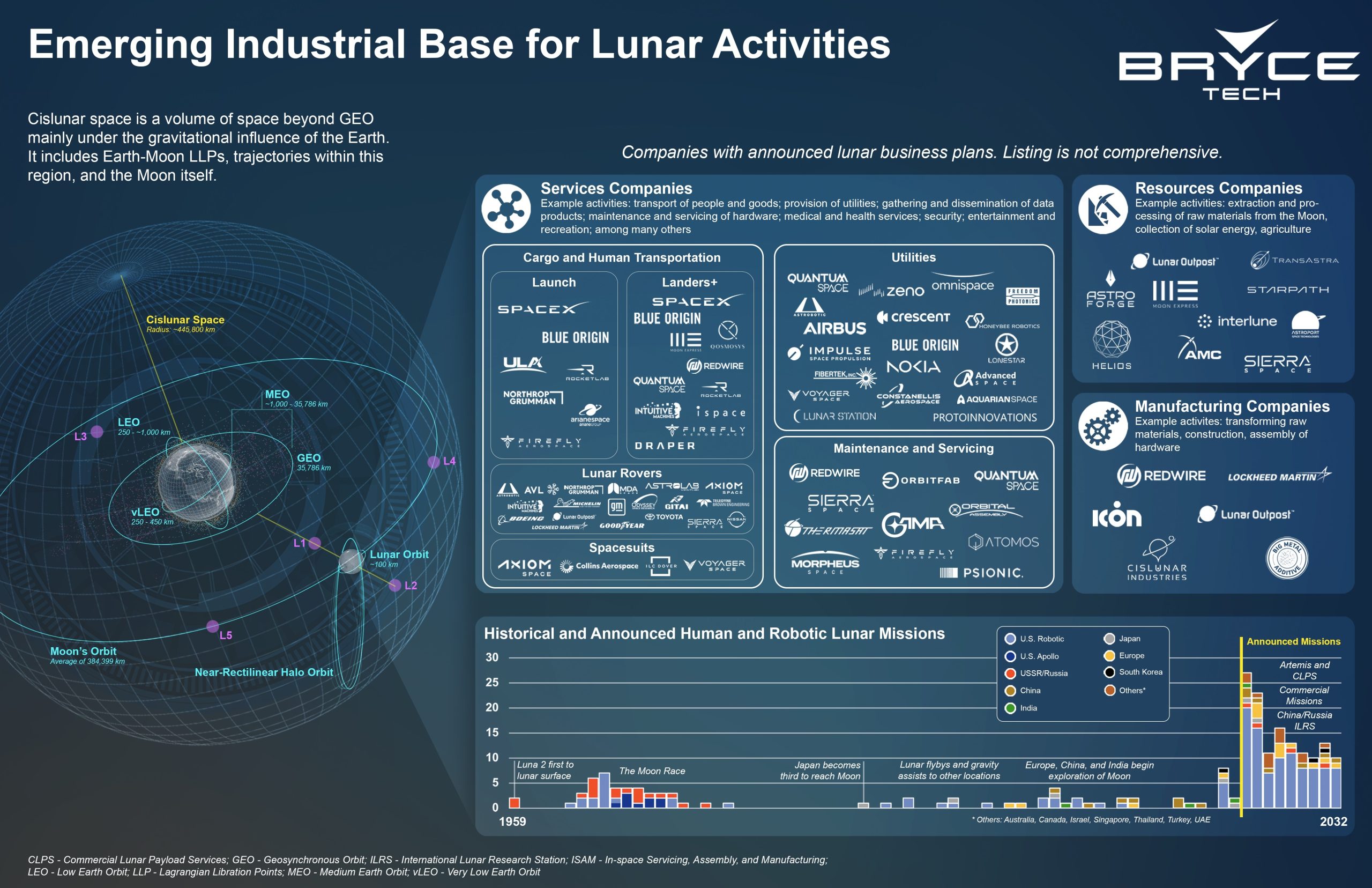
A new lunar activities infographic has been assembled by BryceTech of Alexandria, Virginia.
“As interest in lunar exploration grows, both government and commercial programs are pushing forward,” BryceTech notes. “Companies are now focusing on essential services like transportation, telecommunications, and maintenance, and even mining, to support lunar missions.”
Market elements
The BryceTech infographic flags the market elements as:
Services: Companies providing transportation, utilities, and maintenance.
Resources: Companies focused on lunar resource extraction.
Manufacturing: Companies building hardware for lunar activities.
Complex interplay
Bryce is providing insight and expertise on the blossoming space economy, a complex interplay of national security, civil and commercial space programs, technical capabilities, and markets.
To download the Bryce infographic, go to:
https://brycetech.com/reports/report-documents/emerging-industrial-base-lunar-2024/
 Posted in

Image credit: SpaceX
The Federal Aviation Administration (FAA) is proposing that SpaceX cough up $633,009 in civil penalties for allegedly failing to follow its license requirements during two launches in 2023, in accordance with statutorily-set civil penalty guidelines.
The FAA proposal cites two incidents in May and June of 2023.
SpaceX submitted a request to revise its communications plan related to its license to launch from Cape Canaveral Space Force Station in Florida. The proposed revisions included adding a new launch control room at Hangar X and removing the T-2 hour readiness poll from its procedures.
But on June 18, 2023, SpaceX used the unapproved launch control room for the PSN SATRIA mission and did not conduct the required T-2 hour poll.
The FAA is after $175,000 for each alleged violation.
Propellant farm

Image credit: SpaceX
In July 2023, SpaceX submitted a request to revise its explosive site plan related to its license to launch from the Kennedy Space Center in Florida. The proposed revision reflected a newly constructed rocket propellant farm.
But on July 28, 2023, SpaceX used the unapproved rocket propellant farm for the EchoStar XXIV/Jupiter mission, earning them the FAA proposed $283,009 civil penalty.
SpaceX has 30 days to respond to the FAA after receiving the agency’s enforcement letters.

Image credit: CCTV/Inside Outer Space screengrab
Leading space officials in China are detailing deep space exploration plans, from setting up a scientific research station on the Moon, collecting and returning specimens of Mars and asteroid, as well as exploring the Jupiter system.
A recently held 2nd International Deep Space Exploration Conference in Tunxi of Huangshan City in east China’s Anhui Province provided the stage to discuss China’s long-range plans.

Image credit: CCTV/CGTN/Inside Outer Space screengrab
Lunar south pole
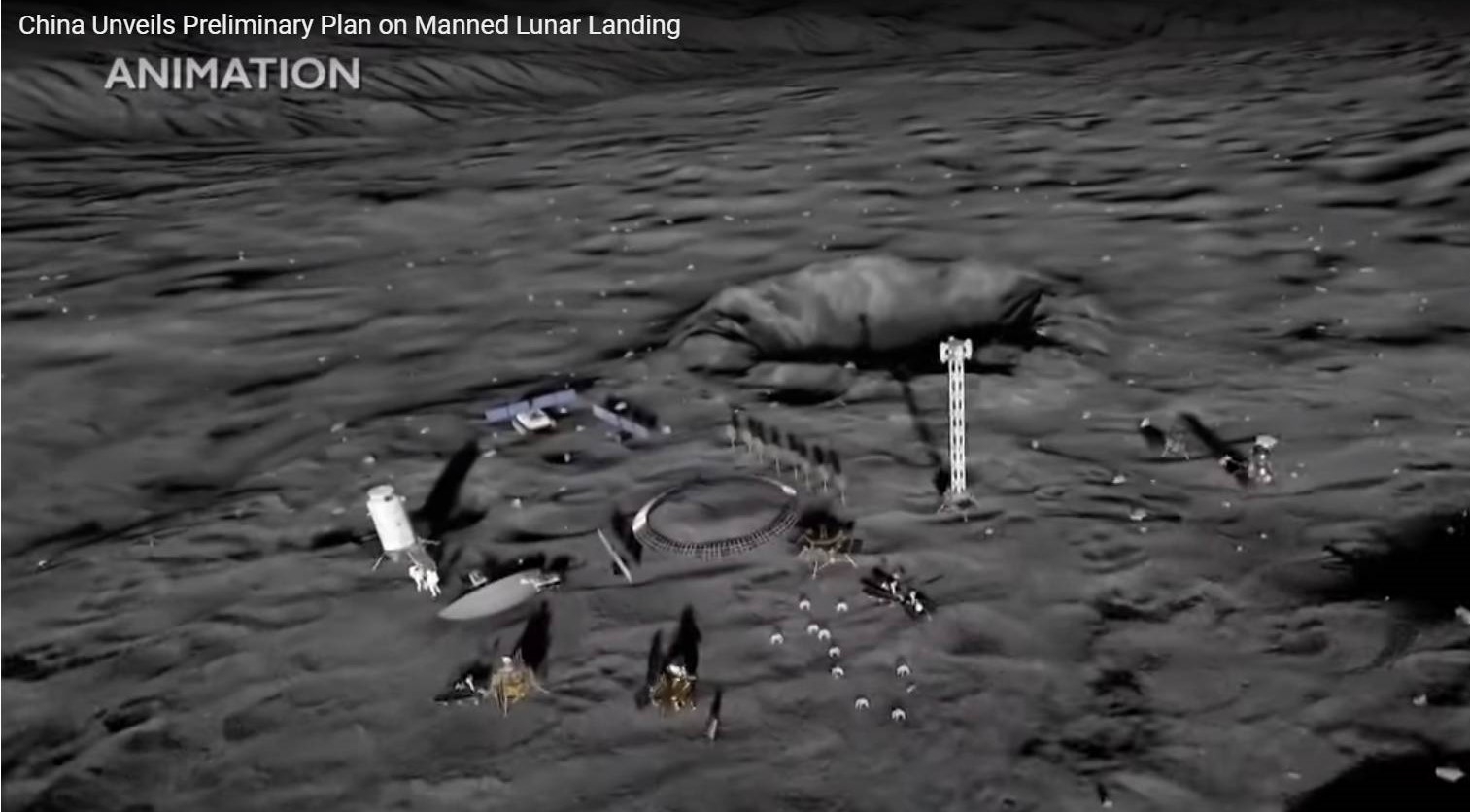
In the cue is putting in place an International Lunar Research Station (ILRS).
Wu Weiren, chief designer of China’s lunar exploration project, explains that the ILRS project will be implemented in two phases. Wu is also director and chief scientist of Deep Space Exploration Lab.
The first phase will see a basic facility built by 2035 in the lunar south pole region, Wu explains in recent interviews, posted by China Central Television (CCTV) and China Global Television Network (CGTN).
An ILRS second phase, Wu added, is being scripted to establish a network connecting the Moon’s south pole, equator and far side by 2050.
Artist’s view of International Lunar Research Station to be completed by 2035. Credit: CNSA
Shadow pits
“According to scientists’ deduction, or based on our international counterparts’ previous long-time scientific exploration,” Wu said, “we should strive to have people go up to the Moon in a short term. Then we could see whether there is water in the permanent shadow pits there.”
If water molecules are indeed found and direct evidence of the existence of water ice on the Moon at the poles of the Moon, Wu continued, “that will pave the way for humans to stay on the Moon for a long time and even lay a foundation for humankind to reach farther deep space from the Moon, such as Mars or other planets.”

Chang’e-8 south pole lander.
Image credit: CNSA
Upcoming lunar landers
Following two successful robotic Moon sampling, Earth-return ventures – near-side Chang’e-5 (December 2020) and far-side Chang’e-6 (June 2024), upcoming is the Chang’e-7 that will land on the south pole of the Moon and search for water.
Chang’e-8 will also touchdown at the south pole of the Moon and will join Chang’e-7 “to form the basic structure of the south pole station on the Moon,” Wu said.
The ILRS initiative, officially launched by the China National Space Administration (CNSA) in 2017, has been bolstered since that time with more than 40 institutions from around the world already signing agreements for cooperation with China.

Tianwen-3 mission’s chief designer, Liu Jizhong.
Image credit: CCTV/CGTN/Inside Outer Space screengrab
Mars sample return
Chinese space engineers are also moving ahead in orchestrating a Mars sample retrieval plan, a mission known as Tianwen-3. That robotic snag, bag, and rocket to Earth Red Planet bits and pieces involves two launches to Mars by around 2028, according to the mission’s chief designer, Liu Jizhong.
Liu unveiled details of the plan in a recent interview with CGTN.

Image credit: CCTV/CGTN/Inside Outer Space screengrab
The plan is structured into 13 stages, employing both on-the-spot and remote sensing techniques to conduct comprehensive research on Mars samples to ensure that they can be successfully returned and yield meaningful scientific discoveries. The mission’s top priority, Liu said, is to search for traces of life on Mars, and will involve critical engineering technologies, according to CGTN.

Image credit: CCTV/CGTN/Inside Outer Space screengrab
Challenges ahead
“We have made many optimizations and upgrades during the demonstration process. So, it should be carried out with two Long March 5 carrier rockets, which basically would be launched in succession,” said Liu. “Then all the samples can finally be returned.”
However, Liu added that the sample return mission still faces many challenges.
“First of all, there is the issue of landing accuracy. Secondly, the return mission requires a launch from the surface of Mars, which actually involves a small rocket launch. Therefore, it is very difficult to ensure the reliability of the entire flight process. Thirdly, the temperature of Mars is relatively low, which poses a challenge to the propellants used in our current rockets,” Liu said.

Conceptual video of China’s Mars sample return plans show robot specimen collection.
Image credit: CCTV/CGTN/Inside Outer Space screengrab
Payload collaboration
International cooperation on the Tianwen-3 mission, Liu continued, will focus on three areas: payload collaboration, sample and data sharing, and planning for future missions.
“International cooperation has always been an important part of China’s deep space exploration. Throughout the process, we’ve been working together with our international fellow scientists,” said Liu.
According to Liu, space planners have set aside certain resources for international payloads.
“Basically, we kept 25 kilograms for the orbiter and five kilograms for the service orbiter. Many international scientific research institutions and universities have expressed great interest,” Liu noted, “including Russia, Europe and some other countries. Other forms of international cooperation include data cooperation in future, such as data sharing, including joint research on the samples.”

Sample handoff high above Mars.
Image credit: CCTV/CGTN/Inside Outer Space screengrab
Humans to Mars
Liu underscored China’s progress in its crewed Moon exploration plans, and said they could pave the way for future human missions to Mars in the decades to come.
“Currently, we are working on the manned lunar landing mission, and it’s progressing smoothly. In fact, one of the goals of this mission is to conduct research through landing humans on the lunar surface, which will pave the way for future missions to Mars. Therefore, it is definitely a possibility for us humans to land on the Mars,” Liu said.

Image credit: CCTV/CGTN/Inside Outer Space screengrab

Caltech-led Lunar Trailblazer mission on the prowl to probe the abundance, distribution of water on the Moon, as well as the lunar water cycle.
Image credit: Lockheed Martin
A hot topic in Moon exploration is finding reservoirs of water ice within “cold traps” at the lunar south pole.
If found in permanently-shadowed regions, or PSRs, that resource may be ripe for the picking and processing into oxygen and hydrogen – ideal for life support, even manufacturing rocket fuel.
Exploitable water ice at the lunar south pole is high on NASA’s Artemis agenda to facilitate a “sustainable” human presence on the Moon.

Intuitive Machines (IM-2), a Nova-C lunar lander dubbed Athena is being prepared for sendoff to the Moon’s south pole. Onboard the lander is the Polar Resources Ice Mining Experiment-1 (PRIME-1), a NASA experiment designed to search for water ice on the Moon.
Image credit: Intuitive Machines
But NASA is not alone in wanting to locate and use that celestial commodity.
For more information, go to my new SpaceNews story – “Ice-hunting Lunar Trailblazer and IM-2 nearly ready for January 2025 launch” – at:
https://spacenews.com/ice-hunting-lunar-trailblazer-im2-nearly-ready-january-2025-launch/

NASA’s Mars rover Curiosity prepares for a thorough examination of the unusual, dark “Tungsten Hills” rocks in front of it, studying these rugged boulders covered in paper-thin sedimentary layers, some of which contain intriguing ripple structures that may have formed in running water or windblown sand.
Curiosity Left B Navigation Camera image acquired on Sol 4298, September 8, 2024.
Image credit: NASA/JPL-Caltech
NASA’s Mars rover Curiosity at Gale crater is targeted to make a thorough examination of the unusual, dark “Tungsten Hills” rocks.
The robot is studying these rugged boulders covered in paper-thin sedimentary layers, some of which contain intriguing ripple structures that may have formed in running water or windblown sand.

Curiosity Mars Hand Lens Imager (MAHLI) image produced on Sol 4301, September 11, 2024.
Image credit: NASA/JPL-Caltech/MSSS
Earlier this week, Deborah Padgett, Operational Product Generation Subsystem (OPGS) Task Lead at NASA’s Jet Propulsion Laboratory, reported that Curiosity completed its most southerly planned exploration of the Gediz Vallis channel.

Curiosity Mast Camera Left image taken on Sol 4301, September 11, 2024.
Image credit: NASA/JPL-Caltech/MSSS
Climb out of the channel
“From here, our rover will head north and climb out of the channel to explore terrain to the west. Our planned drive to the ‘Tungsten Hills’ rocks, named for a famous mining district near Bishop, California, completed successfully over the weekend, placing a pile of unusual dark rocks within our workspace,” Padgett said.

Curiosity Mast Camera Left image taken on Sol 4301, September 11, 2024.
Image credit: NASA/JPL-Caltech/MSSS
The Mars machinery is currently in the “Bishop” quadrangle, so all targets in this area of Mount Sharp are named after places in the Sierra Nevada and Owens Valley of California.

Curiosity Mast Camera Left image taken on Sol 4301, September 11, 2024.
Image credit: NASA/JPL-Caltech/MSSS
Rugged boulders
On sols 4300-4301, Curiosity was slated to perform a thorough examination of these rugged boulders, which are covered in paper-thin sedimentary layers like the pages of a book, Padgett reports. “Some layers have intriguing ripple structures that may have formed in running water or windblown sand. These features are the prime targets for contact science and remote observation at this location.”
On Sol 4300, the plan for Curiosity was to obtain Chemistry and Camera (ChemCam) laser spectra and Mastcam imagery on a part of the closest plate-like rock called “Bonita Flat,” after a high valley above the southern Kern River canyon in Sequoia National Forest, Padgett adds.

Curiosity Chemistry & Camera (ChemCam) RMI photo taken on Sol 4301, September 11, 2024.
Image credit: NASA/JPL-Caltech/LANL
Telescopic views
ChemCam was also set to obtain telescopic views of a section of the Gediz Vallis channel banks with its Remote Micro-Imager (RMI) camera. Mastcam will take a mosaic of the upper reaches of the channel, then turn its cameras on the interesting bedrock of “Coffeepot Canyon,” honoring a ravine along the precipitous East Fork of the Kaweah River canyon in Sequoia National Park, explains Padgett.

Curiosity Front Hazard Avoidance Camera Left B image taken on Sol 4301, September 11, 2024.
Image credit: NASA/JPL-Caltech
The first science block ends with atmospheric observations, including a dust-devil movie, supra-horizon cloud imaging, and Mastcam measurement of dust in the air across the crater.

Curiosity Left B Navigation Camera image acquired on Sol 4301, September 11, 2024.
Image credit: NASA/JPL-Caltech
Dog’s eye maneuver
“Curiosity will then use its arm to brush the dust from the closest block in an area dubbed ‘Pond Lily Lake,’” Padgett adds, “for a petite meadow lake atop the canyon wall of the San Joaquin River, downstream of Devil’s Postpile National Monument.”

Curiosity Left B Navigation Camera image acquired on Sol 4301, September 11, 2024.
Image credit: NASA/JPL-Caltech
This cleared spot will then be imaged by the rover’s Mars Hand Lens Imager (MAHLI) and Mastcam, and its composition will be measured by Alpha Particle X-Ray Spectrometer (APXS) spectroscopy.
MAHLI will perform an intricate “dog’s eye” maneuver to obtain detailed images of ripples in “Window Cliffs,” named after sheer walls above the spectacular fault-controlled Kern River canyon west of 14,505-foot Mount Whitney, the tallest peak in the lower 48 states.

Curiosity Left B Navigation Camera image acquired on Sol 4301, September 11, 2024.
Image credit: NASA/JPL-Caltech
MAHLI wraps up a very full day of work by imaging the scalloped edge of the largest nearby block, dubbed “Boneyard Meadow” for a wetland in the western Sierra foothills where many sheep sadly perished due to a late spring snowstorm in 1877.

Curiosity Left B Navigation Camera image acquired on Sol 4301, September 11, 2024.
Image credit: NASA/JPL-Caltech
Morning light
Early on sol 4301, Curiosity was scheduled to use Mastcam to thoroughly document the Tungsten Hills in pre-sunrise morning light.

Curiosity Left B Navigation Camera image acquired on Sol 4301, September 11, 2024.
Image credit: NASA/JPL-Caltech
Padgett points out that, later in the day, a second science block starts with ChemCam spectroscopy and Mastcam imagery of “Castle Domes,” honoring the granite domes of Castle Valley, acclaimed as some of the most beautiful mountain scenery in Kings Canyon National Park.

Curiosity Left B Navigation Camera image acquired on Sol 4301, September 11, 2024.
Image credit: NASA/JPL-Caltech
ChemCam RMI will perform telescopic observations of the channel floor.
Drive north
Mastcam is on tap to look for possible sulfur rocks at the base of the Tungsten Hills blocks in a target named “Hummingbird Lake,” for an alpine lake at 10,000 feet between Bloody and Lundy Canyons near Mono Lake.
“This science block of the plan ends with Navcam deck monitoring, dust measurement, and a large dust-devil survey. Curiosity will then drive north, taking a MARDI [Mars Descent Imager] “sidewalk” video of the terrain under the rover during the drive,” Padgett says in completing the report.

Curiosity Front Left B Hazard Avoidance Camera photo taken on Sol 4298, September 9, 2024.
Image credit: NASA/JPL-Caltech

Curiosity Front Left B Hazard Avoidance Camera image taken on Sol 4291, September 1, 2024.
Image credit: NASA/JPL-Caltech

Curiosity Left B Navigation Camera image acquired on Sol 4301, September 11, 2024.
Image credit: NASA/JPL-Caltech

Curiosity Left B Navigation Camera image acquired on Sol 4301, September 11, 2024.
Image credit: NASA/JPL-Caltech

Curiosity Left B Navigation Camera image acquired on Sol 4301, September 11, 2024.
Image credit: NASA/JPL-Caltech

Wait-a-Minute!
Image credit: Barbara David
In a new Wait-a-Minute report, the prestigious National Academies has taken a hard look at the NASA of today and what’s ahead.
For a space agency that has been a leader in exploring our planet and other worlds, it is in a world of hurt, the report suggests.

Sign of the crossroad.
The report identifies out-of-date infrastructure, pressures to prioritize short-term objectives, budget mismatches, inefficient management practices, and nonstrategic reliance on commercial partners as the core issues.

That said, the report explains that NASA should rebalance its priorities and increase investments in its facilities, expert workforce, and development of cutting-edge technology, “even if it means forestalling initiation of new missions.”
As noted in an Academies press statement, “NASA’s portfolio is based on accomplishing things that have never been done before, but the environment in which the agency functions is complicated by several factors,” including:
- Rapid advancements in technology
- The need to compete for talent with the commercial space sector, other space agencies, and other high-tech sectors
- A declining federal discretionary budget and a flat agency budget (in terms of purchasing power)
- Lack of timely congressional authorization acts
- Shortfalls in the nation’s pre-K-12 education system
- Increasing competition in space from China

Astronauts explore lunar south pole crater. A water ice-rich resource ready for processing awaits?
Credit: NASA
Core findings
The committee offers seven “core findings” that, in its view, rise to the highest level of priority. They are:
Core Finding 1: NASA’s ability to pursue high-risk, long-lead science and technology challenges and opportunities in aeronautics, space science, Earth science, and space operations and exploration has arguably been the agency’s greatest value to the nation. Pursuit of such potentially transformative opportunities requires constancy of purpose, consistent long-term funding commensurate with the tasks it has been asked to undertake, a technically skilled workforce able to devote sustained effort to address challenging problems, and leading-edge equipment and supporting infrastructure that enable work at the cutting edge of science and engineering.

Image credit: NASA/JPL-Caltech
Core Finding 2: NASA faces internal and external pressures to prioritize short-term measures without adequate consideration of longer-term needs and implications. This produces adverse impacts on contracting, budgeting, funding, infrastructure, R&D, and execution of NASA’s mission portfolio. If left unchecked, these pressures are likely to result in a NASA that is incapable of satisfying national objectives in the longer term.
Core Finding 3: NASA’s budget is often incompatible with the scope, complexity, and difficulty of its mission work. The long-term impacts of this mismatch include erosion of capabilities in workforce, critical infrastructure, and advanced technology development. The current relative allocations of funding to mission work as compared with that allocated to institutional support has degraded NASA’s capabilities to the point where agency sustainability is in question.

Image credit: NASA
Core Finding 4: NASA’s shift to milestone-based purchase-of-service contracts for first-of-a-kind, low-technology-readiness-level mission work can, if misused, erode the agency’s in-house capabilities, degrade the agency’s ability to provide creative and experienced insight and oversight of programs, and put the agency and the United States at increased risk of program failure.
Core Finding 5: Mission effectiveness across NASA is compromised by slow and cumbersome business operations that have been a consequence of legitimate efforts to increase efficiency and better coordinate complex tasks.

Artemis 2 crewmembers will cruise by the Moon during their mission, an eye-encounter of the lunar kind.
Image credit: NASA/Kennedy Space Center
Core Finding 6: Over the past decade, significant responsibilities and authorities for major programs previously delegated to the NASA center level have been shifting to the mission directorates. This may have potentially compromised checks and balances for a clear and independent technical oversight. While the optimum allocation of checks and balances can depend on the needs of a particular organization and mission, incorrectly establishing this balance can have extreme impacts.
To read the full and troublesome report — NASA at a Crossroads: Maintaining Workforce, Infrastructure, and Technology Preeminence in the Coming Decades – go to:

Wait a Minute!
Image credit: Barbara David

With the launch today of the Expedition 72 crew members — Roscosmos cosmonaut Ivan Vagner, NASA astronaut Don Pettit, and Roscosmos cosmonaut Alexey Ovchinin – there are now 19 humans in space, circling the Earth:
SpaceX Polaris Dawn Crew
ISS – SpaceX Crew-8
ISS – Soyuz MS-25 Crew
ISS – Starliner Crew
Tiangong space station/Shenzhou 18 Crew
For details, go to Who Is In Space at:


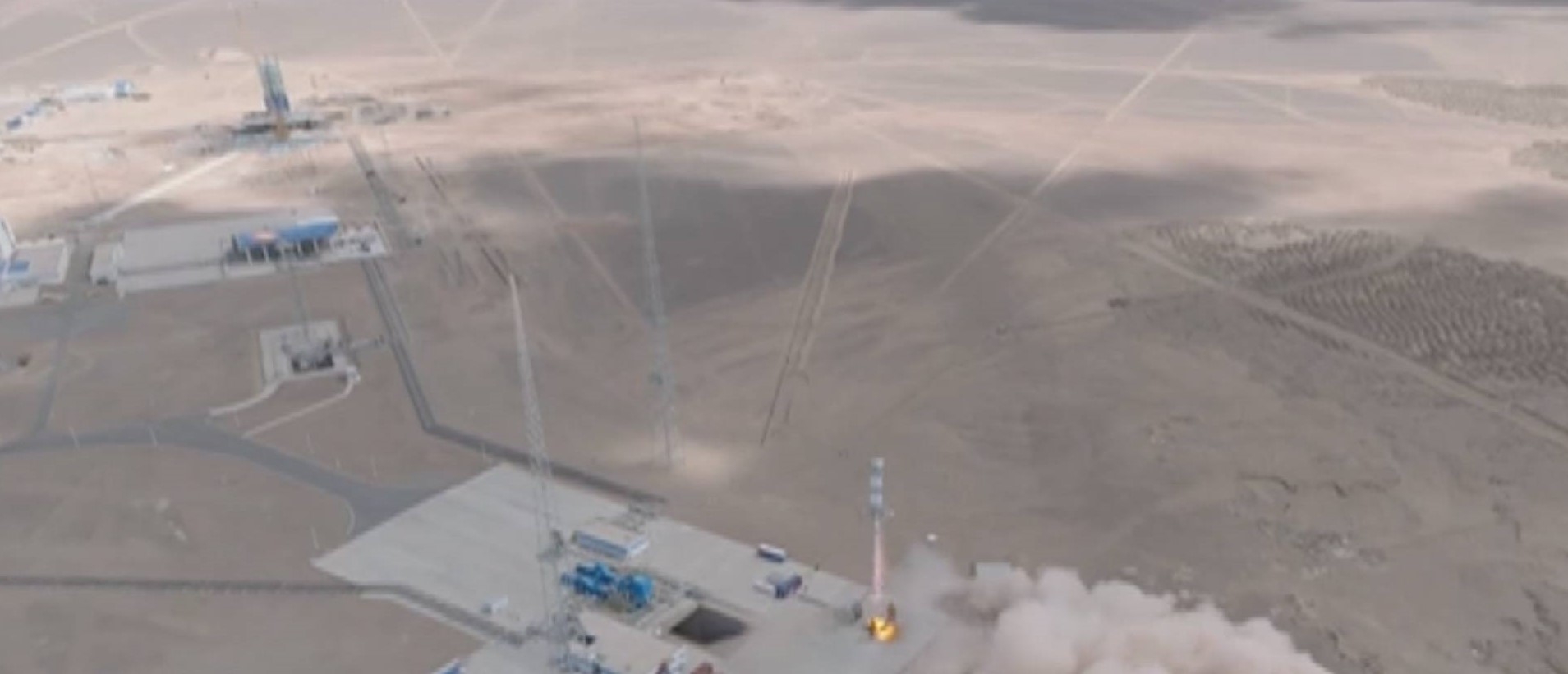
Image credit: CCTV/Inside Outer Space screengrab
China’s reusable Zhuque-3 rocket has completed a vertical takeoff and landing test, attaining an altitude of 6 miles (10 kilometers) at the Jiuquan Satellite Launch Center in northwest China.
According to China Central Television (CCTV), the 200.7 seconds of Zhuque-3 flight by the LANDSPACE company took place on Wednesday.
At the noon hour local time, China’s first rocket made of stainless steel used liquid oxygen-methane as propellant, ascended. Following a 40-second unpowered glide, it then reignited its engines at an altitude of 2.9 miles (4.64 kilometers) above the ground and achieved a soft and precise vertical landing at a designated recovery pad.
That landing spot was roughly 2 miles (3.2 kilometers) away from the launch pad.

Image credit: CCTV/Inside Outer Space screengrab
Crucial technologies
“During the real vertical return recovery of Zhuque-3, we have verified these crucial technologies in advance, thus laying a sound technical foundation for the rocket,” Dai Zheng, chief commander of Zhuque-3 told CCTV.
This test is a follow-on to the reusable rocket’s first launch and landing test in January this year.
CCTV notes that this flight served to advance and verify several key technologies for the vertical takeoff and landing retrieval of the reusable rocket.

Dai Zheng, chief commander of Zhuque-3.
Image credit: CCTV/Inside Outer Space screengrab
“The flight process closely simulated the actual conditions of rocket recovery and comprehensively verified the key technologies of the propulsion system applied by Zhuque-3,” CCTV reports.
Further verification
“Further verification of Zhuque-3 is required, specifically regarding the powered deceleration after the separation of the first and second stages but prior to the rocket’s entry into the denser layer of the atmosphere,” Dai explained.
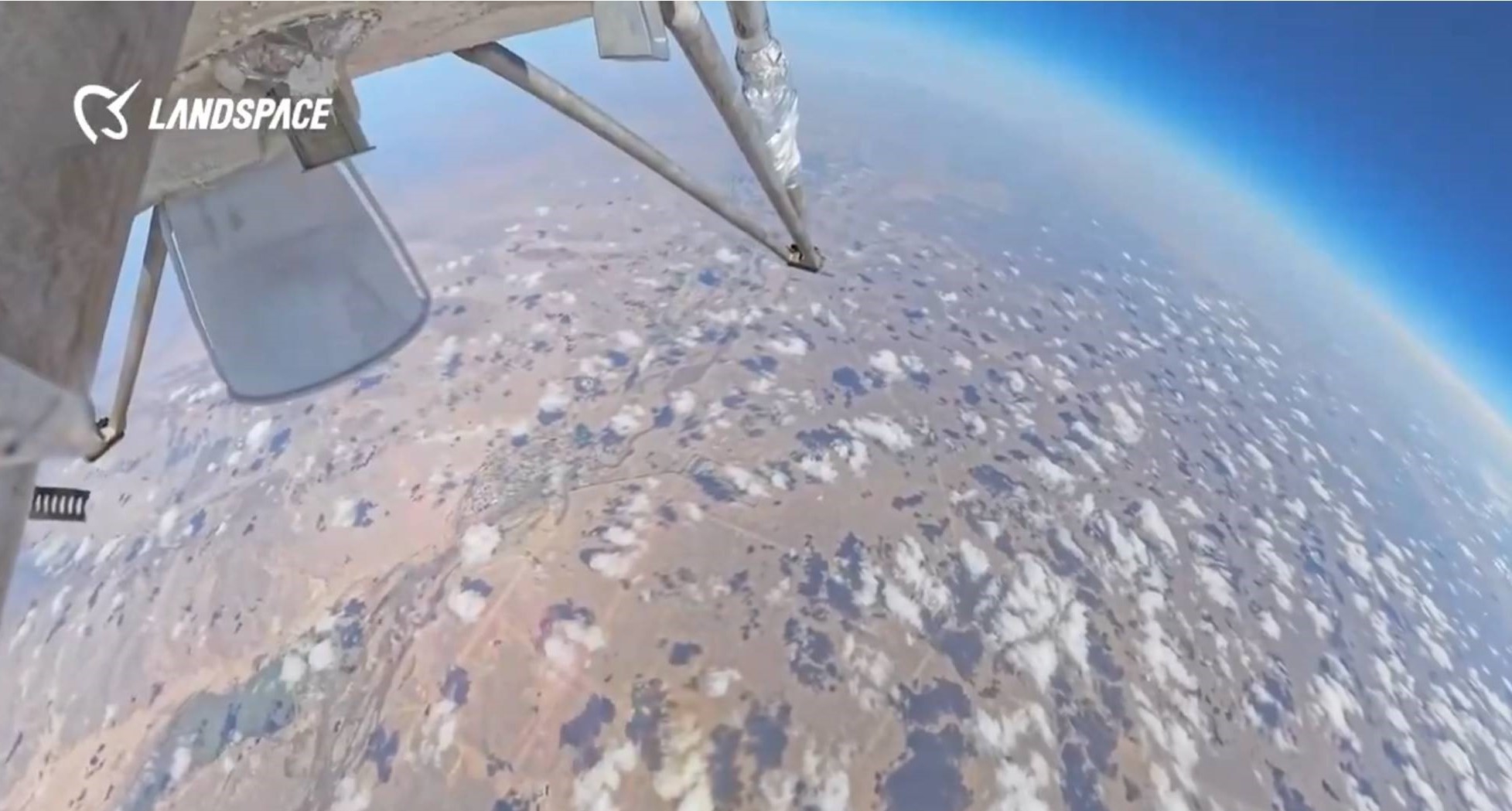
Image credit: LANDSPACE
Zhuque-3 carrier rocket’s liftoff weight is about 660 tons and it has a carrying capacity of over 18.3 tons.
Its first stage designed to be reused at least 20 times, with the rocket able to launch multiple satellites at one time, such as flat stackable satellites, the CCTV report notes.
Go to this video as posted by China ‘N Asia Spaceflight at:

Artwork depicts Cluster satellite reentry.
Image credit: ESA/David Ducross
The European Space Agency’s Salsa spacecraft took the plunge into Earth’s atmosphere on September 8.
That fiery finale yielded the first recorded observation of a satellite reentry from a high-speed orbit, taken from a plane in bright daylight.
Bright dot
A newly issued photo captures the craft burning up further out and to the left from the predicted field of view. But airplane mounted gear caught Salsa’s nose dive just left of center as a bright dot.
Together with partners at Astros Solutions, ESA sent a plane to observe Salsa’s reentry live from the sky to observe a satellite class and reentry conditions which have never been accessible before.
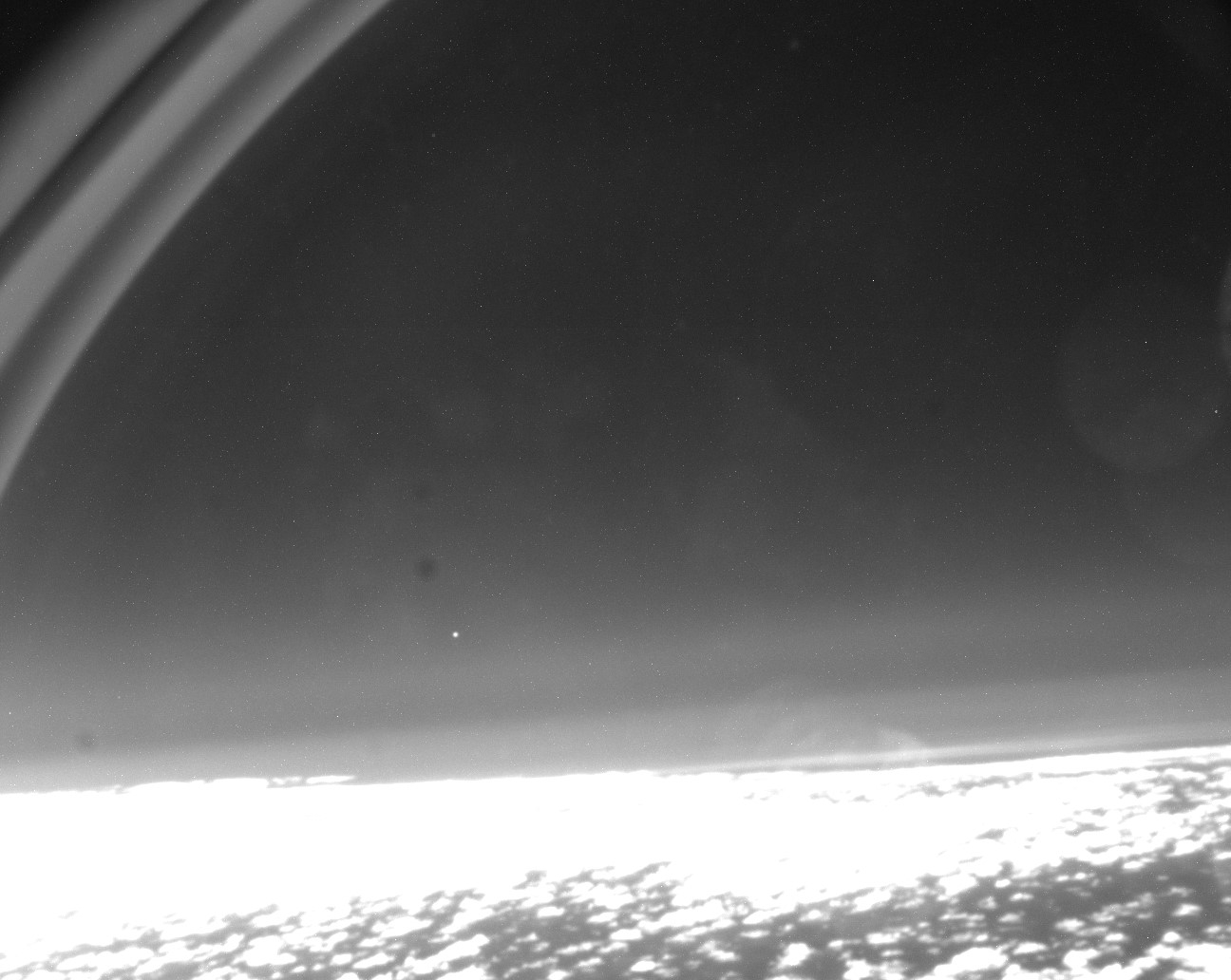
Image credit: ESA/ROSIE/University of Southern Queensland with photo taken by Ranjith Ravichandran and Gerard Armstrong
The reentry was still in range of instruments and the team managed to collect the first-ever data points of the targeted reentry.
Aerial/ground teams
Still ahead is painstakingly looking at all the data gathered, as will the information gleaned by observation teams on the ground.
Salsa was the first of four Cluster satellites to plow into the atmosphere.
ESA’s Space Debris team is hoping to monitor and improve current reentry prediction models as well as learn more about how a satellite “burns up.”

Airplane observation team.
Image credit: FalconAir/ESA
Joint effort
The ROSIE-Salsa observation mission is a joint effort, with academic partners from University of Stuttgart (IRS/HEFDiG), Comenius University in Bratislava (CUB), the University of Southern Queensland (UniSQ) and industrial partners from Hypersonic Technology Göttingen (HTG) and Astros Solutions in close cooperation with the European Space Agency (ESA).
The airborne observation campaign saw Salsa back at Earth again after 24 years in space, with more of the Cluster satellites in the series reach their respective reentry dates in 2025 and 2026.
Wait-a-Minute!
Image credit: Barbara David
In a wait-a-minute moment, U.S. lawmakers are probing NASA leadership regarding the space agency’s cancellation of the Volatiles Investigating Polar Exploration Rover (VIPER) project.
On July 17, 2024, NASA announced its decision to cancel the VIPER lunar craft.

Artwork depicts NASA’s VIPER, on the prowl for water and other resources.
Image credit: NASA Ames/Daniel Rutter
In a September 6 letter to NASA chief, Bill Nelson, science committee leaders have requested the space agency to provide detailed cost and schedule information regarding NASA’s proposed termination of VIPER.
Also requested is information regarding alternative options for the rover going forward, “including the option of proceeding with the launch and landing of VIPER on the Moon,” the letter states.
Investments made in VIPER
“We understand that the fiscal environment for NASA is challenging and that NASA must make difficult decisions when programs are significantly over budget and behind schedule,” the letter to NASA states.

The VIPER rover heading into the Thermal Vacuum (TVAC) Chamber for testing.
Image credit: Daniel Andrews/LinkedIn
“Given the investments made on VIPER to date, the status of the assembled and integrated rover, and the national importance of our civil and commercial lunar exploration activities, it is imperative that Congress fully evaluate NASA’s proposed decision to terminate VIPER,” the letter adds.
The full letter can be found here at:
Vacuum chamber
In the interim, VIPER recently entered thermal vacuum chamber testing to be completed by October.
The NASA decision to cancel the VIPER south pole Moon rover also stirred up lunar exploration advocates, prompting an open letter campaign to Congress requesting lawmakers to “refuse to authorize” the NASA verdict.

Lights out for NASA’s VIPER ice-hound?
Image credit: NASA
“The decision to cancel the mission was taken by NASA without giving the wider VIPER team or lunar exploration community an opportunity to propose cost-saving solutions or alternatives to the dismemberment or scrapping of the rover,” the open letter explains.
On ice
The south pole machinery was dedicated to — as NASA’s first mobile robotic mission to the Moon, directly analyze ice on the surface and subsurface of the Moon at varying depths and temperature conditions within four main soil environments.
VIPER-supplied data was slated to be used to create resource maps, helping scientists determine the location and concentration of ice on the Moon and the forms it’s in, such as ice crystals or molecules chemically bound to other materials.

A close-up view of the areas that were to be explored by VIPER, showing a nominal traverse route and highlighting permanently shadowed regions that may contain water ice and other volatiles.
Credit: NASA’s Scientific Visualization Studio/Ernie Wright
VIPER’s projected landing site: the Nobile Region of the Moon’s south pole.
The rover is under the wing of NASA’s Commercial Lunar Payload Services (CLPS) and was built to scout about on the Moon for 100 Earth days, covering 3 cycles of lunar day and night.
Go to the NASA VIPER cancellation statement at:
https://www.nasa.gov/news-release/nasa-ends-viper-project-continues-moon-exploration/
The open letter to Congress can be viewed at:
https://docs.google.com/forms/d/e/1FAIpQLSeIUzsdEiT8cbt7YqYE1RdctvtMaflyh3bc2M9HnH0C0Wpzww/viewform
Go to my earlier story — “VIPER Bite Marks: NASA Moons a Lunar Rover” — at:
https://www.leonarddavid.com/viper-bite-marks-nasa-moons-a-lunar-rover/
Wait-a-Minute!
Image credit: Barbara David

