Archive for the ‘Space News’ Category
 Author:
  September 24th, 2024
Image credit: Felix Schöfbänker
New image of China’s secret space plane shows delta-wing design
https://www.space.com/china-space-plane-image-delta-wing-design
 Posted in

Image credit: CGTN/CNSA/Inside Outer Space screengrab
China is pressing forward on a major space drive into deep space, highlighted on Monday by Chinese President Xi Jinping asking personnel in China’s space industry to continue to work hard and accelerate progress in space endeavors.
Xi met with space scientists and engineers Monday at the Great Hall of the People in Beijing, meeting and greeting those that participated in the research and development of the far side lunar landing mission, the Chang’e-6 snag, grab, and return to Earth Moon endeavor.

Image credit: CCTV/Inside Outer Space screengrab
Research station update
Meanwhile, Wu Weiren, chief designer of China’s Lunar Exploration Program told China Central Television (CCTV) that agreements with over 10 countries and nearly 30 international research institutions, have been inked to put in place an International Lunar Research Station, the ILRS.
“We hope to work with 500 foreign scientific research institutions and 5,000 foreign scientific research personnel to build our International Lunar Research Station,” Wu told CCTV.

China’s Chang’e-8 lunar lander, a bridge build to the International Lunar Research Station.
Image credit: CNSA
Permanent shadow zone
In pointing to China’s upcoming Chang’e-7 lunar lander mission to the Moon’s south pole, Wu said that there’s need to leap into the permanent shadow zone to find direct evidence of water. “We will also launch Chang’e-8, the main purpose of which will be to investigate what resources are at the south pole of the Moon, and other resource development,” he said.
As far as the intent of the ILRS, this scientific research station will combine orbital and lunar surface stations, plus ground facilities, to carry out large scientific projects.
“This is being done so that work can continue for a long time with or without people at the Moon’s south pole,” Wu said. “It will facilitate scientific exploration and resource development.”
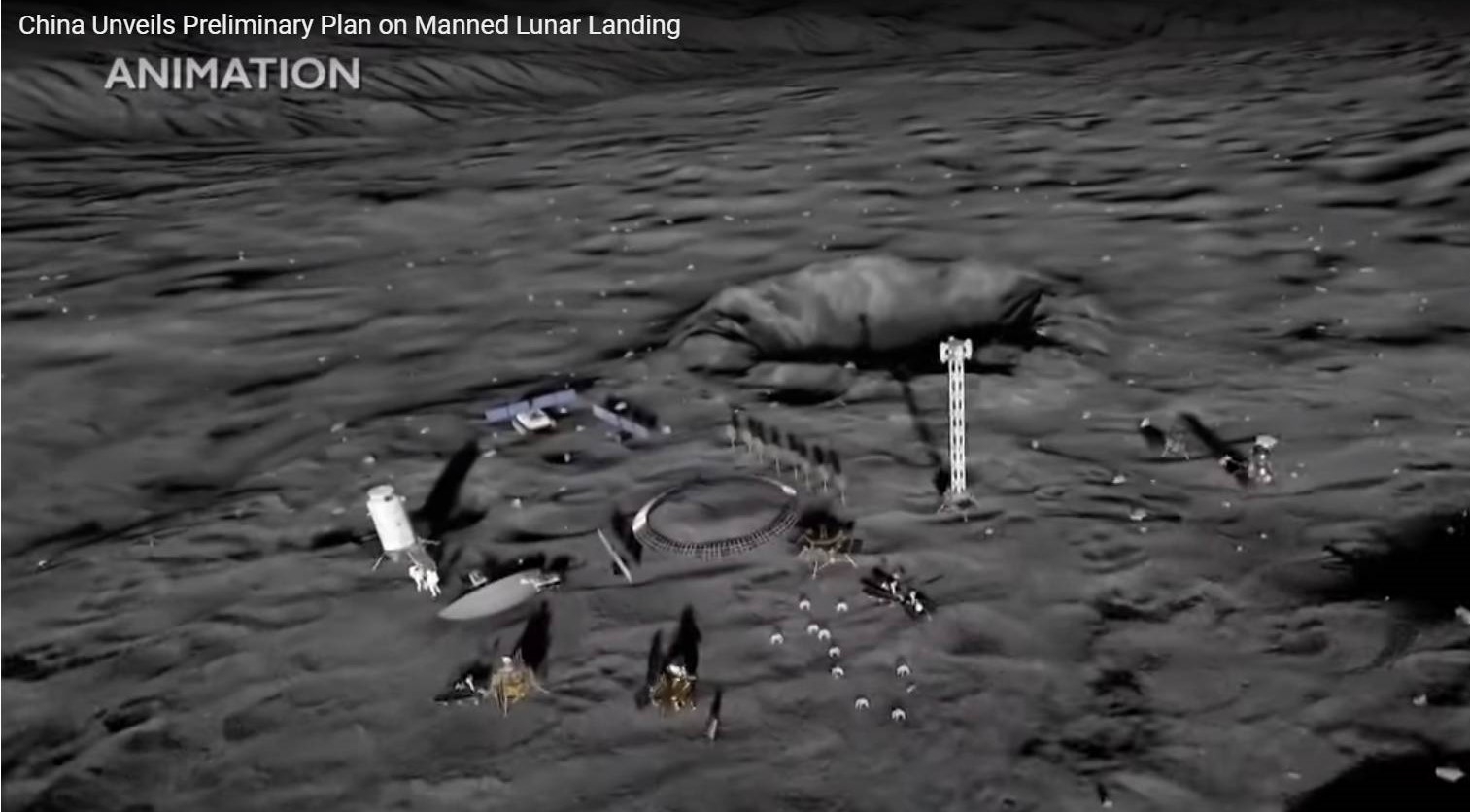
Artist’s view of International Lunar Research Station to be completed by 2035. Credit: CNSA
Four must-haves
Wu also pointed out that, for the International Lunar Research Station to work, there are four must-haves: tools, energy, communication and shelter.
“We’ve started to prepare the first bricks. We could use sunlight and draw on local resources. It’s possible with 3D printing that such bricks could be used to build walls, houses and roads,” Wu told CCTV. “We hope in the future, the lunar research station will be a hub that prepares us for more distant celestial bodies, such as for Mars exploration.”
By 2030, China is aiming to realize a crewed lunar landing. By 2035, the country has stated it wants to establish the core structure of an international lunar research base.

Image credit: CGTN/CNSA/Inside Outer Space screengrab
Documentary video
Meanwhile, in a related development, a documentary video – “Back to the Far Side” – has been released by the China Global Television Network (CGTN) and the China National Space Administration (CNSA).
This behind-the-scenes video captures the intense and sometimes emotional outcomes from drilling and scooping up far side samples during the Chang’e-6 lunar mission.
The Chinese engineering team spent more than a decade perfecting the Moon lander operations to accumulate the samples, later rocketed back to Earth.
How this feat was achieved can be seen in this clip taken from “Back to the Far Side.”
Video at:
https://news.cgtn.com/news/2024-09-21/A-gift-from-the-moon-1x4qPPm4DYY/p.html

Image credit: CGTN/CNSA/Inside Outer Space screengrab
A documentary video – “Back to the Far Side” – has been released by the China Global Television Network (CGTN) and the China National Space Administration (CNSA).

Image credit: CGTN/CNSA/Inside Outer Space screengrab
This behind-the-scenes video captures the intense and sometimes emotional outcomes from drilling and scooping up far side samples during the Chang’e-6 lunar mission.
The Chinese engineering team spent more than a decade perfecting the Moon lander operations to accumulate the samples, later rocketed back to Earth.
Image credit: CGTN/CNSA/Inside Outer Space screengrab
How this feat was achieved can be seen in this clip taken from “Back to the Far Side.”
Video at:
https://news.cgtn.com/news/2024-09-21/A-gift-from-the-moon-1x4qPPm4DYY/p.html

Image credit: CCTV/Inside Outer Space screengrab
Lunar collectibles from China’s Chang’e-6 far side Moon mission have been unveiled with geochemical researchers finding the returned-to-Earth samples markedly different from the samples retrieved by the Apollo missions and China’s earlier Chang’e-5 lunar sample mission.
The samples, weighing a total of 1,935.3 grams, were retrieved by Chang’e-6 in June this year, and spotlighted in a September 21 reveal, as reported by China Central Television (CCTV).

Image credit: CCTV/Inside Outer Space screengrab
Notable differences
“I have processed both separate samples from Chang’e-5 and 6,” said Liu Jianjun, researcher, National Astronomical Observatories. “We have observed notable differences in their physical properties. For example, when viewed under a microscope, the particles from Chang’e-6 show a bimodal distribution, whereas Chang’e-5’s particles present a single peak.”
Liu added that another difference is that during the selection process, “we found that there were noticeably fewer rock fragments in the Chang’e-5 sample, while Chang’e-6 contained more. We believe this is likely due to the impact crater near the Chang’e-6 landing site, which measures about 50 meters in diameter. It’s possible that ejecta from the crater was collected by Chang’e-6,” he told CCTV.

China’s Chang’e-6 lander/ascender in far side sampling scenery.
Image credit: CNSA/CLEP
“The overall petrochemical composition of the Chang’e-6 samples is quite different from Chang’e-5 samples,” Liu continued. “It’s a low titanium, low aluminum, low potassium basalt composition. There is almost no olivine in basalt from the Chang’e-6 samples, indicating that its rock genesis, material source, and chemical composition are quite different from that of the Chang’e-5 samples. It shows that the samples taken from the far side of the Moon are indeed very different from that from the near side.”
Mineralogical content
“In the breccia obtained by the Chang’e-6, we can find many small rock fragments that actually came from the non-lunar maria area, which is the highlands on the Moon, that is, the white or shiny part of the Moon that we see with the naked eye,” said Zhou Qin, researcher at the National Astronomical Observatories of the Chinese Academy of Sciences, who also serves as a deputy chief designer of ground application system of the Chang’e-6 mission.

Far side scenery taken by Chang’e-6 lander/ascender.
Image credit: CNSA/CLEP
“These fragments were sputtered onto their area by impact and then cemented into rocks. And the proportion of this kind of rocks is significantly higher than that of the Chang’e-5 samples,” Zhou told CCTV.
“Comparing the images of basalt in the Chang’e-5 and Chang’e-6 samples, we’ve found out that the rock structures of these two are similar. But the further detailed study of the mineralogical content indicates that the olivine content of the Chang’e-6 samples is significantly lower compared to the Chang’e-5 samples,” said Zhou.
Glass fragments
According to Li Chunlai, deputy chief designer of the Chang’e-6 mission and researcher with the National Astronomical Observatory of the Chinese Academy of Sciences: “The Chang’e-6 lunar samples contain a significant amount of white material, including feldspar minerals, which are more abundant than in the Chang’e-5 samples,” said “Additionally, there are significantly more glass fragments, contributing to a lighter overall appearance for the Chang’e-6 samples,” Li told CCTV.

Image credit: CCTV/Inside Outer Space screengrab
The team reports that Chang’e-6 soil samples have a lower density than previous samples, indicating a more porous and loosely structured composition. The plagioclase content of the Chang’e-6 samples is significantly higher than that of the Chang’e-5 samples, while their olivine content is significantly lower. The study has also revealed that the Chang’e-6 lithic fragment samples are primarily composed of basalt, breccia, agglutinate, glasses and leucocrate.

Image credit: CCTV/Inside Outer Space screengrab
Separated and packaged
In a lunar sample laboratory, the surface samples have largely been separated and packaged, CCTV reports. Experts explained that the process of unsealing, dividing, and preparing the samples for experimentation took approximately two months.
“For the surface samples, we will separate any rock fragments larger than one millimeter. These larger samples may have originated from different locations, and their research methods differ from those used for powdered samples,” Li said. “The remaining powder samples, smaller than one millimeter, will be thoroughly mixed and packaged into 10-11 bottles, each containing approximately 150 grams.”

The Chang’e-6 sample container is shown being removed from the Chang’e-6 return capsule.
Image credit: Jin Liwang via SegerYU X posting.
Stuck to the sample bag
In contrast, the processing of the drilled samples is more complex and is expected to take an additional one to two months, CCTV notes. Researchers are currently handling the remaining samples in a nitrogen-filled unit.
“In terms of weight, the scooped samples make up the majority of the total 1935.3 grams, roughly 1610 grams, and the remaining is drilled samples,” said Li. He also pointed out that a significant portion of the drilled samples are stuck to the sample bag and cannot be removed, complicating the determination of their exact weight.
“The drilled samples account for less than 20 percent of the total and are all contained within a single sample bag. We need to divide them into 1.5-centimeter segments to represent different depths,” Li added. “This process, which involves separating over 100 individual samples, requires extreme care. So, we may still need another month or two to finish the pre-processing.”

Image credit: CCTV/Inside Outer Space screengrab
Two-day stay
The Chang’e-6 lunar landing and sampling craft was launched from the Wenchang Spacecraft Launch Site in south China’s Hainan Province on May 3, 2024, touching down on the far side of the Moon on June 2.
During the lander’s two-day stay, Chang’e-6 used a scoop and drill, collecting nearly 2 kilograms of lunar material.
On June 25, the Chang’e-6 returner segment of the mission brought back the samples to Earth, with a sample container parachuting into a pre-designated landing zone in north China.
A set of new CCTV videos showcases the Chang’e-6 sample reveal at:

Earth’s moon is viewed as a major construction site as roads, shelters, launch and landing pads are emplaced to sustain a permanent foothold on this celestial destination.
Image credit: Astroport Space Technologies
New research indicates that potential landing sites at the moon’s south pole for robotic landers and crewed Artemis missions are susceptible to quakes and landslides.
Science results published early this year point to a group of faults located in the moon’s south polar region, making use of data on moonquakes recorded by seismometers set up by Apollo moonwalkers over 50 years ago.

More power to you! LUNARSABER is a Honeybee Robotics concept selected by DARPA’s LunA-10 program. LUNARSABER utilizes onboard gimbaled lights to illuminate local terrain during lunar night.
Image credit: Honeybee Robotics
“The potential of strong seismic events from active thrust faults should be considered when preparing and locating permanent outposts and pose a possible hazard to future robotic and human exploration of the south polar region,” the research paper explains.
The installation of habitats, landing pads, equipment shelters, tall towers on the moon could be off to a shaky start, suggests Nerma Caluk, an intermediate designer and lunar specialist for Skidmore, Owings & Merrill, an architecture and structural engineering firm in San Francisco, California.
For more information, go to my new Space.com story – “Moonquakes could ‘pose a possible hazard’ to Artemis moon missions, study finds” — at:

While that mysterious Chinese space plane rolled to full stop on a landing strip earlier this month, little is known about the craft.
It was hurled into orbit on December 14, 2023 atop a Long March 2F rocket from the Jiuquan Satellite Launch Center in northwest China.
The whatever it is and does spacecraft touched down after 268 days of in-orbit operation, making its touchdown on September 6, 2024.
Growing maturity
“Its mission was to conduct reusable technology verification and space science experiments to provide technical support for the peaceful use of space,” explained the state-run China Global Television Network (CGTN). “This achievement underscores the growing maturity of China’s reusable spacecraft technology, paving the way for more convenient and cost-effective space travel for peaceful purposes in the future.”
CGTN also noted that China had launched reusable experimental spacecraft in September 2020 and August 2022, which respectively spent two days and 276 days in orbit “before returning to their designated landing sites.”
Image credit: Felix Schöfbänker
Delta-wing design
While the recent space plane flight was underway, space watcher veteran Felix Schöfbänker in Upper Austria took imagery of the craft.
In a recent posting, Schöfbänker reported he has imagery taken August 10 of the Chinese space plane which shows a delta-wing design, captured when the craft turned 180 degrees since an earlier observation he made on July 30.
The dark spot between the wings could possibly be the cargo bay, Schöfbänker suggests.
Go to new video at:
https://cdn.astrobin.com/images/107843/2024/b2b3728f-1138-4061-a271-046b8a94b92b.gif
Meanwhile, still circling the Earth is the U.S. Space Force X-37B. It has been on an equally mysterious sojourn since its launch on Dec. 29, 2023. It is now 267 days into its secretive mission.

U.S. Space Force X-37B space plane.
Image credit: Boeing
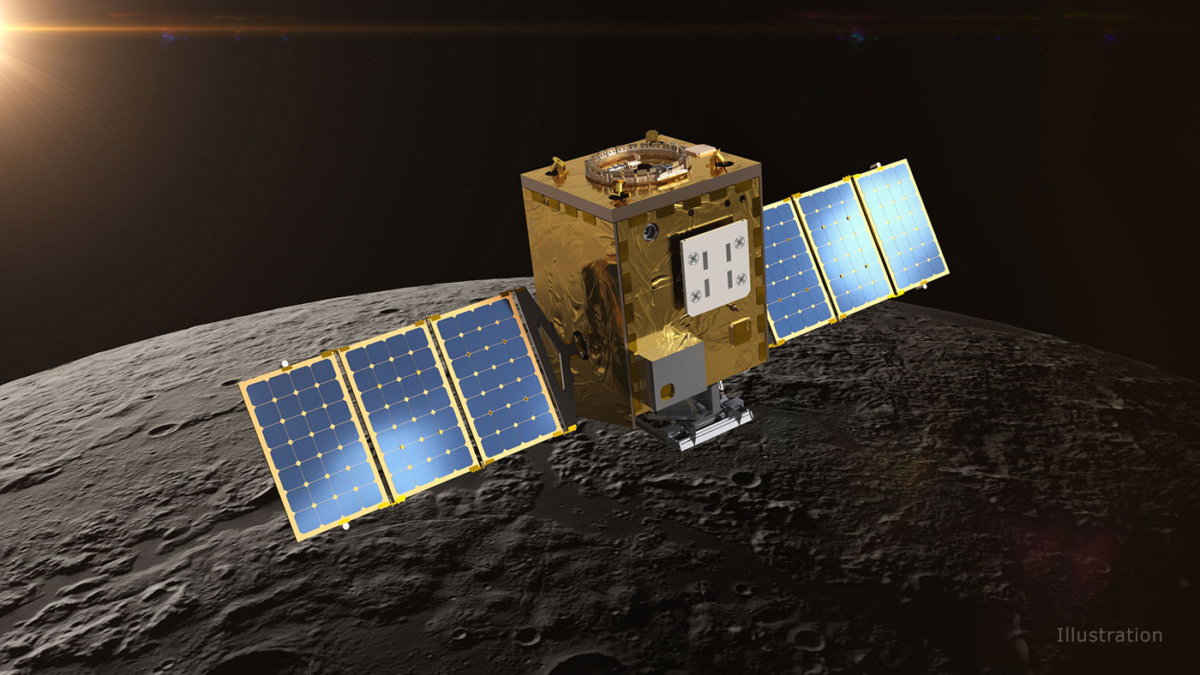
Artistic view of Lunar Trailblazer.
Credit: Lockheed Martin
A spacecraft that is hot on the trail of scouting out super-cold water ice on the Moon is the Caltech-led Lunar Trailblazer orbiter.
This NASA-backed mission is to be co-launched with the Intuitive Machines (IM-2), a Nova-C lunar lander now dubbed Athena under the space agency’s Commercial Lunar Payload Services (CLPS) initiative.
The unique Lunar Trailblazer orbiter is a secondary spacecraft to be hurled into space with the IM-2, launched together on a SpaceX Falcon 9 rocket.
Inside Outer Space sources indicate the window of opportunity for takeoff appears to be January 1-5, 2025.

Image credits:
Lunar south pole basemap: LROC
PSR detections from Mazarico, et al. (2011)
Crater: Caltech/PCC/Hongyu Cui for Lunar Trailblazer project
Co-collected datasets
Lunar Trailblazer is a NASA Small Innovative Missions for Planetary Exploration (SIMPLEx) program spacecraft, built to gather science data as it circuits the Moon. Here on Earth, it will be operated by both Caltech and Pasadena City College students at the Caltech-based Infrared Processing and Analysis Center (IPAC).
Lunar Trailblazer is to utilize “co-collected datasets” gleaned from two instruments: the High-resolution Volatiles and Minerals Moon Mapper (HVM3) and the Lunar Thermal Mapper (LTM).
Great gobs of water ice?
Hypothesized to be resident at the poles of the Moon are great gobs of water ice, sitting within regions that are permanently in shadow. They could also potentially host organic content.
Gauging the amount of water ice present — its form, purity, and geologic and topographic context — are viewed as critical to not only figuring out the role of these reservoirs in the lunar water cycle but could they be tapped as a resource to sustain future human expeditions.

Infographic of Lunar Trailblazer’s data acquisition strategy. Image credit: Filo Merid (PCC/Caltech)
Curio
Under contract with Caltech, Lockheed Martin has provided the spacecraft and is integrating the flight system.
Lockheed Martin has developed a scalable deep space SmallSat spacecraft and tagged the architecture with the name Curio.
“The Lunar Trailblazer spacecraft team has completed the assembly of the vehicle and integration of its instruments, and has also taken the fully assembled spacecraft through its environmental testing,” said Ryan Pfeiffer, Lunar Trailblazer program manager at Lockheed Martin.
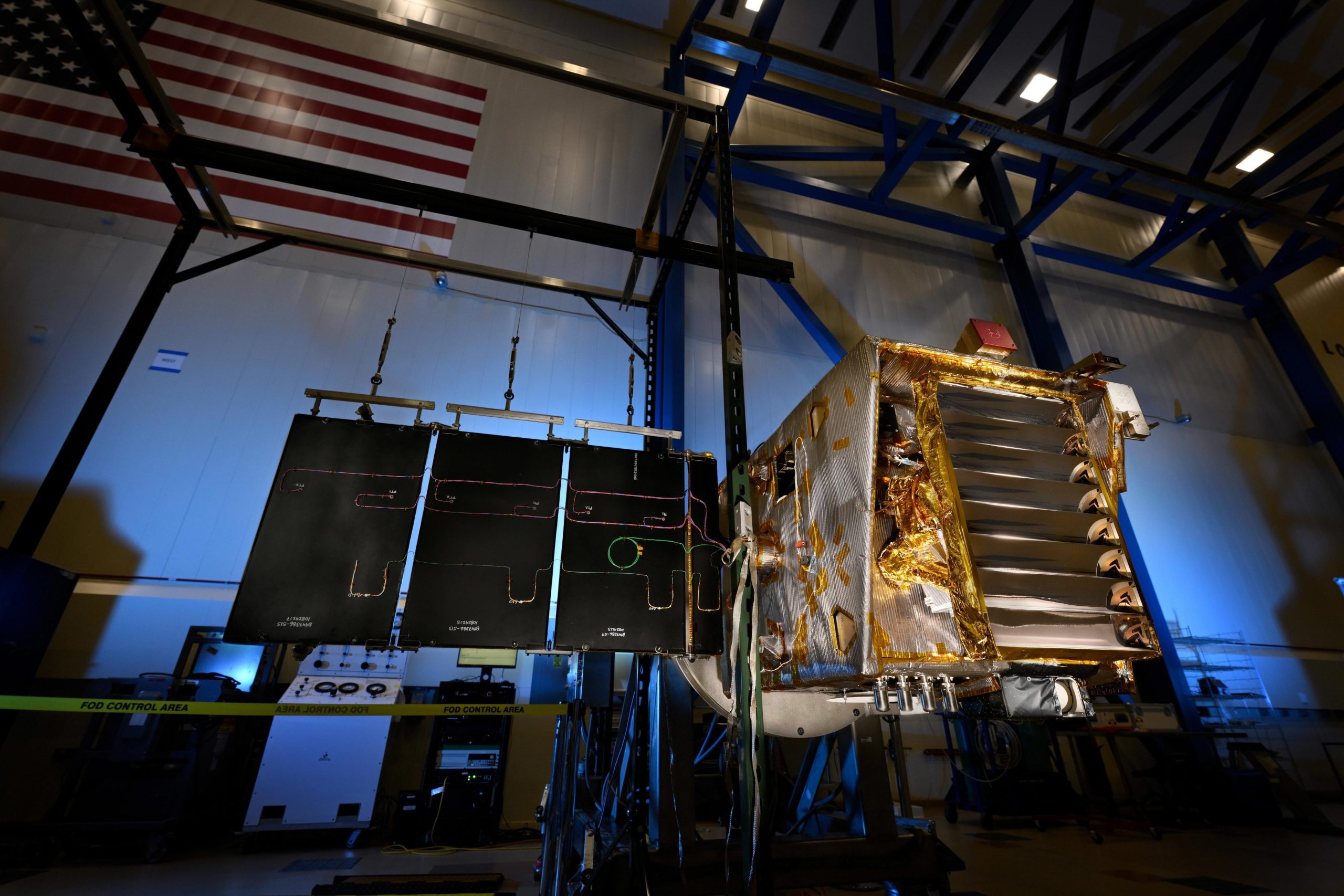
Lunar Trailblazer undergoes final checkout and testing.
Image credit: Lockheed Martin
“We’re very excited to demonstrate our Curio small-sat, a low-cost and rapidly flexible spacecraft, in this first-of-its-kind mission to seek out water on the lunar surface and advance humanity’s exploration and understanding of the universe around us,” Pfeiffer told Inside Outer Space.
Ship to Florida
The team is now performing tests that will simulate key aspects of the Lunar Trailblazer mission, such as launch and the primary science mission to ensure the spacecraft will perform as designed once it arrives in lunar orbit, said Pfeiffer.
“We’re planning to ship the spacecraft to Florida about a month prior to launch,” Pfeiffer added, “where we will perform final checkouts and then assist our partners with integration onto the launch vehicle.”

This approximate model was created by fellow satellite enthusiast Oliver Jankovich based on Schöfbänker’s interpretation of collected images.
Image credit: Oliver Jankovich/Felix Schöfbänker
In the hush-hush, secretive world of space-based spy satellites, few details are publicly available – and groups like the U.S. Space Force, National Reconnaissance Office, the Central Intelligence Agency, and the National Geospatial-Intelligence Agency like it that way.
There’s an armada of classified spacecraft assigned an array of vigilant duties. Some intercept radio waves or detect missile launches. Others yield close-up looks at select areas using sharp-eyed optical systems or scan the Earth with powerful radar technology.

Image credit: Felix Schöfbänker
Imagery details
These high-flying satellites are temping targets for amateur astro-photographers.
Such is the case for space watcher veteran Felix Schöfbänker in Upper Austria.
For imagery and details on what’s being seen, go to my new Space.com story – “Caught on camera: Satellite tracker photographs secret spacecraft” – at:
https://www.space.com/secret-satellites-caught-on-camera

Image credit: Felix Schöfbänker

Chang’e-4 far side mission – lander and Yutu-2 rover.
Credit: CNSA/CLEP
Still on a roll on the Moon is China’s Yutu-2 far side rover.
Wheeling and dealing with the scenery within the Von Karman Crater in the South Pole-Aitken Basin, the mini-robot has traveled 5,292 feet (1,613 meters) as of Tuesday, report its operators. It is currently the longest-working lunar rover in history, noted China Central Television (CCTV).
Deployed from the Chang’e-4 lander, Yutu-2, or Jade Rabbit-2, back in early January 2019, the rover has completed its work for the 71st lunar day. In “Moon time” that marks nearly five years and nine months of operation and far beyond its original three month design lifespan.

Image credit: CCTV/Inside Outer Space screengrab
Lunar photos
Zuo Wei, deputy chief designer of the Chang’e-4 mission’s ground application system, noted that collection of lunar photos highlighted a variety of features of the Moon’s surface, including flat areas, hills, impact craters and large rocks.
Zuo told CCTV that the Moon-based optical telescope onboard Chang’e-3 lander “is still operational, performing regular on-off cycles every month, though it is no longer conducting scientific observations. Chang’e-4 is also still active.”

China’s Chang’e 3 lander as view by Yutu rover.
Image credit: National Astronomical Observatories of Chinese Academy of Sciences
In addition to Yutu-2, the Chang’e-3 Moon lander that touched down mid-December 2013 within Mare Imbrium and the Chang’e-4 mission lander are both operational on the Moon.
The Chang’e-3 lunar lander dispatched the first Yutu rover that reportedly ceased transmitting data in March 2015.
“While some scientific instruments continue to function and transmit data, researchers are also evaluating their long-term operational capabilities,” CCTV reports.
Next lunar lander
In other China lunar updates, the country’s Queqiao and Queqiao-2 relay satellites are working in orbit around the Moon.
Queqiao mainly provides Earth-moon relay communications for Chang’e-4 and Yutu-2, CCTV adds. After completing its mission for Chang’e-6, Queqiao-2 is currently conducting scientific observations in orbit while awaiting the arrival of Chang’e-7, scheduled for launch around 2026.

Image credit: CCTV/CGTN/Inside Outer Space screengrab
Meanwhile, China’s Chang’e-7 lunar lander mission is tasked to find if there is evidence of water at the Moon’s south pole.
Wu Weiren, chief designer of the country’s lunar exploration project, recently told CCTV that finding water ice would be an important milestone.
“Some international peers have launched probes and they think the detected results show the presence of water molecules in the atmosphere above the south pole,” Wu said. “If this is true, then it’s possible that water exists in the permanently shadowed regions there, likely in the form of ice, as these areas have not been exposed to sunlight for long time. Whether there is water, and how much it is there, are key questions that concern people and the scientists worldwide,” he said.

Image courtesy U.S. Defense Intelligence Agency (DIA) in its “2022 Challenges to Security in Space” report.
Technology testing
Following Chang’e-7, China plans to launch Chang’e-8 around 2028 to test technology for utilizing local lunar resources.
By 2030, China has its sights set on a crewed lunar landing, and by 2035 to establish the core structure of an international lunar research base. According to CCTV, now more than 50 countries and international organizations have signed cooperation agreements with China on the Moon-situated facility.
For a video on China’s Yutu-2 operations, go to:

Artwork depicts Cluster satellite reentry.
Image credit: ESA/David Ducross
In an era of increasing global launch rates, heightened by the buckshot approach to tossing mega-satellite constellations into Earth orbit, there’s also escalating anxiety about the ramifications from reentry of defunct space hardware.
What’s lacking in the United States is a single coordinated effort, one that is consistently funded and engages a variety of disciplines. There is also no agreement about who should fund reentry studies; government space interests and roles are spread out over multiple federal agencies.

Image credit: Chelsea Thompson/NOAA
For more details, go to my new SpaceNews story – “The Aerospace Corporation pushes research on hard-to-spot spacecraft reentries” – at:


