Archive for the ‘Space News’ Category
 Author:
  October 4th, 2024
Image credit: Blue Origin
Blue Origin is set to debuts its second human-rated suborbital tourism vehicle – named RSS Kármán line.
An uncrewed verification flight window opens on Monday, October 7 at 8:00 a.m. Central Daylight Time.
New Shepard (NS-27) will fly 12 payloads—five on the booster and seven inside the crew capsule. The vehicle is designed to enable “expanded flight capacity to better meet growing customer demand,” according to a Blue Origin statement.

Image credit: Amaranthine Books/Inside Outer Space screengrab
Black monoliths
One commercial payload to be carried is a reproduction of black monoliths from 2001: A Space Odyssey. The monoliths are flying on behalf of Spacemanic for a special edition printed by Croatian publisher Amaranthine Books.
Also onboard the uncrewed test flight, a new navigation systems developed for New Shepard and the Blue Origin New Glenn booster; two different LIDAR sensors for the Lunar Permanence program; and ultra-wideband proximity operations sensors flying as part of a NASA TechFlights grant with Blue Origin’s Space Systems Development group.
Last August Blue Origin completed its 26th mission to suborbital space with six crew onboard. It was its eighth human spaceflight and the 26th flight for the New Shepard program.
The upcoming test flight will be webcast, starting 15 minutes before liftoff on: https://www.blueorigin.com/
 Posted in

NASA’s Artemis program wants to establish a sustainable presence on the Moon.
Image credit: NASA
As nations rocket forward plans to “reboot” the Moon with crews, what that celestial destination needs is real-time monitoring and emergency response.
For example, there are high-risk situations in remote areas like the lunar south pole – the currently preferred place for planting long-term expeditions.
A team of international scientists wants to make lunar exploration safer. To do so, they are proposing a distress monitoring and rescue system for that off-Earth and challenging environment.
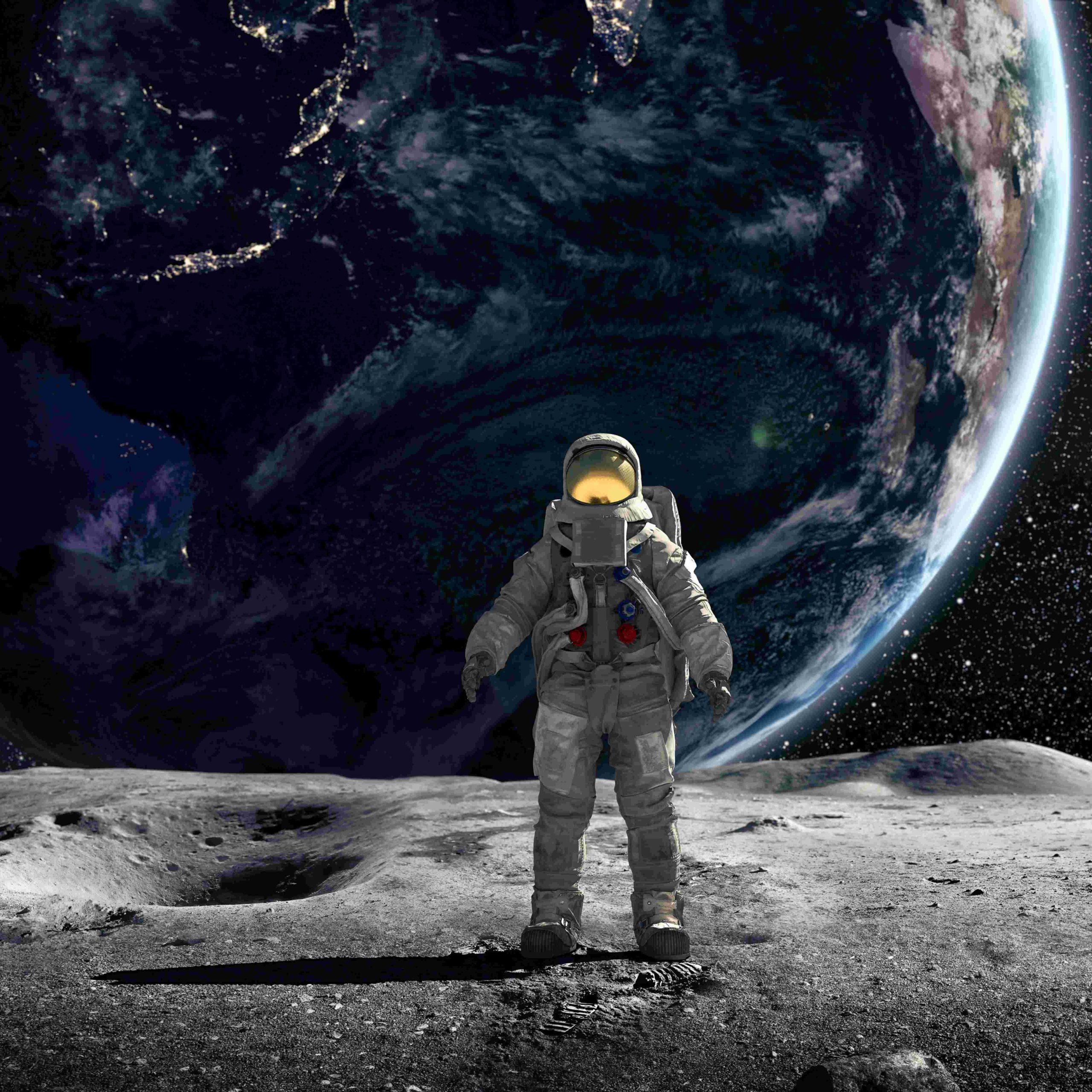
Image credit: University of South Australia
Safety alerts
A project led by the University of South Australia (UniSA) is looking into the critical need for an emergency system capable of providing safety alerts, incident reporting, and location tracking of astronauts in distress.
At the system’s core, the idea is based on Cospas-Sarsat technology, the international humanitarian search and rescue system here on Earth. Cospas-Sarsat now includes 45 nations and two independent search and rescue (SAR) organizations.
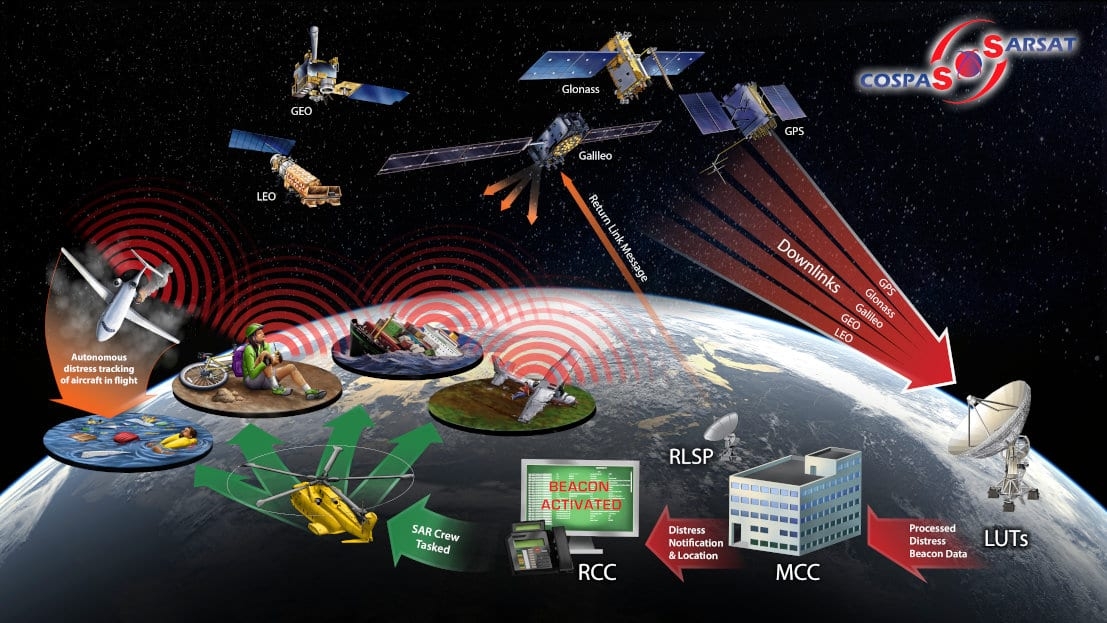
Image credit: COSPAS-SARSAT
On planet Earth, Cospas-Sarsat brings together a worldwide network of satellites, ground stations, mission control centers, and rescue coordination centers.
Network of satellites
According to Mark Rice, a UniSA adjunct researcher and founder of Safety from Space, the Moon-based distress system could allow continuous communication with astronauts for up to 10 hours, even in tough terrain, such as craters or lunar mountains.
“Our team has also developed a waveform that supports low-power emergency beacons, ensuring that communication remains possible with minimal infrastructure and energy consumption,” Rice points out in a UniSA statement.
Researchers from Adelaide and the US are designing a satellite constellation that prioritizes communication and geo-location on the Moon’s surface. Once in place, Moon exploring astronauts would be able to send distress signals to a network of satellites that will relay the information back to Earth or other lunar bases.

Image credit: NASA
Frequency approvals
Safety from Space was founded in 2018 with the support of UniSA’s Innovation and Collaboration Center. The startup recently was awarded $100,000 from the South Australia government to help drive the Lunar Search and Rescue project, with an anticipated field trial with NASA in 2025.
A Safety from Space study has scoped out lunar search and rescue services. During this study, NASA’s Search and Rescue Mission Office served as a technical consultant regarding lunar distress message contents, lunar surface considerations, and insight into international frequency approvals as they evolved over the technical study.
Trial-run technology
Safety from Space is using the $100,000 for the LunaSAR project which will trial advanced satellite communications designed to be lighter and more reliable than current devices on the market, with a longer battery life.
The project will be conducted in collaboration with NASA, The Mars Society (US and Australian arms) and several Australian partners including SmartSat CRC, UniSA and Flinders University.
“This innovation is a critical advancement for space exploration. As humans venture further into space, the ability to quickly locate and rescue individuals in distress is vital,” explains Rice. “By creating a robust search and rescue system for the Moon, this research sets the foundation for similar systems on other planets, potentially revolutionizing how we approach human safety in space exploration.”

Up close and personal! Scene from Earth vs. the Flying Saucers circa 1956.
Credit: Columbia Pictures
If you are wondering where is the best location to spot an Unidentified Flying Object (UFO), well it’s a roll of the dice.
But place your chips on several cities, according to BetUS, an online sports betting group.
When and where you most likely can have UFO run ins taps years of data accumulated by the National UFO Reporting Center (NUFORC).
Luck and rarity
“Our fascination with UFOs taps into our innate curiosity about the unknown. According to the Pew Research Center, 65% of Americans believe that intelligent life exists on other planets,” BetUS explains. The luck and rarity of a UFO sighting further fuels our obsession and curiosity, they add.
BetUS points to their one-stop guide to single out where in the U.S. you’re can likely make your own eye-encounter with an UFO.

Image credit: National UFO Reporting Center (NUFORC).
Prime time
“By analyzing data from the National UFO Reporting Center, we were able to find the most common months, locations, and times you are most likely to see a UFO, sourcing data going all the way back to 2013,” BetUS explains.
Turns out, 9:00 pm is the prime time to spot UFO activity across the country. July is the best month to make eye contact.
“From Phoenix to New York, there is no shortage of flying saucers and flashing lights across the U.S.,” the website points out. “Why not increase your odds and test your luck with your very own extraterrestrial adventure?”

Image credit: Statista
Take a gamble
BetUS made use of data from the National UFO Reporting Center, ranking where and when in the U.S. are you most likely to see something off-world, based on the number of sightings per city, state, and date going all the way back to 2013. The data is accurate as of June 24, 2024.
So take a gamble, visit the website to enhance your chances at: www.betus.com.pa/casino-guide/usa-ufo-encounter-2024
Be advised that BetUS also explains that “if you have a gambling problem,” they’ve got a hot line.
Also, check out the National UFO Reporting Center that has processed over 180,000 reports, distributing its information to thousands of individuals.
Visit NUFORC at:

The American Foreign Policy Council Space Policy Initiative co-directors have designed a series of workshops to examine near-term scenarios that could have a significant psychological impact on public perceptions of space, and thus on resourcing and policy.
The report, REACTING TO MAJOR SPACE EVENTS ON THE MOON AND IN CISLUNAR SPACE —After Action Report— asks what do we want space to look like? What policies are necessary to get there?

Image credit: American Foreign Policy Council
Among futuristic scenarios, the report addresses what if China’s lunar factory crushes U.S. ambitions?; Can a private company claim the Moon?; Are China’s Moon safety zones a massive lunar land grab?
For access to the report, go to:
https://www.afpc.org/uploads/documents/Workshop_2_-_After_Action_Report_-_9.16.24.pdf

Image credit: CCTV/Inside Outer Space screengrab
Crew members of China’s Shenzhou-18 mission are now wrapping up their stay on the country’s space station. The trio of space travelers slated to return to Earth later this month.
Ye Guangfu, Li Cong and Li Guangsu were sent to the orbital outpost on April 25 for a six-month assignment.
Crew member and commander Ye has become the first Chinese astronaut to chalk up 340 days in Earth orbit. Ye is a veteran astronaut who was part of the Shenzhou-13 mission in 2021.

Image credit: CCTV/Inside Outer Space screengrab

Image credit: CCTV/Inside Outer Space screengrab
Self-sustaining ecosystem
As noted by China Central Television (CCTV), the Shenzhou-18 crew has been carefully watching a small aquarium of fish in a novel experiment aboard the country’s space station that the astronauts said is going smoothly.
Four zebrafish are contained in a water-filled tank in the Tiangong space station’s Wentian laboratory module.

Image credit: CGTN/Inside Outer Space screengrab
Using a plant called hornwort, the tank forms a miniaturized self-sustaining ecosystem. The hornwort conducts photosynthesis with LED light, sustaining the lives of the fish.
Genetic mysteries
Scientists on Earth designed the experiment to study how the space environment affects their growth and system balance, and they expressed hope that the fish may even lay eggs, CCTV reports.
The experiment is the country’s first in-orbit aquatic ecological research project, performed in cooperation with the Institute of Hydrobiology and the Shanghai Institute of Technical Physics of the Chinese Academy of Sciences.

Image credit: CGTN/Inside Outer Space screengrab
The aim of the project is cultivation of vertebrates in space to help decode more human genetic mysteries, as zebrafish share over 80 percent of genes with humans.
For a video showcasing the station’s current crew, go to:

This image was taken by the Left Navigation Camera (NavCam) aboard NASA’s Mars rover Curiosity, and captures the bright stones of the “Sheep Creek” target — just above the rover wheel – which strongly resemble elemental sulfur blocks identified earlier in the traverse. This image was taken on Sol 4314, September 24, 2024.
Image credit: NASA/JPL-Caltech
NASA’s Curiosity Mars rover at Gale crater continues onward in its wheeled survey of its surroundings.
Amelie Roberts, a Ph.D. candidate at Imperial College London, reports that the robot is navigating rugged, unforgiving Martian terrain.

Curiosity Right B Navigation Camera image taken on Sol 4317, September 27, 2024.
Image credit: NASA/JPL-Caltech
Roberts said that this landscape challenge was recently underscored by Curiosity’s recent attempt to reach the “Sheep Creek” target.
“We had aimed for small, distant bright rocks, but from 50 meters away (about 164 feet), the limited resolution of our images made it difficult to fine-tune navigation. After an ambitious drive, the rover came agonizingly close — stopping just short of these small bright rocks,” Roberts points out.

Curiosity Mast Camera Right image acquired on Sol 4316, September 26, 2024.
Image credit: NASA/JPL-Caltech/MSSS
Just out of reach
The rocks, with their distinctive rounded and pitted “weathering” pattern, “strongly resemble elemental sulfur blocks that we’ve encountered before. Frustratingly, although the target rocks were right under the front wheel and clearly visible in our navigation cameras, they remained just out of reach of the rover’s arm,” Roberts notes.

Curiosity Left B Navigation Camera photo taken on Sol 4316, September 26, 2024.
Image credit: NASA/JPL-Caltech
While the rover’s arm couldn’t quite reach the bright stones of Sheep Creek, Roberts adds, “we didn’t let that stop us and planned to use other onboard instruments to help us analyze the composition, textures, and context before we move to our next position.”

Curiosity Front Hazard Avoidance Left B Camera image taken on Sol 4316, September 26, 2024.
Image credit: NASA/JPL-Caltech
Promising stones
To find out the composition of the stones of Sheep Creek, the robot’s Chemistry and Camera (ChemCam) observed two promising stones named “Arch Rock” and “Ash Mountain.”
“We’re hoping to see if they have any evidence of elemental sulfur as their appearance suggests,” Roberts explains. “For a closer look at the texture, we will take high-resolution, color images with Mastcam. We also want to look at an interesting transition between light-colored and dark-colored bedrock nearby, which we will cover with more high-resolution, colored images. This transition could give us clues about where the unusual white rocks of Sheep Creek came from and how they formed.”

Curiosity Right B Navigation Camera image taken on Sol 4317, September 27, 2024.
Image credit: NASA/JPL-Caltech
Intriguing white patches
Researchers had their eyes on another bright rock in the area, named “Beryl Lake.”
It had an interesting bright-toned crusty appearance and as investigators could reach it with the rover arm, the Alpha Particle X-Ray Spectrometer (APXS) was used to see its composition and if it had any traces of sulfur.

Curiosity Mars Hand Lens Imager (MAHLI) photo produced on Sol 4312 September 22, 2024.
Image credit: NASA/JPL-Caltech/MSSS
“We took a closer look with our rover hand lens (MAHLI) at a rock called “Aster Lake,” which had intriguing white patches that might be similar to the stones of Sheep Creek,” Roberts reports. “Ultimately, our science goal this plan was to collect data on whether these bright-toned stones had evidence of elemental sulfur and increase our understanding on how they formed.”
Weekend “bump”
Next, the rover was slated to be carefully repositioned to move closer to these interesting targets — a maneuver called a “bump” — so that next plan, set to occur over the weekend, “we’ll be able to get up close and personal with the white stones of Sheep Creek,” says Roberts.

Curiosity Mast Camera (Mastcam) Left image taken on Sol 4312, September 22, 2024.
Image credit: NASA/JPL-Caltech/MSSS
While the rover waits for the weekend plan, Curiosity was set to do “untargeted” science after the drive. This includes using an automated tool called Autonomous Exploration for Gathering Increased Science (AEGIS) – a software suite that permits the robot to autonomously detect and prioritize targets — and zaps them with the ChemCam laser.
“Plus, it’s a good time to record some observations of the modern Martian environment, so we’ll make the most of the time to measure dust levels, take movies that will hopefully capture some dust devils, and look at clouds — if any — in the Martian sky,” Roberts concludes. “We’re looking forward to the weekend plan to hopefully get another chance to do some contact science on targets that may be rich in sulfur!”

Image credit: CCTV/Inside Outer Space screengrab
China has strutted out its Moon-landing spacesuit, unveiling its design in a ceremony Saturday in southwest China’s Chongqing Municipality.
A technician put the suit through its paces, showcasing various movements and gestures, including climbing the rungs of a ladder.

Image credit: CCTV/CMS/Inside Outer Space screengrab

Image credit: CCTV/CMS/Inside Outer Space screengrab

Image credit: CCTV/CMS/Inside Outer Space screengrab
The Feitian EVA suit is tagged as China’s first indigenous spacesuit. Feitian means “flying in the sky,” is the name of a legendary Buddhist goddess.
Ribbons have always been an important element in the design of Chinese spacesuits. The overall design of the Moon-landing suit is inspired by the traditional Chinese armor, underscoring the suit’s rugged and resolute appearance.

Image credit: CCTV/Inside Outer Space screengrab
Multi-use suit
“The Feitian extra-vehicular activity suit is designed for use in low Earth orbit, where astronauts float in a microgravity environment,” said Zhang Wanxin, director of the Spacesuit Engineering Office and deputy chief designer of the Astronaut System at the China Astronaut Research and Training Center.

Image credit: CCTV/Inside Outer Space screengrab
“Therefore, we chose the ribbon element to convey a sense of free flow,” Zhang told China Central Television (CCTV). “The Moon-landing suit is designed for lunar explorations such as walking and working on the Moon surface, so we would also like to convey a strong-willed and unswerving feeling, which we integrated organically into the suit’s design.”
Following the suit demonstration, Yang Liwei, deputy chief designer of China’s manned space program and China’s first astronaut, together with the technician, launched a public name the Moon-landing suit. This campaign will close at 24:00 on October 31, 2024.
Suit features
Experts on China’s first-ever lunar spacesuit provided additional details on the garment that features light weight and high flexibility to protect astronauts from the Moon’s harsh conditions.
According to CCTV, the suit has several attributes:
- a comprehensively protective fabric that shields against the harsh thermal environment and lunar dust
- a panoramic glare-proof visor for improved vision
- two cameras on the sides of the helmet for video recording
- a multi-functional control console on the chest that streamlines operations for greater efficiency.
-

Wang Chunhui, deputy chief designer of astronauts training systems at the China Astronaut Research and Training Center.
Image credit: CCTV/Inside Outer Space screengrab

Changes in posture
In contrast to China’s current extravehicular spacesuit version, “the new one is mainly designed to be lightweight, catering to the demands of activities in a low-gravity environment, with configurations that allow for squatting and bending with ease,” CCTV reports.
According to Wang Chunhui, deputy chief designer of astronauts training systems at the China Astronaut Research and Training Center, the suit’s fit must remain unaffected by changes in posture to accommodate the various positions required on the Moon.
“The suit allows for more actions. So in various postures, the fitness shouldn’t be affected after a posture change. Therefore it requires a better fit on human body,” Wang told CCTV, adding that the suit is more like regular clothes compared with other extravehicular spacesuits.

Wu Zhiqiang is deputy chief designer, astronauts training systems at the China Astronaut Research and Training Center.
Image credit: CCTV/Inside Outer Space screengrab
Complex environmental factors
Wu Zhiqiang is deputy chief designer, astronauts training systems at the China Astronaut Research and Training Center.
“Different from performing low-Earth orbit missions, astronauts will be exposed to a naturally harsh lunar environment when carrying out lunar-surface extravehicular activities,” Wu said.
“Complex environmental factors such as high vacuum and low gravity, dust and Moon soil, complex surface topography, high and low temperatures, strong radiation will have a big impact on the work and protection of astronauts,” Wu told CCTV.
Better ergonomic support
“Considering that they are working under one-sixth gravity, in order to reduce the metabolic load of the human body, it is a must to greatly reduce the suit’s weight,” said Wu.
“As astronauts will walk on the lunar surface and carry out scientific research activities, the spacesuits must have better ergonomic support capabilities, and be smaller and more integrated. And the comprehensive protection capability of lunar-landing boots must also be greatly improved,” he said.
Go to this video clip of the unveiling ceremony at:
https://www.facebook.com/share/v/bht4oJsE1bKfPf1D/
Also, go to SegerYU posting at:
https://x.com/i/status/1839840815243288951

Image credit: CCTV/CMS/Inside Outer Space screengrab

Image credit: NASA
The increased amount of space hardware flying through cislunar space and at the moon is being viewed as a space debris worry. Even one fragmentation event can have calamitous and far-reaching consequences, which drives the need for appropriate debris characterization tools.
That’s the view of two university researchers who caution that space domain awareness is lacking at a time when cislunar activity is intensifying. Orbital debris that now encircles the Earth has primarily been generated through collisions, propellant tank explosions, detonation of batteries, or due to the deterioration of aging or damaged spacecraft, among other causes.

New study tackles the Circular Restricted Three Body Problem (CR3BP) and the problem of populating cislunar space with debris fragments.
Image credit: Clark/Frueh/Purdue University
Studies indicate that breakup events in the cislunar domain can carry fragments well beyond their original orbits, even as far as Earth. What’s needed is better appraisal of the behavior of cislunar clutter.
For more details, go to my new SpaceNews story – “University researchers flag cislunar space debris concerns” – at:
https://spacenews.com/university-researchers-flag-cislunar-space-debris-concerns/

Image credit: DLR/ESA
To help shape Europe’s Moon exploration plans, a new lunar analogue facility has been established.
LUNA is operated jointly by the European Space Agency and the German Aerospace Agency (Deutsche Zentrum für Luft- und Raumfahrt, DLR).
The inauguration of LUNA took place today in Cologne, Germany and features a 700-square-meter area that replicates the Moon’s surface. To make it lunar-like meant using 900 tons of basalt-derived volcanic grains and rocks, processed to create a material known as “regolith simulant.”

External view of LUNA with the main entrance and external lunar module (VR rendering).
Image credit: ESA/DLR
The unique facility is located next to ESA’s European Astronaut Center and will be used to prepare astronauts, scientists, engineers and mission experts for living and working on the Moon.
Key attributes
LUNA’s role as “Moon on Earth” will also involve robotics as well as artificial intelligence, helping to hone the tools needed for projected on-the-spot utilization of local lunar resources.

Image credit: DLR/ESA
Key attributes of LUNA is a deep floor area that can allow for drilling and sampling up to three meters below the surface, enabling research on regolith including frozen lunar soil. A Sun simulator mimics the day and night cycles on the Moon, including the challenging lighting conditions found at lunar polar regions.
Lava tubes too!
LUNA also offers a simulated lava tube, mimicking a subsurface shelter to thwart micrometeorites or habitats that provide nearly constant temperatures. Additionally, lava tubes could host ice deposits and provide access to the underlying bedrock.

Image credit: VR rendering/ESA/DLR
The presence of lava tubes on the Moon has been inferred based on observed collapsed features and supported by radar measurements.
Mission simulations
Advanced control rooms are linked in real-time to mission control centers in Germany and worldwide. In the future, the analogue facility will also be connected to the Lunar Gateway, or even the Moon itself for seamless mission simulations.
According to an ESA/DLR statement, additional features will soon be implemented such as a gravity offloading system to simulate the Moon’s one-sixth of Earth gravity and an adjustable ramp for testing mobility on lunar slopes.
“LUNA is designed as an open hub, available to space agencies, academia, researchers, space industry, start-ups and small and medium-sized enterprises from all over the world,” the statement notes.

Meld the passion of a leading astrobiologist with the weighty nature of trying to grasp for answers to two key questions: Are we alone in the universe? How did life on Earth begin in the first place?
“The missions are telling us that the stuff we’re made of is not an accident. It’s almost common out there,” explains Nathalie Cabrol, Director of the Carl Sagan Center at the SETI Institute.
Cabrol’s book, The Secret Life of the Universe: An Astrobiologist’s Search for the Origins and Frontiers of Life (Scribner/Simon & Schuster), recently released, offers an insightful, and reflective view of the search for life – a mind-stretching quest not only looking “out there” but also right here on our home planet.
The observer and the observation
Perhaps part of the challenge is that humankind is both the observer and the observation, Cabrol explains. That is, we are life trying to understand itself and its origin.

“We are reminded that the universe is both an enigmatic puzzle and a profound mirror reflecting out own existence,” Cabrol writes.
Nathalie Cabrol is a French American explorer and the director of the Carl Sagan Center for Research at the SETI Institute in Mountain View, California. In an exclusive interview, Space.com discussed with her the new book and the professional odyssey that she has embarked upon.
To read my new Space.com interview with the renowned astrobiologist, go to – “‘We are close:’ SETI astrobiologist Nathalie Cabrol on the search for life” – at:
https://www.space.com/seti-nathalie-cabrol-the-secret-life-of-the-universe

