Archive for the ‘Space News’ Category
 Author:
  October 27th, 2024
Image credit: CCTV/Inside Outer Space screengrab
In the coming few days left of the month, China’s Shenzhou-19 crew will depart Earth for a rendezvous and docking with the country’s space station.
The now-orbiting Shenzhou-18 crew aboard the Tiangong space station is preparing for their return mission while wrapping up remaining experiments. Ye Guangfu, Li Cong and Li Guangsu were sent into space for a six-month mission in April this year.

China’s Shenzhou-18 crew.
Image credit: CCTV/Inside Outer Space
They are expected to hand over operation of the orbiting outpost with the Shenzhou-19 members in late October.
The measurement and control system for the launch of China’s Shenzhou-19 piloted spaceship is set to for liftoff later this month, according to engineers at the Jiuquan Satellite Launch Center in northwest China.
A Long March 2F carrier rocket, topped with the Shenzhou-19 spacecraft, now sits on its pad at the Jiuquan Satellite Launch Center.

Image credit: CCTV/Inside Outer Space screengrab
Comprehensive drill
At the Jiuquan Satellite Launch Center, crews carried out on Saturday a comprehensive drill, involving all launch systems and units, to test their readiness for the upcoming mission.
The drill simulated the whole launch process from functional checks of the launch tower, the carrier rocket and the spaceship, to flight preparations, rocket blastoff and rocket-spaceship separation.
According to China Central Television (CCTV) the three Shenzhou-19 crew members — whose names are yet to be revealed — also participated in the drill, during which they completed equipment checks and finished the key flight maneuvers by cooperating with the ground personnel.
“The collaboration between the ground control personnel and the crew, as well as the collaboration among the crew members were quite good,” said Xing Lei, a staff member of the Beijing-based China Astronaut Research and Training Center.
“After the drill, the three astronauts will make final preparations for the launch, during which they will receive close medical monitoring and continue to conduct skill trainings,” Xing told CCTV.
For a video of launch preparations, go to:
 Posted in

Map of Mars with the tropics (±25°) shaded. With sufficient greenhouse warming, the first tree on Mars grows outside the tropics in Hellas Basin.
Image credit: Mars Orbiter Laser Altimeter (MOLA) data/Olszewski, et al.
What is the amount of greenhouse warming required to heat up the cold climes of Mars enough so that trees can grow on the Red Planet?
New research points to how much you’ve got to jack up the carbon dioxide (CO2) on Mars to support plant growth, to raise the planet’s temperatures just enough for trees to grow.
Surprisingly, the conditions that would allow plant growth on the Red Planet do not occur first in the “tropics” of the planet.
Energy balance
This futuristic plant growing scenario is led by Robert Olszewski, a professor at Warsaw University of Technology in Poland. He and research associates have led a look at the surface energy balance at Mars, such as the diffusive exchange of heat between carbon dioxide condensation and evaporation, heat exchange with the subsurface, and the transport of heat by atmospheric circulation.
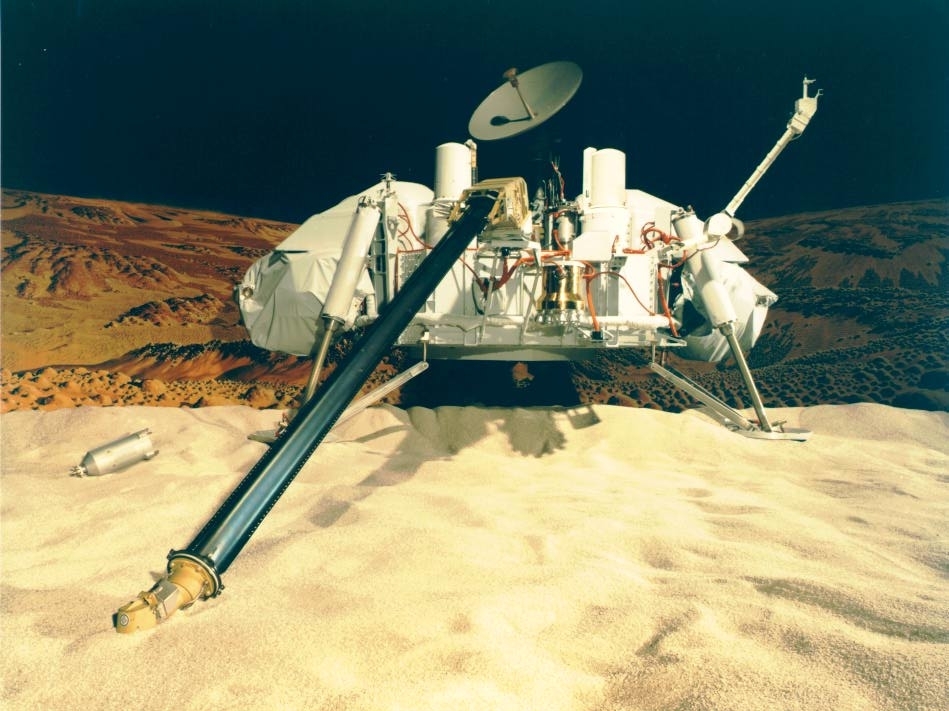
NASA Viking missions to Mars of the 1970s.
Credit: NASA
“Surprisingly, the conditions that allow plant growth do not occur first within the tropics (±25°) but in the Hellas Basin region. A further increase in the greenhouse effect expands the area suitable for plant growth in the southern hemisphere,” a new research paper explains.
Using in part Viking Mars lander temperature and pressure datasets gleaned in the 1970s, Olszewski and research team members have simulated a variety of processes on Mars, both at present and in past/future epochs.
“Here, we use the baseline model to investigate the greenhouse effect caused by an increase in CO2 plus artificial greenhouse warming,” Olszewski notes in a paper presented at an “Astrobiology and the Future of Life Meeting” held recently at the Lunar and Planetary Institute in Houston, Texas.
Pressure cooker
Olszewski and colleagues assessed the total pressure on Mars needed, the high percentage of acceptable CO2, the O2 needed, amount of water available, and the range of temperatures necessary for tree growth.

Mosaic of the Valles Marineris hemisphere of Mars composed of 102 Viking Orbiter images of this huge feature on the Red Planet.
Credit: NASA, USGS, Viking Project
The atmospheric conditions existing on Mars today make the existence of life impossible,” Olszewski points out. “The requirements for plant growth on Mars have been considered in the context of terraforming and for low-pressure greenhouses.”
The research focused on temperature “as this is the fundamental environmental variable that changes during terraforming and it controls the CO2 cycle and the formation of liquid water,” Olszewski adds. Oxygen levels in a thick warmer atmosphere remain an important separate concern.
Growing season
“Focusing on the temperature, it must be several tens of degrees higher, while the diurnal fluctuations should be much lower. For the growth of trees, the growing season must last at least 110 sols (Martian days),” the research shows, given a certain minimum temperature, average temperature, and maximum temperature that could be reached on the Red Planet.
Olszewski and research colleagues point out that, on Earth , the highest elevation treelines are primarily found in the tropics – but modulated by the location of the thermal equator. “Thus, it may be expected that equatorial regions of Mars would be the location of the first tree.”

A future Mars protected from the direct solar wind should come to a new equilibrium allowing an extensive atmosphere to support liquid water on its surface.
Credit: J.L.Green, et al.
But due to Mars’ relatively large orbital eccentricity, the southern hemisphere, which has summer near perihelion, has relatively warm summers, the researchers observe. In addition, the orbital period of Mars is 1.9 Earth years.
Therefore, the long warm southern summer provides the first growing season suitable for trees,” Olszewski reports. “Specifically, we find that the low elevation of the Hellas Basin allows the creation of the first conditions favorable to tree growth,” the researchers conclude.

Image credit: Leonard David Space Archives
Going once, going twice…got a bid?
I’m pleased to take part in today’s RR Auction focused on space items – one of which is from my archives, a letter from Neil Armstrong, the first human on the Moon.
Go to:
For detailed information on the auction today, go to:
https://www.rrauction.com/auctions/details/702-space/
Special thanks to Scott Sacknoff of the Space 3.0 Foundation, Inc. for his invaluable expertise and assistance in culling through over 60 years of my space collections, with more items going up for sale in the near future.

Image credit: Leonard David
For an early story on my extensive space archives, go to:
Leonard David’s Space Archives: Work in Progress at:
https://www.leonarddavid.com/leonard-davids-space-archives-work-in-progress/

Wait-a-Minute!
Image credit: Barbara David
In case you missed this unidentified flying opportunity – there’s a disclosure movement underway!
Billed as a first-of-its-kind event, a wide range of speakers and specialists took part in “Global Disclosure Day” that was held on October 20.

The thrust of the occasion is that there’s a “major sea change” in the history of the UFO, now tied to the term (rightly or wrongly) as Unidentified Anomalous Phenomena, or UAP.
“Up until very recently, the onus was on the movement to prove UFOs were real. Now, so much information has come out at such high levels of the U.S. Government that the burden is now on those who tried to keep UFOs a secret to prove that they are NOT real. We are in a new time,” contend event organizers at the New Paradigm Institute.

Image credit: SCU
Global citizen action
Global Disclosure Day was convened in the spirit of Earth Day and seeks to celebrate UAP Disclosure and the importance of global citizen action on the subject at hand…and in the skies.

Credit: Orbitz
The video is worth a watch as it is a “Wait-a-Minute” rendezvous with the true-believer community, who’s who, and also I think sheds light on what’s still missing in all of this – specifically, more conversation about the consequences of contact in terms of active SETI projects contrasted to “they’re here” advocates.
Let me know what you think!
Go to:
https://youtu.be/dabo3BrInng?si=lrHl5NCHZ91grHdM

Wait-a-Minute!
Image credit: Barbara David

The prestigious National Academies has taken a hard look at the NASA of today and what’s ahead.
And for a space agency that has been a leader in exploring our planet and other worlds, it is in a world of hurt.
That’s the thrust of a hard-hitting report from an Academies blue-ribbon committee.

Norm Augustine, committee chair and former Lockheed Martin CEO, details report findings during a webinar.
Image credit: National Academies/Inside Outer Space screengrab
Core issues
The report released last month is titled “NASA at a Crossroads: Maintaining Workforce, Infrastructure, and Technology Preeminence in the Coming Decades.”
Out-of-date infrastructure, pressures to prioritize short-term objectives, budget mismatches, inefficient management practices, and nonstrategic reliance on commercial partners are spotlighted as core issues needing attention.
For an inside look at the report itself, and reactions to its findings, go to my new Space.com story — “NASA at a crossroads: Budget woes, aging infrastructure and hard choices ahead – ‘This is not a time for business as usual'” – at:
https://www.space.com/nasa-crossroads-budget-issues-national-academies-report

Image credit: NASA

Lunar brick specialist, Zhou Cheng.
Image credit: CCTV/Inside Outer Space screengrab
China rolled out last week a roadmap for the development of space science in China through 2050. A phase of that agenda is constructing the International Lunar Research Station, or ILRS.
Now in research status is use of the lunar regolith to help build that lunar base in the 2028-2035 time period.
In fact, test bricks for lunar construction will be sent to China’s space station aboard the Tianzhou-8 cargo spacecraft. The first lunar brick is expected to return to the Earth by the end of 2025.

Image credit: CCTV/Inside Outer Space screengrab
Brick strength
Flying the lunar soil bricks is an output from China’s National Center of Technology Innovation for Digital Construction and the Huazhong University of Science and Technology (HUST).
The bricks are called simulated lunar soil bricks, said Zhou Cheng, a professor at the center. They have a similar density to that of ordinary bricks but are more than three times stronger than standard red bricks or concrete bricks, Zhou told China Central Television (CCTV).
Temperatures on the lunar surface exceed 180 degrees Celsius during the lunar day and dip to minus 190 degrees Celsius during lunar night – a 14 day/night cycle.

Photo taking during Chang’e-5 moon surface sampling session in December 2020.
Credit: CNSA/China Central Television (CCTV)
In addition, significant levels of cosmic radiation and micrometeorites also strike the surface of the Moon, given its lack of atmospheric protection. Also, there is frequent moonquake activity.
On-station test program
All of these will place demanding requirements on the mechanical, thermal and radiation resistance properties of lunar surface construction materials, Zhou added.
“What we care about the most is its mechanical and thermal performances, including heat preservation and insulation effectiveness, as well as its ability to withstand cosmic radiation. The Moon has a vacuum environment, so there is significant cosmic radiation,” Zhou said.

Simulated lunar bricks to be flown on China space station. Image credit: CCTV/Inside Outer Space screengrab
As for use of the Chinese space station to evaluate lunar soil bricks, the total planned exposure period for the bricks is three years.
So every year, researchers will return one sample panel exposed on the space station to the Earth and conduct related experiments, according to Zhou.
Simulated lunar soil compositions
The research team also designed the bricks in two shapes: columnar and flaky. The pillar-shaped lunar soil bricks are primarily intended for mechanical testing, while the larger-exposed flakes are used to assess thermal and radiation effects.

Image credit: CCTV/Inside Outer Space screengrab
In addition to their various forms, these bricks are made from five simulated compositions of lunar soil and undergo three distinct sintering processes, providing more accurate scientific data for the construction of future lunar bases.
3D-printing robot
As reported by China Global Television Network (CGTN), the team also developed another construction option using additive manufacturing technology. In addition, a 3D-printing robot has been invented to print houses using lunar soil.
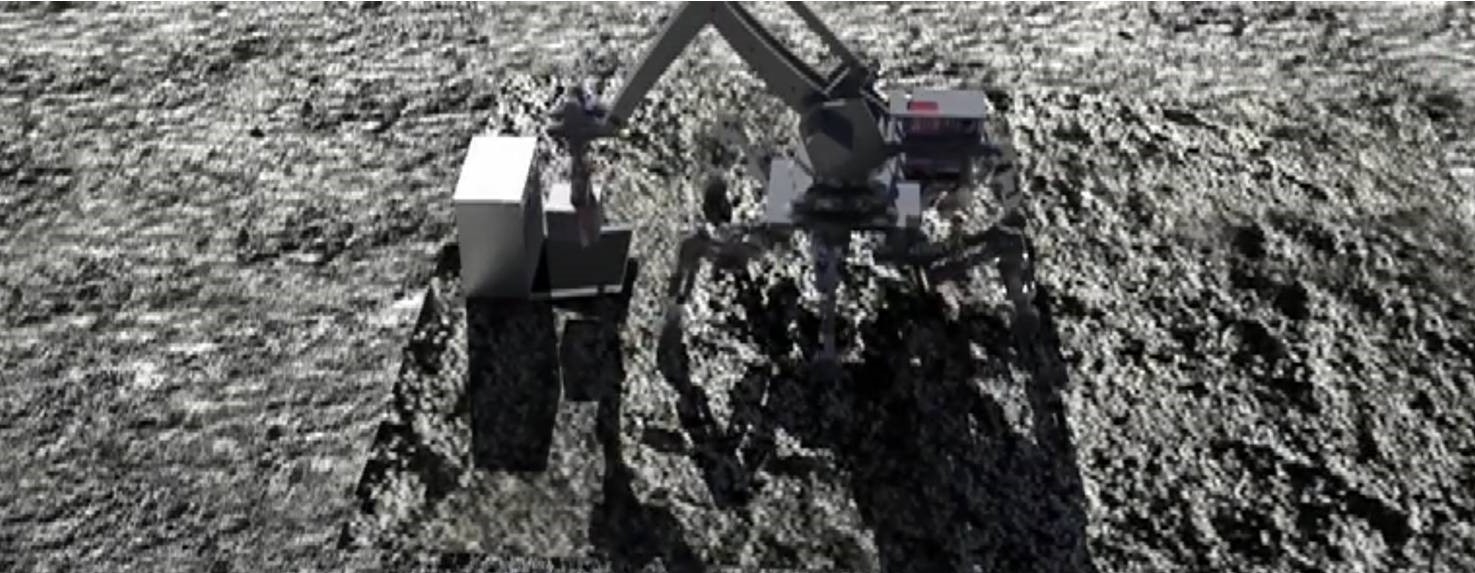
Image credit: CCTV/Inside Outer Space screengrab
Zhou told CGTN that the composition of lunar soil varies in different locations on the Moon, noting that one composition simulates the lunar soil at the landing site of China’s Chang’e-5 lander, which is mainly basalt.
Some other compositions simulate soil found at other locations that is mainly anorthosite, said Zhou.
The HUST team used five different simulated lunar soil compositions and three different sintering processes to help acquire accurate scientific data for selection of materials and process optimization for future lunar base construction.
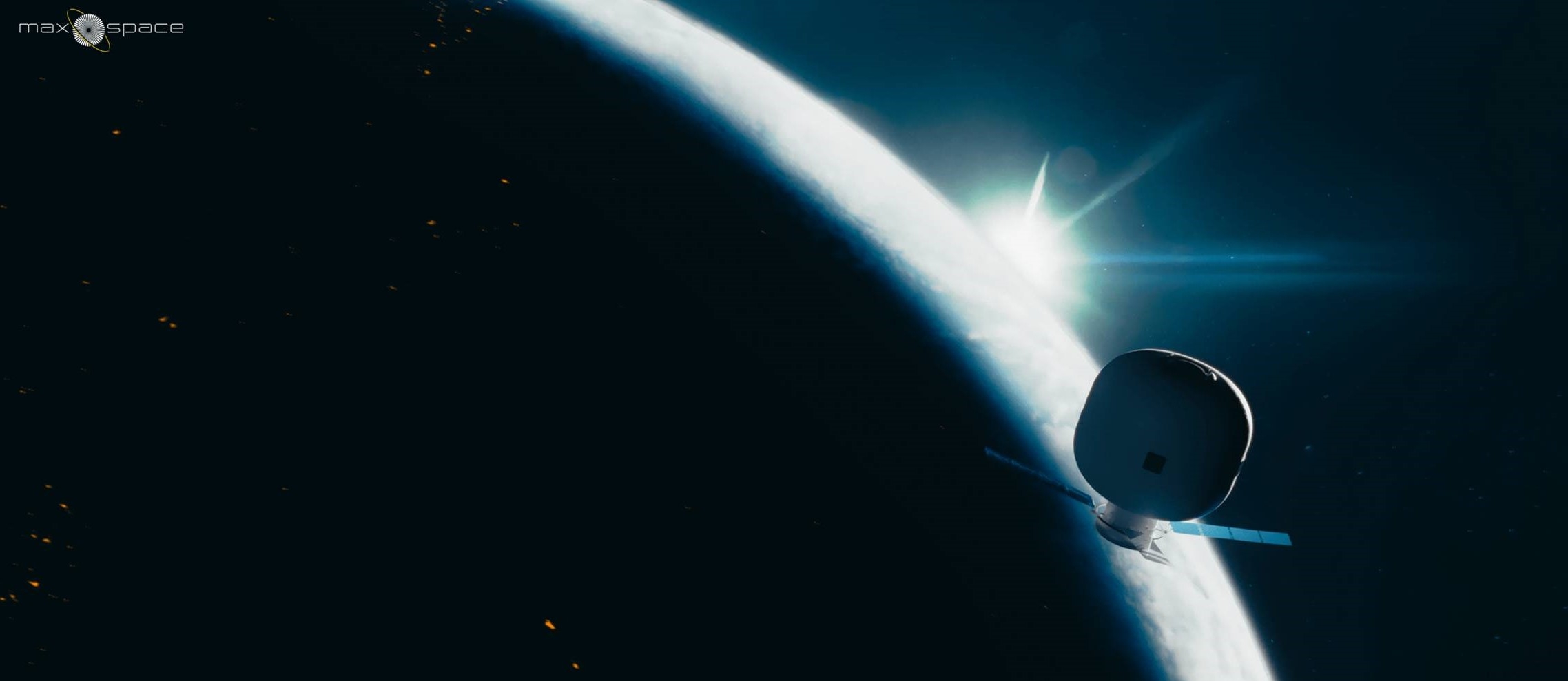
A number of private firms want to see an inflation factor for the future.
What is now being evaluated and tested is the use of “softgoods” to fashion inflatable/expandable airlocks and off-Earth habitats, not only for low Earth orbit, but also to provide comfy housing for future moon and Mars explorers.
Pioneering work
Enter the 21st century and make note of the pioneering work of Robert Bigelow and his team at Bigelow Aerospace of Las Vegas, Nevada.
The company fabricated two uncrewed free-flying expandable prototype modules that flew in 2006 and 2007, respectively, under its Genesis program. They are still circling the globe to this day.
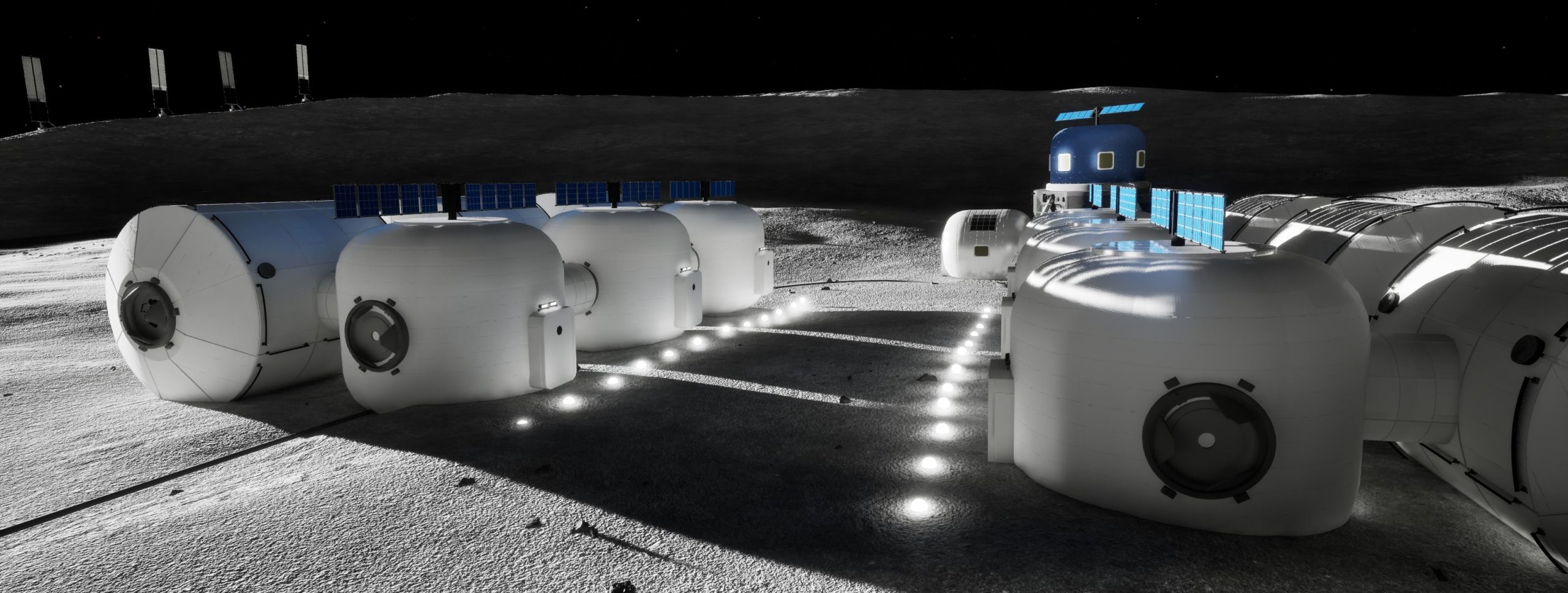
Image credit: Lockheed Martin
For more information on inflatable structures in space, go to my new Space.com story – “Blowing up: Inflatable space habitats could be key to exploring the solar system” — at:
https://www.space.com/expandable-space-habitats-moon-mars-private-companies
The future of Moon exploration construction will benefit from a combination of lunar rovers and Inchworm robots.

Image credit: GITAI/Inside Outer Space screengrab
That’s the vision of GITAI, a space robotics startup that last year relocated its headquarters from Japan to the United States. The group is blueprinting a range of robotic satellites for on-orbit services, as well as lunar rovers and inchworm-type robotic arms for lunar infrastructure construction.
Headquartered in Torrance, California, GITAI is pressing forward on the firm’s goal to significantly reduce space labor costs.

Image credit: GITAI/Inside Outer Space screengrab

Image credit: GITAI/Inside Outer Space screengrab

Image credit: GITAI/Inside Outer Space screengrab
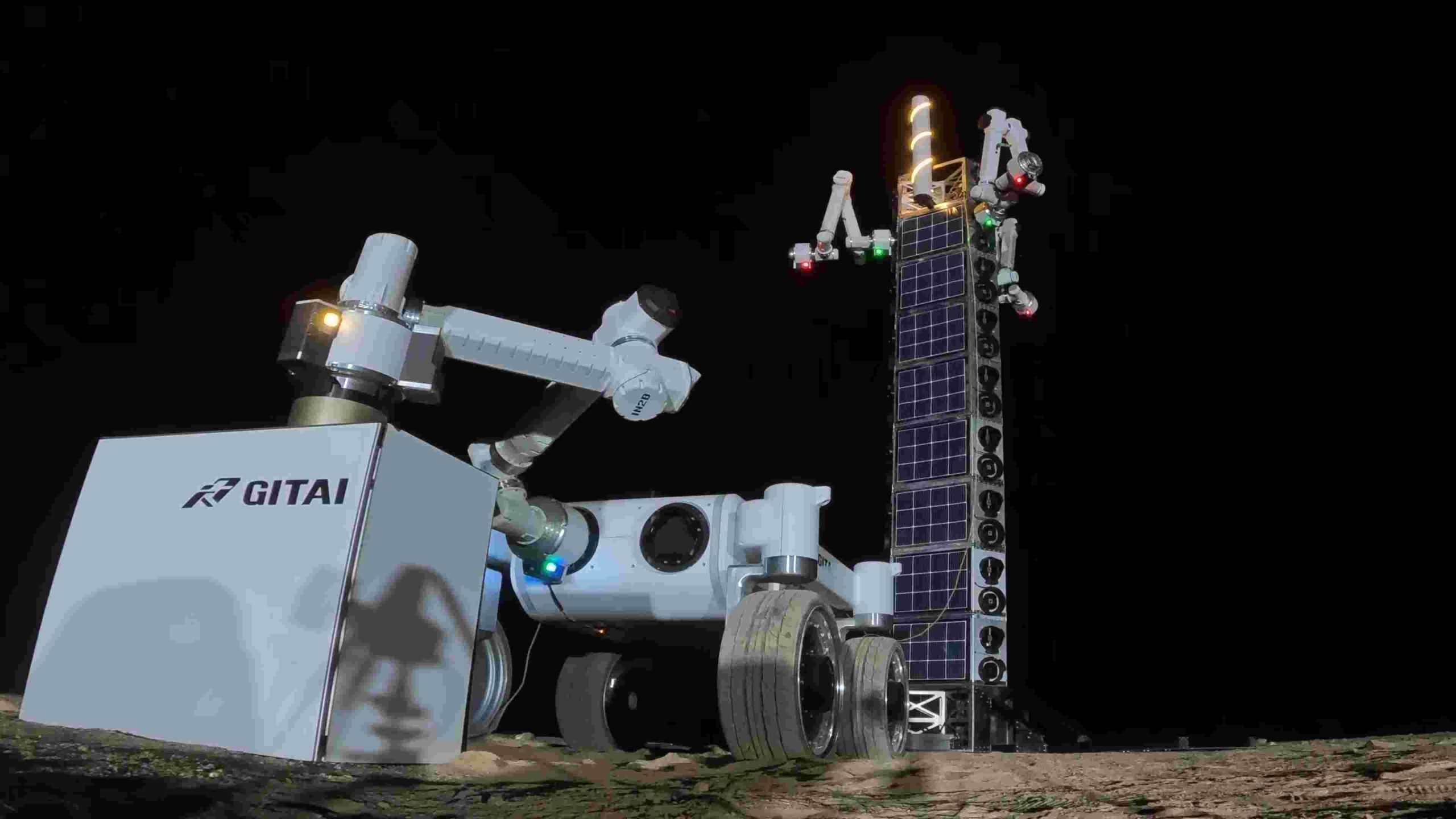
Image credit: GITAI
Truss-based towers
Under a NASA Small Business Innovation Research (SBIR) Phase 1 project award, GITAI has been scoping out the assembly and outfitting of tall truss-based towers on the Moon using autonomous lunar robots. These lunar towers can support communication and solar panel energy needs.
In a recent showcasing of their robotic wares at a California Mojave Desert test site, multiple GITAI robots worked together to perform key tasks such as building communication antennas, exchanging flat tires, drilling holes, welding metal panels, and assembling solar panels.
One output was autonomously assembling a tower 16 feet high (5 meters) to simulate use for future lunar habitats. Put to use was a GITAI Inchworm Robot, a robotic arm equipped with “grapple end-effectors” on both ends of the arm.
To view a fascinating video of this capability, go to:
For more information on GITAI, go to:

Credit: NASA
There’s been a research boost to locate life that may have found a comfy niche on the Red Planet.
The potential for photosynthesis on Mars within snow and ice is the subject of a just-released paper appearing in the journal Nature Communications Earth & Environment.
As for implications for life on Mars, the analysis indicates that, despite higher surface ultraviolet radiation levels on Mars than on Earth, “it is possible for terrestrial photosynthetic organisms to find locations within exposed ice on Mars with favorable solar radiative conditions,” the research team explains.

The white material seen within this Martian gully is believed to be dusty water ice. Scientists believe this kind of ice could be an excellent place to look for microbial life on Mars today.
Image credit: NASA/JPL-Caltech/University of Arizona
Present-day habitats
These potential present-day habitats are centimeters to meters below the surface, the research team observes, “and could be the most easily accessible locations to find extant life on Mars via future robotic and human missions.”
These findings are led by Aditya Khuller, currently at the Jet Propulsion Laboratory, California Institute of Technology.
Khuller is a Postdoctoral Researcher at JPL. His research interests include studying planetary ices, surface processes and atmospheres using a combination of numerical modeling, remote sensing data and geological mapping.

These holes, captured on Alaska’s Matanuska Glacier in 2012, are formed by cryoconite — dust particles that melt into the ice over time, eventually forming small pockets of water below the glacier’s surface. Scientists believe similar pockets of water may exist on Mars.
Image credit: Kimberly Casey CC BY-NC-SA 4.0
Variety of organisms
If indeed present and accounted for, what kind of life might be detected?
“A variety of organisms are found in these shallow subsurface habitats within terrestrial ice, such as cyanobacteria, chlorophytes, fungi, diatoms, and heterotrophic bacteria,” Khuller and colleagues report.
Usually, the most dominant organisms in these habitats are cyanobacteria.
“Cyanobacteria have developed appropriate mechanisms to deal with a wide range of temperatures, nutrient deficiency, UV radiation, and desiccation. These communities can persist even if temperatures are above freezing for only a few days per year,” the research paper explains.
Computer modeling
The research work uses computer modeling to suggest that dusty ice lets in enough light for photosynthesis to occur as deep as 10 feet (3 meters) below the surface.

Zones where levels of DNA-damaging irradiance are safe and there is enough photosynthetically active radiation (PAR) for photosynthesis to occur are shown as the green areas, as a function of (a) dust content, (b) ice radius, (c) latitude, and (d) solar zenith angle.
Image credit: Khuller, et al.
In this situation the upper layers of ice prevents the shallow subsurface pools of water from evaporating and protects those watery pools from harmful radiation.
As for where on Mars the water ice would form these subsurface pools, future exploration would be in the midlatitudes — between the latitudes of 30 degrees and 60 degrees — in both the northern and southern hemispheres of the Red Planet.
In the zone
“This latest paper examines the propagation of solar radiation into the ice, showing that just below the surface there is a zone that is safe from ultraviolet but still gets enough visible light to support photosynthesis,” said co-author Steve Warren, professor emeritus of Earth and space sciences at the University of Washington (UW) in Seattle.
“But of course photosynthetic organisms won’t survive unless the ice in that zone can melt, at least occasionally,” Warren states in a UW statement.

Credit: NASA/Pat Rawlings
Next step
In November, Khuller will join UW’s Applied Physics Laboratory as a senior research scientist. He plans to continue working to find out where liquid water is likely to exist and persist on Mars.
The next step, Khuller explains, will be to recreate some of Mars’ dusty ice in a lab setting.
Meanwhile, Khuller and research partners are starting to map out the most likely spots on Mars to look for shallow meltwater, pinpointing them as possible scientific targets for future robotic and human expeditions.
Co-authors of the just-issued Mars work, along with Khuller and Warren, are Philip Christensen of the School of Earth and Space Exploration at Arizona State University in Tempe and Gary Clow of the Institute of Arctic and Alpine Research at the University of Colorado/Boulder.
To access the paper – “Potential for photosynthesis on Mars within snow and ice” – go to:

Image credit: Space Perspective
Air balloon, space tourist and “uppity up” business mogul, Sir Richard Branson, is co-piloting the first crewed test flight of Space Perspective’s sojourn into near-space.
“I’m passionate about adventure and helping fellow entrepreneurs reach their business dreams. I look forward to dusting off my old ballooning license ahead of some magnificent test flights,” said Branson in a Space Perspective statement.
Branson is an investor in Space Perspective of Titusville, Florida, a group that is offering sustainable, stratospheric balloon travel.

Image credit: Space Perspective
Seeking adventure-seekers
Branson is no stranger to high-flying above Earth having broken two ballooning world records crossing the Atlantic and Pacific oceans in 1987 and 1991 respectively. Space Perspective has the potential to revolutionize balloon flying, he adds, opening a world of new possibilities for adventure-seekers all over the globe.
Branson will be aloft alongside the company founders, Jane Poynter and Taber MacCallum, high-tailing it above Earth next year.
For detailed information regarding Space Perspective, go to:

